
Lieferung heute & morgen

Qualitätsgarantie

Willkommens-Angebote freischalten: KOSTENLOSE Lieferung | Bis zu 80 % RABATT | Kostenlose 30-Tage-JoyPlus-Testphase
App herunterladen
LED recessed spotlights provide neat, space-saving lighting for hallways, kitchens, bathrooms, living rooms and offices. But wattage isn’t the only thing to consider before you buy. The wrong cut-out size, a misunderstood IP rating or incompatible dimming technology can all lead to unnecessary work.
The visible width of a light fitting isn’t necessarily the same as the cut-out size it needs. For example, an LED ceiling spotlight with an external diameter of 145 mm may need a ceiling cut-out of 115 to 135 mm. So, measure any existing openings precisely.
Installation depth is also important for low ceilings. Ultra-flat models measuring around 25.5 mm need less ceiling void space than fittings over 30 mm deep. Even so, there must be enough room behind the fitting for connections and heat dissipation.
A bathroom recessed spotlight with an IP44 rating is designed to withstand splashing from different directions. However, this rating doesn’t automatically make it suitable for installation inside a shower, beneath a direct jet of water or in areas that are constantly damp. Check the installation zones and applicable electrical regulations for the specific position in your bathroom.
Models with an IP20 rating are intended for dry indoor spaces only. Smart LED recessed spotlights with this rating should therefore not be installed in bathrooms or damp outdoor areas.
The wall dimmer you use with a dimmable LED ceiling spotlight must be compatible with the fitting. Some products can only be dimmed via an app, while others need a compatible leading-edge or trailing-edge dimmer. A non-dimmable model must not be used with an external dimmer.
Check the following before you order:
A 12–24 V light must not be connected directly to the mains. Mains-voltage installation should be carried out by a suitably qualified person.
Colour temperature is measured in kelvin:
A CCT LED recessed spotlight lets you choose from several colour temperatures. On smart models, you’ll usually change the setting via an app. Lumens indicate the amount of light produced, making them more useful than wattage alone when planning a room. The CRI or Ra value describes colour rendering; for example, the models mentioned here have a rating of at least 80.
An RGB LED ceiling spotlight can produce coloured light and often warm to cool white light too. This is useful for lighting scenes and accents, but isn’t essential in every room. Smart models with Bluetooth Mesh can be grouped together. Depending on the model, you may need a gateway for remote access or voice control.
So, check whether the light:
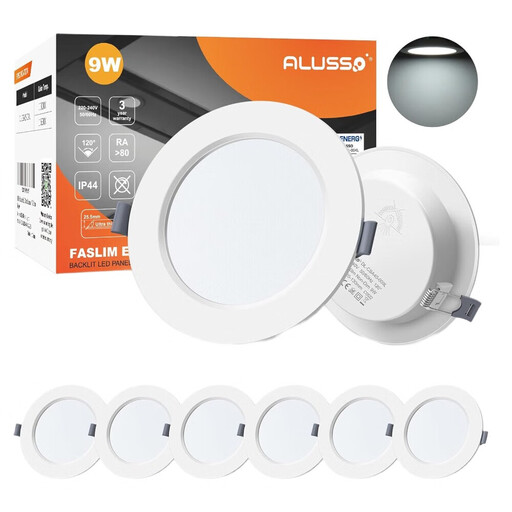
Why this product suits this type of buyer: The six-pack is ideal for renovations with several identical ceiling openings. It connects directly to 220–240 V and doesn’t need a separate transformer.
Its 25.5 mm installation depth and specified cut-out size of 115–135 mm make it easier to plan for ceilings with limited space. The light is explicitly non-dimmable.
9 W, 720 lm, 6500 K, IP44 and a six-pack. According to the product details, the average lifespan is 30,000 hours.
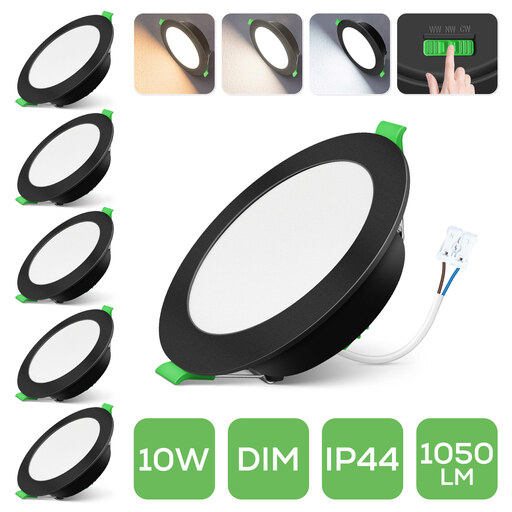
Why this product suits this type of buyer: The 3CCT setting lets you choose 3000, 4000 or 6500 K. This means you can match the colour temperature to the room and how you use it before installation.
Dimming only works with a compatible dimmer, so check this before installation. The cut-out size is 90–100 mm, not the external diameter of 113 mm.
10 W, 1050 lm, aluminium housing, 34 mm depth and IP44. The specified dimming range is 10 to 100 per cent.
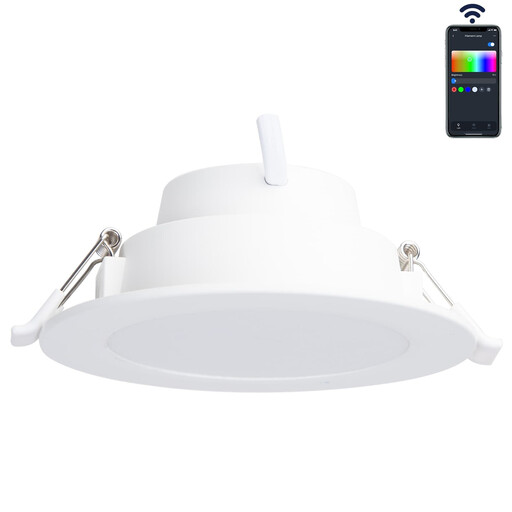
Why this product suits this type of buyer: For hallways, living spaces or several connected rooms, this smart LED recessed spotlight offers Bluetooth Mesh, app control, dimming, and RGB and CCT settings.
The IP20 rating clearly limits use to dry indoor spaces. Dimming is controlled via the app; according to the product details, an external wall dimmer isn’t supported.
9 W, 780 lm, 2700–6500 K, RGB colours and a cut-out size of 120–130 mm. A gateway may be needed for remote access and voice control.
We’ve put together a complete, regularly updated list of products that meet these strict selection criteria and the safety regulations in force across the EU.
Consumption depends on the light’s wattage and how long it’s used each day. A 9 W light used for five hours a day consumes 45 Wh per day. To work out the running cost, multiply its consumption by your electricity tariff. Always consider the lumen rating too, so you don’t judge brightness by wattage alone.
Many models specify a lifespan of around 25,000 to 30,000 operating hours. This is a manufacturer’s estimate and can be affected by heat, frequent switching, voltage fluctuations or incorrect installation. That’s why it’s important to allow heat to dissipate and follow the installation instructions.
Electrical connections for 230 V lights must be made safely and in accordance with the applicable regulations. Switch off the power at the circuit breaker before installation. If you don’t have the relevant qualifications, leave the connection to a qualified electrician. Before buying, also check the cut-out size, installation depth, IP rating and dimmer compatibility.