
Lieferung heute & morgen

Qualitätsgarantie

Willkommens-Angebote freischalten: KOSTENLOSE Lieferung | Bis zu 80 % RABATT | Kostenlose 30-Tage-JoyPlus-Testphase
App herunterladen
Slim LED recessed spotlights are suitable for low ceilings, furniture, kitchen units and many indoor spaces. However, not every light will fit every ceiling cut-out. Most unsuitable purchases aren’t down to the LED technology itself, but to incorrect measurements, an unsuitable IP rating or a misjudged colour temperature.
The Joybuy Product Recommendation Officer explains the key details clearly and shows which option is right for each use.
A light’s external dimensions don’t tell you whether it will fit the existing ceiling cut-out. The key measurements are:
For example, a light with a diameter of 145 mm may need a cut-out of 115 to 135 mm. Other slim LED recessed lights only need 95 to 110 mm. So, before buying, measure the existing cut-out accurately.
An IP44 recessed spotlight for bathrooms is protected against solid foreign objects and splashing water from different directions. However, IP44 doesn’t mean the light is suitable for direct jets of water, prolonged exposure to high humidity or immersion.
You should also consider where the light will be installed in bathrooms and kitchens. Specific requirements apply in areas that come into direct contact with water. The electrical connection must comply with applicable regulations and should be carried out by a qualified electrician.
A dimmable LED recessed spotlight needs either a compatible leading-edge or trailing-edge dimmer, or an integrated control system. With smart lights, brightness may only be adjustable via an app. In that case, an existing wall dimmer may not be suitable.
Colour temperature is often overlooked, too. Warm white, neutral white and cool white each suit different purposes:
According to the product details, 230 V LED recessed spotlights can be connected directly to the 220 to 240 V mains supply. These models don’t need a separate power supply or transformer. This makes planning easier, but it’s especially important to ensure the connection is made correctly.
By contrast, 12 to 24 V lights need a suitable transformer, which isn’t always included. If you’re installing several lights in furniture or a kitchen, also check that the transformer has sufficient capacity and the right connections.
Brightness is measured in lumens, not just watts. Watts describe energy consumption, while lumens indicate the amount of light emitted. Depending on their design and LED technology, two 9-watt models can produce noticeably different levels of brightness.
A wide beam angle, such as 120 degrees, spreads the light over a larger area. This can be useful for even lighting with recessed LED lights for kitchens and living rooms. Narrower beam angles are often better for focused accent lighting.
A 3CCT light usually offers three selectable colour temperatures, for example 3000 K, 4000 K and 6000 or 6500 K. This is useful if you use a room for different purposes. The colour rendering index, CRI or Ra, describes how natural colours look under the light. A rating of at least Ra 80 is typical of the products mentioned here.
An RGB+CCT LED recessed spotlight adds coloured lighting and a choice of different shades of white. This feature is particularly useful if you want to control the lighting via Bluetooth Mesh or an app. However, it may offer more functionality than you need for basic lighting.

Why it suits this profile: This pack of 6 is a good choice if you need several slim ceiling lights with a direct 230 V connection. The installation depth is 25.5 mm, according to the product details.
The cut-out size and installation depth are clearly specified: 95–110 mm and 25.5 mm respectively. The product details also state that the light isn’t dimmable.
6 W, 430 lm, 6500 K, IP44 and direct connection to 220–240 V, according to the product details.
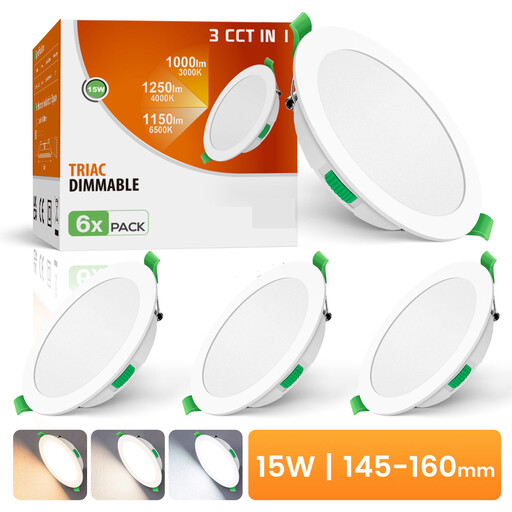
Why it suits this profile: This version combines three selectable light colours with dimming, making it a good choice if you want to adjust the lighting in living rooms or bedrooms to suit your needs.
The product details clearly specify the required cut-out size of 145–160 mm, dimmer compatibility and all three colour temperatures.
1200 lm, 3000/4000/6500 K, dimming from 10–100%, a 120-degree beam angle and IP44, according to the product description.
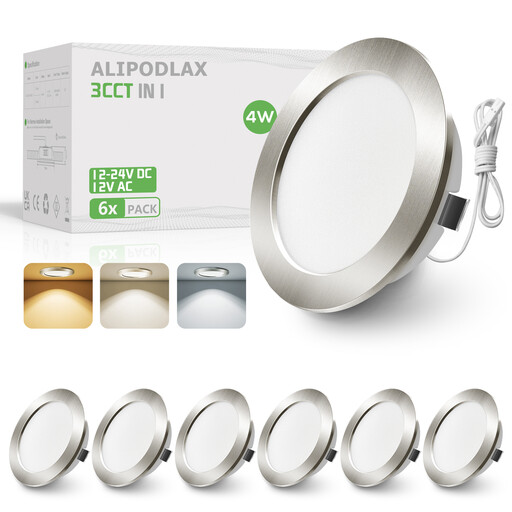
Why it suits this profile: This compact light is designed for furniture, under-cabinet lighting, kitchens, caravans and installations with a low-voltage supply.
According to the product details, the light must not be connected directly to 230 V. A suitable 12 to 24 V transformer is required and must be planned for separately.
14.5 mm installation height, 55–58 mm cut-out, 270 lm, 3000/4000/6000 K and IP44, according to the product details.
We’ve put together a complete, regularly updated list of products that meet these strict selection criteria and fully comply with the safety regulations in force in the EU.
It depends on the size of the room, the number of lights and the type of light distribution you want. For general lighting, several lights with moderate brightness often provide more even coverage than a few very bright spots. So, always consider the lumen rating alongside the beam angle.
230 V models don’t need a separate transformer, but they must be connected to the mains correctly. Switch off the circuit before installation. In Germany, work on fixed electrical installations should be left to a qualified electrician.
Their lifespan depends on the LED module, heat dissipation, operating time and installation environment. The product details for the models mentioned give estimated lifespans of 25,000 or 30,000 operating hours, for example. This is a technical guideline, not a guarantee of how long the lights will last in any particular home.