
Lieferung heute & morgen

Qualitätsgarantie

Willkommens-Angebote freischalten: KOSTENLOSE Lieferung | Bis zu 80 % RABATT | Kostenlose 30-Tage-JoyPlus-Testphase
App herunterladen
Modern, flush-mounted ceiling lighting gives rooms a clean and minimalist aesthetic. Low-profile LED recessed spotlights with a 230V direct connection are an especially popular choice for renovations and new builds. However, the vast selection of models also has its pitfalls. Incorrect assumptions about technical specifications often lead to disappointment, unnecessary costs, or even safety risks.
As your Joybuy Product Recommendation Officer, I'll help you understand the key features and avoid common purchasing errors. This guide focuses on the three most frequent traps and shows you what to look out for.
dimmable LED recessed spotlights require a specific dimmer type (e.g., a trailing-edge dimmer). Combining them with an incompatible, often pre-existing, dimmer will result in flickering, buzzing, or uneven light control.ultra-slim is a crucial criterion here.To avoid the mistakes mentioned above, you should focus on three core technical parameters. These determine the suitability, safety, and functionality of your new ceiling lighting.
Before you make a choice, taking precise on-site measurements is essential.
Low-profile 230V LED recessed spotlights typically have an installation depth of under 35 mm, while models labelled ultra-slim are often even under 30 mm. This is ideal for ceilings with minimal void space.The IP (Ingress Protection) rating indicates how well a light is protected against the ingress of foreign objects and water. For living rooms and bedrooms, IP20 is generally sufficient. For damp rooms, stricter requirements apply.
recessed lights for bathrooms are protected against splashing water from all directions. They are suitable for ceiling installation outside of direct shower and bath areas (Zone 2).The type of connection and the control options determine the installation effort and everyday flexibility.
Here are some recommendations tailored to different user profiles and the criteria mentioned above.
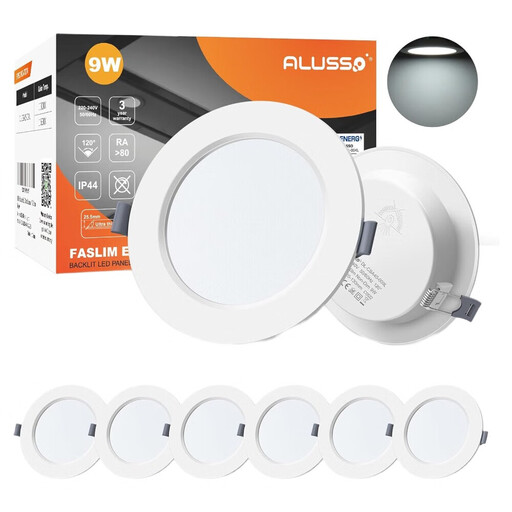
Why This Fits Their Persona: Ideal for a fast, straightforward, and cost-effective upgrade of ceiling lighting in living rooms, hallways, or work areas where clear, bright illumination without a dimming function is desired.
With an ultra-slim installation depth of just 25.5 mm, this spotlight fits even in ceilings with very little void space, bypassing the classic installation depth trap. The IP44 certification ensures it can also be safely used in kitchens, unlike unsuitable IP20 models.
Direct 230V connection without a transformer and supplied as a convenient 6-pack of recessed ceiling spotlights for uniform room illumination.
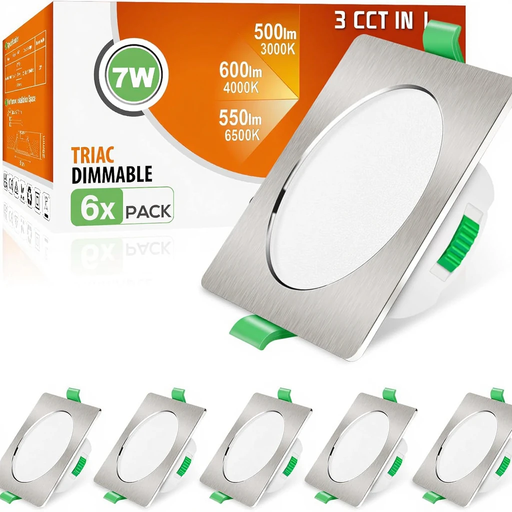
Why This Fits Their Persona: Perfect for users who want to adjust the lighting mood to suit the time of day and occasion—from cosy evening light to bright task lighting in the same room.
This model is explicitly specified as dimmable (10-100%) for trailing-edge dimmers, which minimises the compatibility trap. The integrated 3CCT colour temperature switching solves the problem of having to commit to one light colour in advance.
Maximum flexibility thanks to dimmability and three selectable light colours (3000K/4000K/6500K). The slim profile of 29 mm simplifies installation.
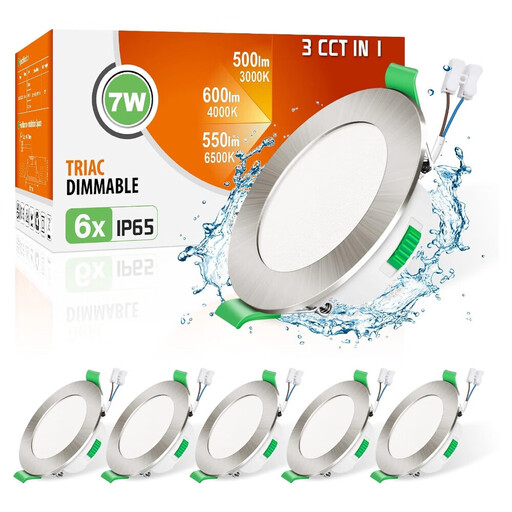
Why This Fits Their Persona: For users seeking a lighting solution for demanding environments like the shower area or above the bathtub, where maximum water resistance is required.
With an IP65 rating, this spotlight offers protection against water jets, making it suitable for installation in Zone 1 of the bathroom. This goes far beyond the splash protection of IP44 and avoids the most common source of error in bathroom lighting.
A high IP65 rating combined with dimmability and 3CCT functionality for safe yet atmospheric lighting in all damp rooms.
We have compiled a complete, up-to-date list of products that fully meet these strict selection criteria and local safety regulations.
Yes, absolutely. For safety and insurance reasons, work on the 230V mains installation should only be carried out by a qualified electrician. Improper installation can lead to electric shocks, fires, and voiding your insurance coverage.
3CCT stands for "3 Correlated Colour Temperatures." This means you can choose between three different light colours on the fixture, either before or after you install it. The usual settings are:
A one-size-fits-all answer is difficult, as the requirement depends on the room height, the desired brightness (lux), the beam angle of the spots, and their luminous flux (lumens). As a rough rule of thumb for uniform general lighting in a room with a standard ceiling height (approx. 2.50 m), you can plan for one spot per 1.5 to 2.5 square metres. For precise planning, a lighting calculation is recommended, which also takes into account the specific lumen values of the chosen 230V ceiling spots.