
Lieferung heute & morgen

Qualitätsgarantie

Willkommens-Angebote freischalten: KOSTENLOSE Lieferung | Bis zu 80 % RABATT | Kostenlose 30-Tage-JoyPlus-Testphase
App herunterladen
LED recessed spotlights are ideal for bathrooms, kitchens, hallways and living spaces where flush-fitting, space-saving ceiling lighting is required. At first glance, choosing one seems straightforward: wattage, colour temperature and design appear to be all that matters. In practice, however, an incorrect cut-out size, unsuitable IP rating or incompatible dimmer can quickly lead to additional costs.
This buying guide from the Joybuy Product Recommendation Officer explains which details are important before buying an LED recessed spotlight and which models suit different requirements.
Despite their shallow installation depth, a flat LED recessed spotlight may require a large ceiling cut-out. Three measurements are therefore crucial:
A model with a depth of 34 mm and a cut-out of 90–100 mm will not fit every existing opening. Before renovating, check the available cavity space. If holes are already present, the cut-out size is more important than the product description “ultra-flat”.
An IP44 recessed spotlight is protected against solid foreign objects measuring 1 mm or more, as well as splashing water from various directions. This does not mean that the light is suitable for direct jets of water, immersion in water or every installation zone in a bathroom.
When choosing an LED bathroom spotlight, you should also consider the relevant installation zones, the distance from water sources and the requirements of the electrical installation. IP54 offers greater protection against dust and splashing water, but it is not a substitute for proper planning and installation.
“Dimmable” does not mean that every existing wall dimmer will work. With dimmable LED recessed spotlights, the dimmer must be compatible with the LED technology being used. According to the product description, the specified 10 W model can be used with a compatible trailing-edge dimmer and allows brightness to be adjusted from 10 to 100 per cent.
When replacing a fitting, check the following:
230 V LED recessed spotlights are connected directly to 220–240 V AC and normally do not require a separate transformer. This simplifies planning, but it does not automatically make the electrical installation a DIY job. Work on the fixed electrical wiring should be carried out in Germany by a qualified electrician.
12–24 V lights, on the other hand, require a suitable transformer. This is not included with every set. The 12–24 V spotlight in the selection is designed for a ceiling cut-out of 55–58 mm, requires a separate transformer and must not be connected directly to the 230 V mains.
Luminous flux in lumens describes the amount of light produced. Wattage, by contrast, mainly indicates power consumption. A 10 W LED recessed spotlight with 1,050 lm therefore produces a different amount of light from a 6 W model with 430 lm.
Colour temperature is measured in Kelvin:
A 3CCT LED spotlight with switchable settings of 3,000, 4,000 and 6,500 K allows you to select the colour temperature before installation or, depending on the model, using a switch on the light fitting. This is useful when a room is used for different purposes.
Aluminium can help dissipate heat, while polycarbonate or PBT is often used for covers and housings. However, material information is not a substitute for checking the installation instructions, CE marking and IP rating.
The energy efficiency classes of the products listed range, for example, from D to F. For running costs, power consumption, daily usage time and electricity price are the key factors. Higher lumen output can be useful over work surfaces, but with the same operating time it will generally also result in higher power consumption.
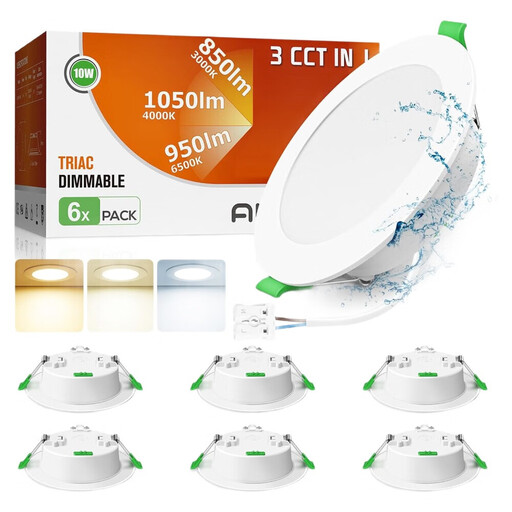
Why this product suits this profile: The 230 V connection, three colour temperatures and six-light set cover typical renovation projects in kitchens, hallways or bathrooms.
The specified dimensions of 34 mm depth, 113 mm diameter and a 90–100 mm cut-out make installation planning more straightforward. Dimming requires a compatible trailing-edge dimmer.
10 W power consumption, 1,050 lm luminous flux, 3CCT selection and IP44 rating according to the product specifications.
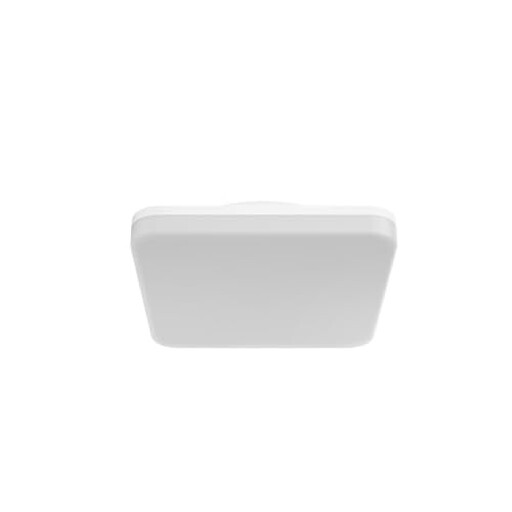
Why this product suits this profile: Anyone who prefers app, voice and smart home control in one central ceiling light gets functions for scenes, schedules and groups.
Compatibility with Matter, Apple Home, Google Home, Samsung SmartThings, Alexa and Home Assistant is clearly specified. A 2.4 GHz Wi-Fi network is required for a direct connection.
18 W, up to 1,800 lm, continuously dimmable, RGBW colours and adjustable colour temperature from 2,700 to 6,500 K; IP54 rating.
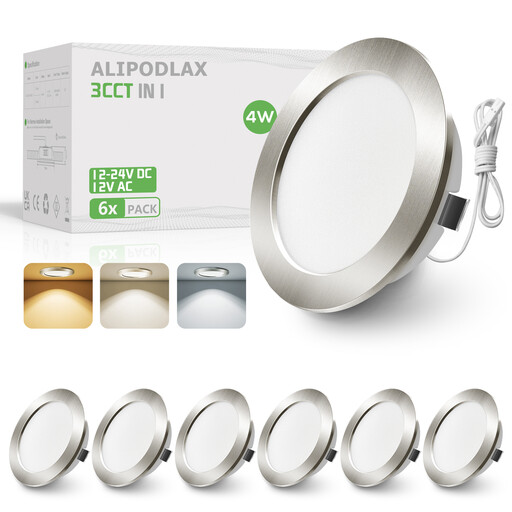
Why this product suits this profile: With a compact design and an installation height of 14.5 mm, it is suitable for furniture, cupboards, kitchen cabinets, motorhomes or areas with limited installation depth.
The required voltage of 12–24 V and the separately required transformer are clearly stated. This helps prevent a dangerous direct connection to 230 V.
4 W, 270 lm, switchable colour temperatures of 3,000, 4,000 and 6,000 K, plus a 55–58 mm cut-out size.
We have put together a complete, regularly updated list of products that fully meet these strict selection criteria and the safety regulations applicable in the EU.
Before buying, check the existing wiring, ceiling type and installation zone. For 230 V lights:
Models with an installation depth of 25.5 mm are an option for low ceilings. However, they differ in cut-out size and, according to the product specifications, are not dimmable. This limitation should be taken into account before installation in an existing dimmer system.
This depends on the size of the room, ceiling height, beam angle and number of lights. A higher luminous flux per light may be useful in a kitchen or work area, while lower output is often sufficient in a hallway. Do not compare wattage alone. Pay particular attention to lumens, light distribution and spacing between lights.
The product specifications for the models listed often state around 30,000 operating hours. Actual service life can be affected by ambient temperature, operating time, mains quality and heat dissipation. Adequate ventilation behind the light and compliance with the installation instructions are therefore important.
Running costs are calculated from power consumption, operating hours and electricity price. The basic formula is: wattage divided by 1,000 × operating hours × price per kilowatt-hour. For several lights, add their power consumption together. A dimmable or smart light can make use more flexible, but it only reduces consumption when it is actually operated at lower power.