
Lieferung heute & morgen

Qualitätsgarantie

Willkommens-Angebote freischalten: KOSTENLOSE Lieferung | Bis zu 80 % RABATT | Kostenlose 30-Tage-JoyPlus-Testphase
App herunterladen
LED recessed spotlights provide even ceiling lighting, require little installation depth and can be operated via a wall switch, app or voice control, depending on the model. However, it is worth taking a close look at the technical specifications before buying. Product descriptions such as “ultra-flat”, “waterproof” or “smart” do not automatically indicate whether a light is suitable for your ceiling, dimmer or intended room.
This buying guide explains which specifications are crucial for LED recessed spotlights, LED ceiling spotlights and slim LED recessed lights.
For installation, it is not just the visible diameter of the light that matters, but above all the ceiling cut-out. For example, a spotlight with an overall diameter of 145 mm may require a cut-out of 120 to 130 mm or 145 to 160 mm. These measurements are not interchangeable.
You should therefore measure the following before ordering:
An IP44 recessed spotlight is protected against solid foreign objects and splashing water from various directions. However, this rating does not mean that the light is suitable for a direct jet of water, continuous exposure to moisture or immersion.
For an LED recessed light in the bathroom, it is also important to consider which zone of the room it will be installed in. Local installation regulations and the manufacturer's requirements must be followed. For dry rooms such as living rooms, bedrooms or hallways, an IP20 version is sufficient for many models, provided that the installation conditions allow it.
With dimmable LED recessed spotlights, the dimmer being used must be compatible with the light. Depending on the model, trailing-edge or leading-edge control may be required. Some smart lights can only be dimmed via an app and must not be connected to an external wall dimmer.
Installation depth is particularly important for suspended ceilings or shallow cavities. An ultra-flat LED ceiling light with an installation depth of 25.5 mm can be used where a deeper fitting does not fit. However, there must still be enough space for the connection, heat dissipation and spring clips.
The lights in the product selection differ considerably:
Luminous flux is measured in lumens (lm) and describes the amount of light emitted. Wattage alone therefore says little about brightness. A 9 W LED spotlight with 780 lm and a 15 W model with 1,430 lm are designed for different lighting requirements.
With regard to colour temperature, you typically have the following options:
A 3CCT LED recessed spotlight allows you to choose between warm white, neutral white and cool white using a switch on the housing. A RGB+CCT LED spotlight additionally offers coloured light and seamless selection within a white-light range. The CRI or Ra value describes colour rendering. Several of the models listed here have a stated value of Ra ≥ 80.
A 230 V LED spotlight is connected directly to the mains and, according to the product specification, does not require a separate transformer. Installation at 220 to 240 V in Germany must only be carried out in accordance with the applicable electrical regulations. Permanently connected lights are intended to be installed by a qualified electrician.
The energy efficiency class should also be taken into account. For example, the models listed range from Class D to F. A low consumption per light can affect running costs when several spotlights are used every day. This simple calculation can help you make a realistic estimate:
Power in kW × operating hours × electricity price = approximate running costs

Why this product suits the profile: The set of 6 provides a consistent solution for several installation locations and, according to the product specification, requires just 25.5 mm of installation depth. The fixed colour temperature of 6500 K is suitable for buyers who specifically want cool white light.
The specified cut-out of 95–110 mm and the installation depth are clearly stated. The model is also explicitly marked as non-dimmable.
6 W, 430 lm, 230 V, IP44 and a stated service life of 30,000 hours.
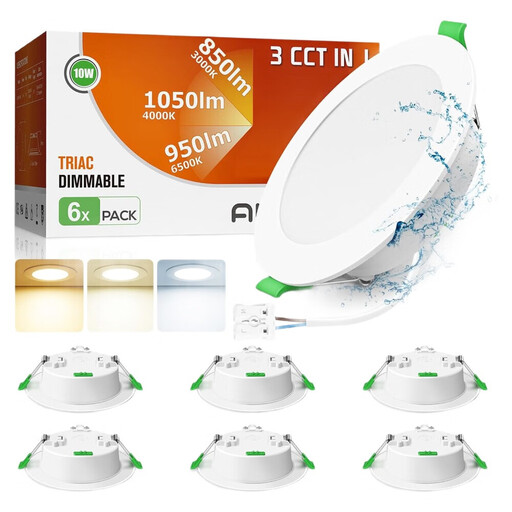
Why this product suits the profile: The combination of 3CCT selection, dimming capability and an aluminium housing allows you to customise the lighting across several rooms. The 90–100 mm cut-out is relevant for existing ceiling openings within this size range.
The three colour temperatures are selected using a switch on the housing. According to the specification, dimming requires a compatible trailing-edge dimmer.
1050 lm per light, 3000/4000/6500 K, 10–100% dimming range and IP44.
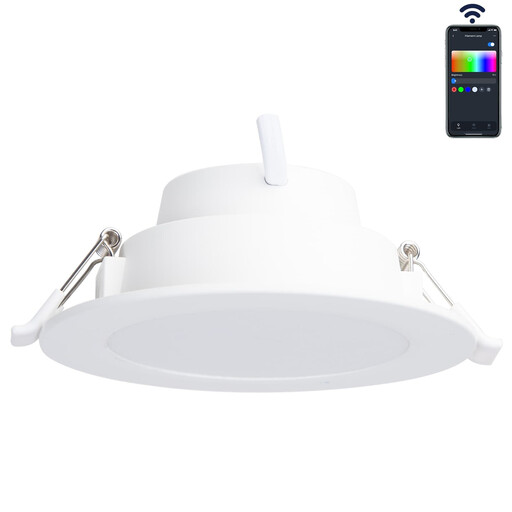
Why this product suits the profile: This smart LED recessed spotlight is aimed at users who want to combine colour changes, warm white to daylight white and Bluetooth Mesh control across several indoor spaces.
The IP20 rating is clearly stated and rules out damp or wet areas. According to the specification, dimming is carried out via the app rather than an external wall dimmer.
780 lm, 2700–6500 K, RGB colours, Bluetooth Mesh, 120° beam angle and a maximum standby consumption of 0.5 W according to the product data.
We have put together a complete, regularly updated list of products that fully meet these strict selection criteria and the safety regulations applicable in the EU.
For living rooms and bedrooms, warm white or adjustable LED ceiling spotlights are often a good choice. In kitchens and hallways, neutral white can make it easier to see and find your way around. In the bathroom, the protection rating is just as important as the colour temperature. An IP44 model may be intended for certain indoor areas at risk of splashing, but it must be positioned correctly and connected professionally.
For a new installation, you should also check the following before buying:
Service life depends on the model, operating conditions, heat dissipation and switching frequency. The product data mentioned above gives a service life of 25,000 to 30,000 hours, depending on the model. These figures are manufacturer specifications and are not a guarantee for every installation situation.
A 230 V connection says nothing about whether a light is dimmable. Check the product description and compatibility with the intended dimmer. Some dimmable models require a specific type of dimmer, while smart lights can only be controlled via an app or gateway.
Running costs depend on power, usage time and the electricity price. If you are using several lights, multiply the wattage per spotlight by the daily operating time. The energy efficiency class and actual luminous flux can help you compare different models more objectively.