
Lieferung heute & morgen

Qualitätsgarantie

Willkommens-Angebote freischalten: KOSTENLOSE Lieferung | Bis zu 80 % RABATT | Kostenlose 30-Tage-JoyPlus-Testphase
App herunterladen
LED sensor lights switch on automatically when they detect light or movement. This makes them practical for kitchen cupboards, drawers, hallways, stairs and bedrooms. At the same time, models vary considerably in terms of sensor type, battery capacity, light colour and installation. If you focus solely on a low purchase price or a particularly high number of LEDs, you may later be faced with frequent recharging, unsuitable brightness or a loose adhesive fitting.
A PIR sensor detects changes in thermal radiation caused by moving people. Its range depends on the installation height, viewing angle and layout of the room. A motion detector will therefore not automatically work reliably if the light is installed behind the edge of a cupboard or too close to the floor.
When choosing a cupboard light with a motion detector, you should also check whether it responds only to movement or also has a dusk sensor. A motion sensor on its own can switch on even when the room is already bright enough. An LED night light with a motion detector and dusk sensor is often more practical for hallways or children’s bedrooms, as it only activates in the dark.
The number of LEDs alone says little about how well an area will actually be illuminated. Other important factors include luminous flux, beam angle and the position of the light. The dimensions are also crucial for LED cupboard lighting: an LED strip for a cupboard or drawer that is too short will illuminate only part of the interior.
Colour temperature is measured in Kelvin:
A dimmable LED pendant light with several colour temperatures can be used more flexibly above a kitchen island than a light with just one fixed colour temperature.
A rechargeable LED under-cabinet light requires regular charging cycles. Battery capacity is an objective point of comparison, but actual runtime depends on brightness, how often it switches on and sensor sensitivity. A USB connection should be used with a suitable power source. Lithium batteries should also be protected from damage, excessive heat and moisture.
Measure the available area before placing your order. For narrow cupboard shelves or drawers, 20 centimetres may be sufficient; long wall cupboards benefit from 30 or 40 centimetres. Drill-free kitchen lighting is often attached using adhesive strips. The surface should be clean, dry, free from grease and as smooth as possible. Adhesion may deteriorate on rough wood, dusty surfaces or in high humidity.
Magnetic mounting makes it easier to remove the light for charging. With a permanent installation, check that the sensor remains unobstructed and that the light cannot fall down.
The PIR models listed here have a stated detection range of 3 to 5 metres. In practice, this can be affected by furniture, doors and the installation angle. A small detection area is sufficient for a drawer, while a wider angle is beneficial in a hallway.
Compare battery capacity, charging method and control system. USB-rechargeable LED lights can be charged using compatible USB chargers, computers or power banks. A model with 800 mAh may be more compact, while 1100 mAh offers greater energy reserves with comparable use. However, this specification is not a guarantee of a specific runtime.
For kitchen use, you should also consider the installation location: the models described are not designed for direct contact with water. Lights installed near a sink or hob should be protected from splashes and intense heat. Also check the manufacturer’s stated information regarding the CE marking, power supply and safe indoor use.

Why this product suits this profile: This 2-pack is suitable for smaller cupboards, shelving, hallways or two separate locations. At 200 mm long, each light takes up very little space.
The product details explicitly state PIR detection, three colour temperatures and USB charging. This makes it possible to check the sensor type and control options before buying.
Two lights, 21 LEDs per light, an 800-mAh battery and drill-free adhesive-strip installation.
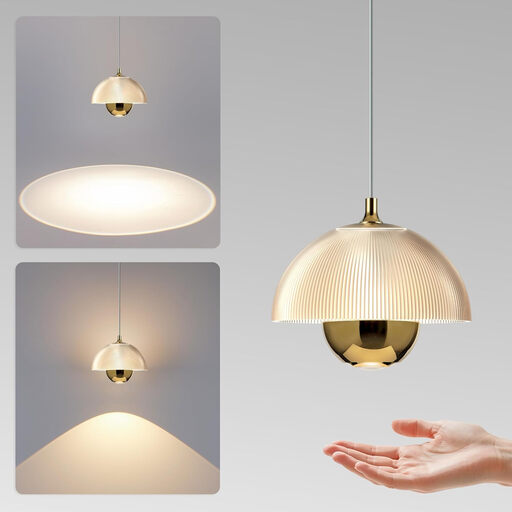
Why this product suits this profile: This pendant light is designed for kitchen islands, dining tables or bedrooms, combining a decorative design with touch-free control.
The specifications state 10 W, three colour temperatures from 2700 to 5000 K and stepless dimming. This makes it easier to choose between task and ambient lighting.
Integrated 10 W LED, up- and downlighting, plus touch-free infrared control activated by hand movement.
Why this product suits this profile: At 400 mm long, it is designed for wide kitchen wall cupboards, work areas or longer shelves where shorter lights may leave dark areas at the edges.
The product description states the dimensions, 61 LEDs per light, PIR range and 1100-mAh battery. Buyers can therefore plan the light to suit the width of their cupboard.
Two 40 cm lights, three colour temperatures, 5 V USB charging and drill-free adhesive installation.
We have put together a complete, regularly updated list of products that fully meet these strict selection criteria and the safety regulations applicable in the EU.
Many wireless models are attached using adhesive strips or magnets. Clean the surface, allow it to dry completely and check before final installation that the sensor covers the desired area. For heavy or permanently installed lights, screw fixing may be more suitable.
It is not possible to determine a general runtime from battery capacity alone. Brightness level, how often the light switches on, sensor range and standby consumption all affect operating time. With 800 or 1100 mAh models, a decrease in brightness should be taken as a sign that the battery needs recharging. Damaged or swollen batteries must not be used.
LEDs require comparatively little electrical power during operation. With battery-powered lights, most of the energy consumption occurs during charging. A sensor can limit operation to times when movement is detected; on suitable models, a dusk sensor also prevents the light from switching on when there is sufficient ambient brightness. Check the power consumption and automatic switch-off time before buying.