
Lieferung heute & morgen

Qualitätsgarantie

Willkommens-Angebote freischalten: KOSTENLOSE Lieferung | Bis zu 80 % RABATT | Kostenlose 30-Tage-JoyPlus-Testphase
App herunterladen
An LED sensor night light should automatically help you find your way at night without lighting up the whole room unnecessarily. For families, older people and households with hallways or stairs, a plug-in model is a practical choice: it usually needs no batteries and responds to darkness, movement or both, depending on the design.
However, it’s easy to make the wrong choice. A high lumen rating doesn’t automatically mean pleasant light, and the word ‘sensor’ doesn’t always describe the same feature. The following points will help you choose the right plug-in night light.
A motion-sensor night light switches on when it detects movement. A dusk-sensor night light, on the other hand, responds to ambient light levels and may stay on continuously when it’s dark. Some models combine both features.
Motion detection can be useful in a hallway or on the stairs, where you only need light for a short time. In a nursery or bedroom, a dim light that stays on may be more practical. So check that the product description clearly states which sensor is fitted and whether the light switches off automatically.
Colour temperature is measured in kelvin. Warm white light at around 2700 to 3200 K is usually less harsh indoors than cool white light at around 6500 K. Luminous flux, measured in lumens, matters too: some of the models featured here produce 8 to 20 lm, making them suitable for guidance lighting rather than illuminating an entire room.
A warm white LED night light is therefore often a good choice for bedrooms, children’s rooms or the route to the bathroom. To light a larger area, a wider beam angle or several lights may work better than a single, particularly bright light source.
Power consumption, measured in watts, shows how much electrical power the device uses while it’s operating. A 0.3 or 0.4 W model may use less energy over time than a more powerful light, particularly if it’s on for longer. However, the actual running cost depends on how many hours the light is in use.
An energy-efficient night light with a dusk sensor may stay on continuously, while a motion-sensor model only lights up for short periods. Both options can be useful, but they suit different needs.
A PIR motion sensor with a specified detection angle is useful for a hallway night light or a light for the stairs. For example, the GRIFEMA model has a stated range of up to 3 m and a 120° detection angle. This gives you a helpful indication of where to place it.
For a dusk sensor, the activation light level should be stated. Some products give a threshold of around 20 lux. Make sure the sensor isn’t obstructed by furniture, curtains or decorations.
Look out for three figures:
A low brightness setting is often enough for smaller rooms. Stepless dimming or several fixed settings may be more practical than a light that only operates at full brightness.
A plug-in night light should be suitable for the mains supply used in Germany. The specifications for the models featured here, for example, list voltage ranges of 220–240 V or 100–240 V. Depending on the model, the casing is made from ABS, metal or polycarbonate.
Important: a model designed for indoor use isn’t automatically suitable for damp rooms. Even if a product lists an IP rating, follow the manufacturer’s guidance. Don’t place electric night lights directly beside sinks, baths or other areas that are regularly damp unless the manufacturer explicitly says this is safe. Always unplug the device before cleaning and wipe it with a dry cloth only.
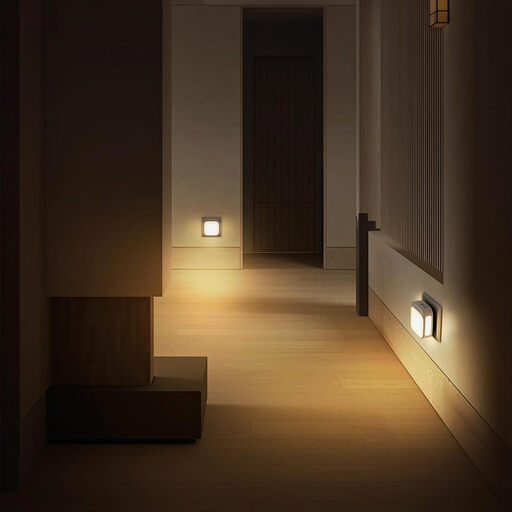
Why it’s a good fit: The set contains two lights, making it suitable for use in a bedroom, nursery or hallway. The automatic light sensor switches them on when it gets dark.
The specifications list 0.3 W, 2800–3000 K and dimming from 10 to 100%. This makes it easier to assess the power consumption, light colour and brightness before you buy.
Two lights, 20 lm, warm white light and stepless brightness adjustment, with a stated power consumption of 0.3 W.

Why it’s a good fit: Five brightness settings, warm white light at 2700 K, and motion and dusk sensors give you several ways to adjust the light for a children’s room, hallway or stairs.
The combination of dusk and motion detection stops the light switching on unnecessarily when there’s enough daylight. According to the product details, it switches off after 60 seconds without movement.
Five brightness settings, a 3 m detection range, a 120° detection angle and 0.5 W power consumption.
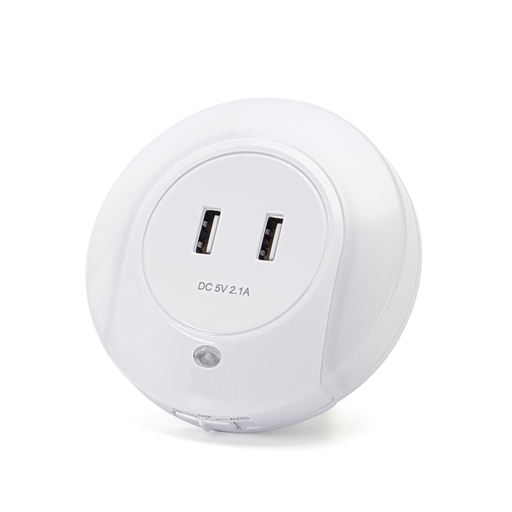
Why it’s a good fit: This night light combines automatic guidance lighting with two USB ports. It’s a good choice for bedrooms or hallways where you also want to charge mobile devices.
The specifications list 3000 K, 8 lm and 0.4 W. This makes it easier to judge the light as a more subtle aid to finding your way, rather than relying on marketing claims alone.
Two USB ports, a 120° beam angle, 3000 K warm white light and a stated power consumption of 0.4 W.
We’ve put together a complete, regularly updated list of products that meet these strict selection criteria and fully comply with the safety regulations applicable in the EU.
Plug in the light so that the sensor and LED aren’t blocked by furniture, curtains or decorations. In hallways and on stairs, it’s best to place it near the route you’ll walk. In a nursery, make sure the light doesn’t shine directly at your child’s face or at eye level.
Lifespan is usually given in hours. The specifications for the featured models list figures such as 10,000, 15,000 or 25,000 hours. This is a technical guide, not a guarantee of how long the light will actually last. Heat, mains quality, frequent switching and physical knocks can all affect its lifespan.
That depends on its power consumption and how long it’s on. At 0.3 W, 1,000 hours of use works out to 0.3 kWh; at 1 W, it’s 1 kWh. To work out your own costs, multiply the energy used by your electricity rate. A motion sensor can reduce the time the light is actually on.