
Lieferung heute & morgen

Qualitätsgarantie

Willkommens-Angebote freischalten: KOSTENLOSE Lieferung | Bis zu 80 % RABATT | Kostenlose 30-Tage-JoyPlus-Testphase
App herunterladen
A new lighting concept using a recessed LED spotlight kit can completely transform a room. However, the joy of a modernised kitchen or a renovated bathroom can quickly fade if the new spots start to flicker, fail in damp areas, or if the installation becomes unexpectedly complicated. Often, it's the subtle product details that determine a project's success or failure.
As a Joybuy Product Recommendation Officer, I analyse product data and customer feedback daily. In doing so, the same three pitfalls consistently emerge, leading to frustration and unnecessary costs. This guide will show you how to avoid them and apply the right criteria to your selection.
To avoid these mistakes, you should carefully examine three technical features. These define the functionality, safety, and longevity of your new lighting system.
The choice of operating voltage is fundamental.
For most renovation projects in the living room, hallway, or for kitchen recessed spotlights, a 230V kit is the more pragmatic choice.
The IP (Ingress Protection) rating indicates how well a light is protected against the ingress of foreign objects and water. The second digit is crucial here:
When planning for a bathroom, ensure you select IP44-rated recessed bathroom lights or higher to comply with regulations and ensure safety.
Two dimensions are critical here: the cut-out diameter and the installation depth.
Based on these objective criteria, we have identified several products that provide a suitable solution for specific user profiles and projects.
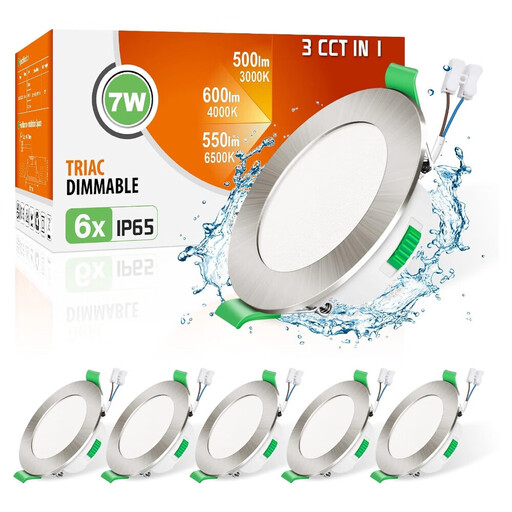
Why This Fits Their Persona: Ideal for renovators who refuse to compromise on safety in the bathroom. The high IP65 protection rating allows for installation even in zones with increased moisture, while the dimming function and selectable colour temperature create the perfect atmosphere.
Solves the problem of an incorrect protection rating with its IP65 certification, which offers protection against water jets and thus far exceeds the minimum IP44 standard.
Combines high safety (IP65) with flexibility (dimmable, 3 colour temperatures) and fits into standard cut-outs with a 68-75 mm hole size.
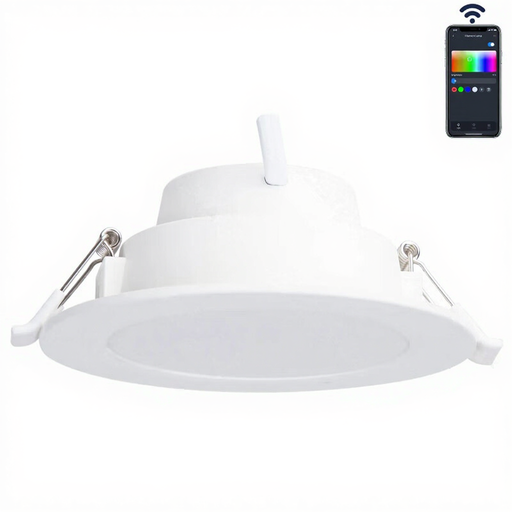
Why This Fits Their Persona: Perfect for users who want to fully customise their lighting and integrate it into their smart home. This model offers full control over brightness, colour temperature (3000K-6500K), and millions of RGB colours via app or voice command (smart recessed lights for Alexa/Google).
Bypasses the dimmer compatibility trap because the dimming function is integrated directly into the light and controlled via an app. No external, physical dimmer switch is required.
Complete lighting control (RGB ceiling light, CCT, dimming) via Bluetooth Mesh and app. Allows for the creation of scenes and schedules without any structural changes.
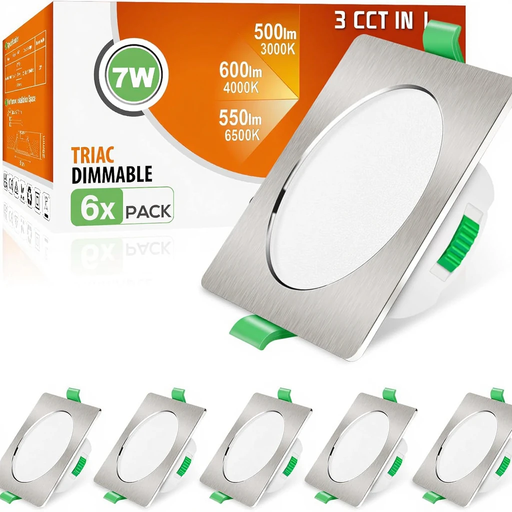
Why This Fits Their Persona: A straightforward, all-in-one solution for renovators dealing with low ceiling heights. The kit is easy to install, versatile, and covers all basic requirements like dimmability and suitability for damp rooms (IP44).
Solves two problems at once: The 230V direct connection makes a transformer redundant, and the very shallow installation depth of 29 mm fits even in ceilings with minimal clearance.
Extremely low-profile design for hassle-free installation. Comes as a complete kit for quick and easy setup without needing additional components.
We have compiled a complete, up-to-date list of products that fully meet these strict selection criteria and UK safety regulations.
A general rule of thumb for ambient lighting in living spaces is one spot per 1.5 to 2.5 square metres. However, this heavily depends on the ceiling height, the light output (lumens) of the spots, and the desired brightness. For task areas like kitchen recessed spotlights, you should plan for a higher density or spots with a higher lumen count.
No, this is a common source of error. Many modern LED spots require a trailing-edge dimmer (identifiable by the "RC" code), whereas older installations often use leading-edge dimmers ("RL"). Check the LED kit's product description for a recommendation on the dimmer type to avoid flickering. Smart lights that are dimmed via an app bypass this problem entirely.
3CCT stands for "3 Correlated Colour Temperatures." Spots with this feature have a small switch that allows you to choose between three light colours before installation: