
Lieferung heute & morgen

Qualitätsgarantie

Willkommens-Angebote freischalten: KOSTENLOSE Lieferung | Bis zu 80 % RABATT | Kostenlose 30-Tage-JoyPlus-Testphase
App herunterladen
LED spotlights are suitable for living rooms, kitchens, bathrooms, hallways, gardens and paths. The choice ranges from permanently installed LED recessed spotlights and LED ceiling spotlights to smart GU10 bulbs and solar garden lights. However, differences in light output, cut-out size, IP rating and controls determine whether a model is actually right for the space you have in mind.
Wattage describes power consumption, not brightness directly. The light output in lumens is what matters when comparing products. A recessed spotlight with 430 lumens is suited to a different purpose from one with 1,200 lumens. For even room lighting, you should also consider the number of lights, their beam angle and the distance between them.
IP44 protects against solid objects larger than 1 mm and splashing water. This rating does not mean a product can withstand prolonged rain, a water jet or submersion. IP44 may be suitable for covered outdoor areas or damp indoor spaces. For exposed outdoor areas, a higher rating such as IP65 is often a better choice, provided the manufacturer explicitly states it.
For recessed spotlights, the cut-out diameter, outer diameter and installation depth must suit your existing ceiling. A dimming function is not automatically compatible with every wall dimmer, either. Some models can only be dimmed via an app, while others need a leading-edge or trailing-edge dimmer. Check the technical specifications for compatibility before buying.
Colour temperature is measured in kelvin:
CCT LED lighting lets you choose from several colour temperatures. Some products let you switch between settings using a switch on the light fitting, while others use an app or remote control. RGB LED bulbs add coloured lighting, but do not necessarily replace functional room lighting.
230-volt recessed spotlights connect directly to the mains. Installation should be carried out with the power switched off and by a qualified electrician. 12- to 24-volt models need a suitable transformer, which is not always included.
GU10 smart bulbs fit existing GU10 sockets. Before buying, check the fitting type, dimensions, ventilation around the light fitting and compatibility with your preferred smart home system. Depending on the model, smart LED spotlights can be controlled via Wi-Fi, Bluetooth Mesh, a manufacturer’s app or voice assistants.
Power consumption in watts is what determines running costs. You can estimate electricity costs using this formula:
Watts ÷ 1,000 × hours of use × electricity price per kilowatt-hour
A 6-watt spotlight uses around 6 kilowatt-hours over 1,000 hours of use. You should also consider the energy efficiency rating, standby consumption and actual daily usage.
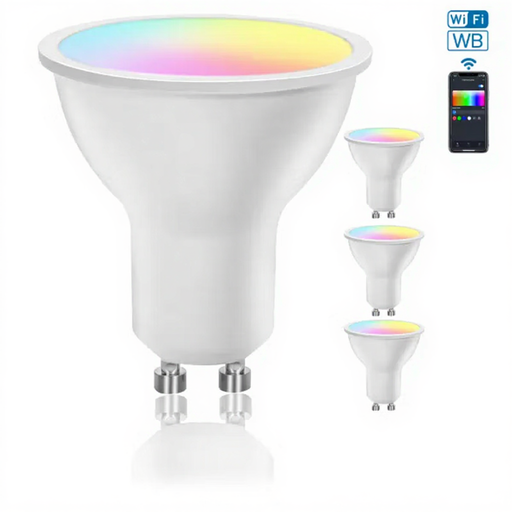
Why this product suits your needs: This set of four fits GU10 sockets and offers app control, RGB colours and a colour temperature range of 2,700 to 6,500 kelvin for indoor use.
Brightness is specified as 420 lumens, making it easier to judge the light output rather than focusing only on the RGB function.
GU10 base, RGB+CCT and app control via Wi-Fi; supplied as a set of four bulbs.
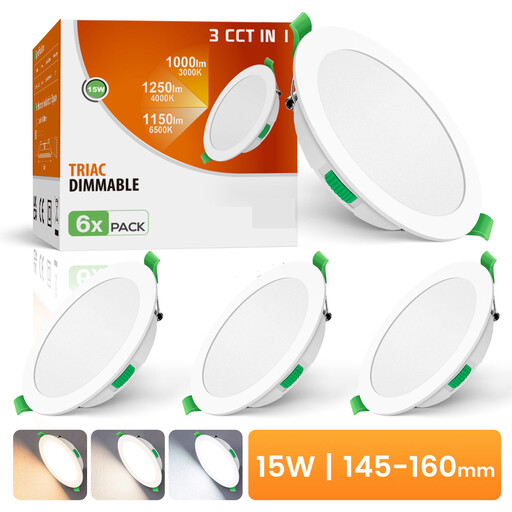
Why this product suits your needs: This set of six is designed for 145–160-mm cut-outs and combines 1,200 lumens with three selectable colour temperatures.
Details on the cut-out size, installation depth, light output and dimming range of 10 to 100 per cent make it easier to plan before installation.
3CCT selection, 120-degree beam angle, IP44 rating and direct 230-volt connection.
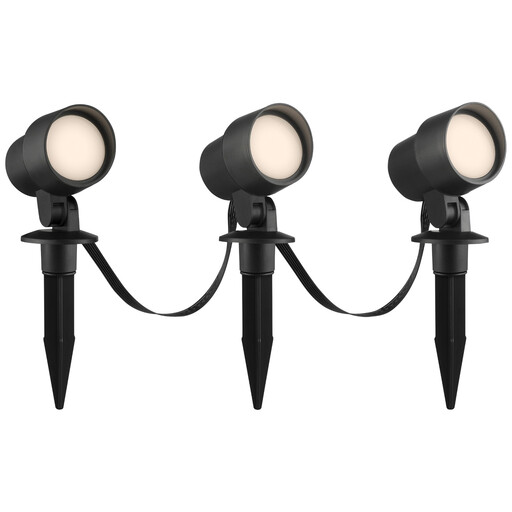
Why this product suits your needs: Position the three LED ground spotlights along paths, flower beds or patios, and control them using Tuya Smart or voice assistants.
The IP44 rating is clearly stated. Even so, it should not be taken to mean the lights are protected against direct water jets or submersion.
RGB, CCT and dimmable; three lights for flexible placement outdoors.
It depends on the size of the room, ceiling height, beam angle and the level of brightness you want. For general lighting, several spotlights with a moderate light output often provide more even coverage than one very bright fitting. Kitchen worktops usually need more functional lighting than a hallway or bedroom.
Models with an IP44 rating may be suitable for areas exposed to splashing water, provided the installation location matches the manufacturer’s guidance. Areas exposed to direct water or high levels of moisture have additional requirements. A qualified electrician should carry out installation on the 230-volt mains.
Many products have a stated lifespan of between 15,000 and 30,000 hours. This is a manufacturer’s estimate and depends, among other things, on operating time, heat dissipation, ambient temperature and how often the light is switched on and off. If an integrated LED fails, the entire fitting usually needs replacing; with GU10 systems, you can replace the bulb separately.