
Lieferung heute & morgen

Qualitätsgarantie

Willkommens-Angebote freischalten: KOSTENLOSE Lieferung | Bis zu 80 % RABATT | Kostenlose 30-Tage-JoyPlus-Testphase
App herunterladen
LED strips, often called LED tape, are a flexible way to give rooms a special ambiance through indirect lighting. Whether for accent lighting in the living room, functional under-cabinet lighting in the kitchen, or dynamic gaming room illumination—the applications are endless. However, the market is saturated, and many products don't live up to their promises. This guide will help you navigate the common pitfalls and make an informed decision.
As your Joybuy Product Recommendation Officer, I filter the relevant information for you, so you can make a choice based on facts, not marketing hype.
Many buyers experience disappointment shortly after their purchase. Certain shortcomings are particularly common and can be avoided by selecting the right product.
To avoid the problems mentioned above, you should check a few technical parameters before buying. These provide insight into the product's quality and longevity.
The type of LEDs used has a direct impact on brightness and colour mixing. A common designation is the chip type, for example, 5050 SMD. These chips are larger than older models (e.g., 3528) and can house three diodes in one package, which ensures better colour mixing for RGB strips. Another important metric is the LED density, specified in LEDs per metre. A higher density (e.g., 60 LEDs/m) creates a more uniform and brighter line of light, whereas a low density can lead to visible light dots or "hotspots."
The control method should match your intended use.
Pay attention to the specified voltage (V). Most strips operate on low voltage (5V, 12V, or 24V) and require a matching power adapter. Using the wrong power supply can damage the strip. For use in damp environments or outdoors, the IP rating is critical. IP20 is only suitable for dry indoor spaces, while IP65 offers protection against water jets. A visible CE mark on the product or power supply indicates that the manufacturer declares compliance with EU standards.
Here are some recommendations tailored to different needs and use cases.
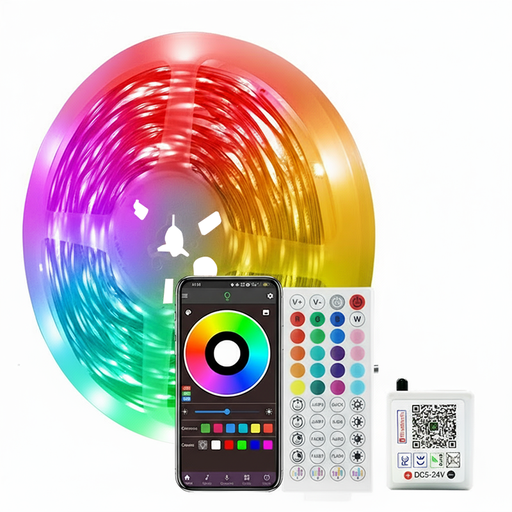
Why This Fits Their Persona: Ideal for fully illuminating large rooms or entire gaming setups. The combination of app and remote control offers maximum flexibility, while the music sync feature provides an immersive experience.
At 30 metres long, it solves the problem of strips being too short. The dual control via an established app and a physical remote minimises the risk of depending on a single, failure-prone control method.
Extensive length for seamless installations; 5050 RGB LEDs for excellent colour mixing; built-in music synchronisation.
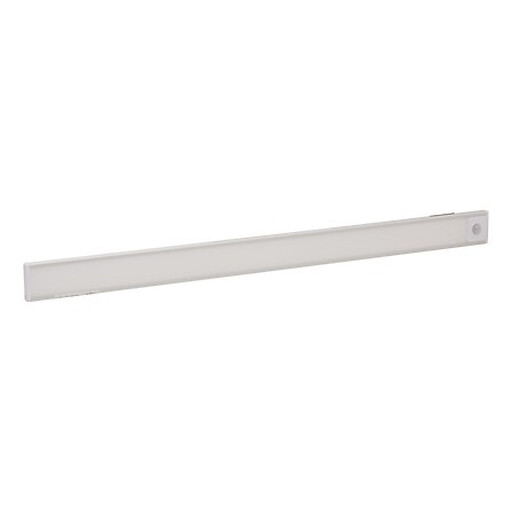
Why This Fits Their Persona: Perfect for functional lighting in closets, drawers, or under shelves where no power outlet is available. The focus is on simple installation and on-demand use.
As a self-contained bar with a battery and magnetic mount, this product bypasses the typical adhesive problems of long, flexible tapes. It requires no complex app setup, instead working reliably via its integrated motion sensor.
Wireless operation thanks to a 2200mAh battery; automatic on/off via motion detection; simple, screw-free installation with a magnetic strip.
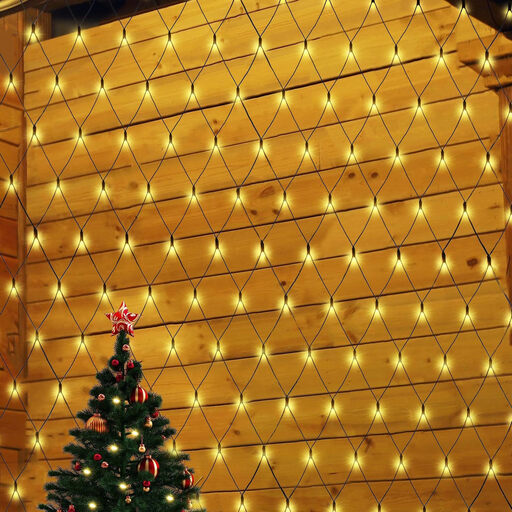
Why This Fits Their Persona: For users looking for large-scale, unconventional light decoration. The boxwood-style light net is perfect for decorating walls, fences, or balconies, creating a natural and atmospheric ambiance.
This product is not a linear strip, thus avoiding the typical issues of routing and adhesion. Its net shape ensures even light distribution over a 2x2 metre area, something difficult to achieve with a single strip.
Unique boxwood look; large-area illumination (2x2 m); 9 different light modes and a memory function; IP44-certified for outdoor use.
We have compiled a complete, up-to-date list of products that fully meet these strict selection criteria and rigorous safety standards.
Yes, most LED strips can be cut. Look for the designated cut marks, which are usually indicated by a scissor icon. Cutting at an unmarked spot will interrupt the electrical circuit, causing the subsequent section to stop working. After cutting, the ends do not need to be specially sealed unless the strip is used in a humid environment.
Power consumption depends on the strip's length, the number of LEDs, and the set brightness and colour. The power is specified in watts (W), often per metre. A typical 5-metre RGB strip consumes between 30 and 72 watts at full brightness on white light. Using a dimmable LED strip significantly reduces consumption. However, compared to traditional light sources, LED technology is very energy-efficient.
No, adhesion is highly dependent on the surface condition. Smooth, clean, and non-porous surfaces like painted wood, metal, or plastic are ideal. On rough surfaces such as woodchip wallpaper, untreated wood, or dusty walls, adhesion is often insufficient. It is recommended to thoroughly clean and degrease the surface with a suitable agent before application. For difficult substrates, additional mounting clips or stronger double-sided mounting tape can help.