
Lieferung heute & morgen

Qualitätsgarantie

Willkommens-Angebote freischalten: KOSTENLOSE Lieferung | Bis zu 80 % RABATT | Kostenlose 30-Tage-JoyPlus-Testphase
App herunterladen
LED strips, often called LED tape or LED light ribbons, are a versatile way to give rooms, furniture, or even vehicles a custom atmosphere. But the market is crowded, and not every product delivers on its promise. Before you invest in new ambient lighting, you should know the typical weak points that often only become apparent after purchase.
Many buyers report three recurring problems:
self-adhesive, peels off the wall or ceiling after just a few weeks.RGB LED strip fails to produce a pure white, the colours look washed out, or the brightness is uneven along the tape.battery-powered LED strip drains its batteries in no time.These defects can be avoided by paying attention to the right technical specifications before you buy.
To make an informed decision, it's helpful to be guided not by marketing promises, but by objective product features. Three factors are particularly relevant.
The density of the LEDs, specified in LEDs per metre, is a key determinant of lighting quality. A low density (e.g., 30 LEDs/m) often results in visible light dots, which can look distracting. For the homogeneous and even illumination desired for high-quality ambient lighting, densities of 60 LEDs/m or more are recommended.
For RGB LED strips, the ability to display mixed colours is also crucial. Basic models often struggle to produce a clean white. Advanced technologies like RGBIC (Independent Control) allow for the control of individual segments of the strip, leading to smooth colour gradients and more precise colour mixing.
The IP rating indicates how well an LED tape is protected against the ingress of foreign objects and water. This is not an optional detail, but a crucial safety and durability feature.
waterproof should have at least this classification.The type of control significantly affects user convenience.
LED strip with remote must be within the receiver's line of sight.gaming room lighting.battery-powered LED strip offers maximum flexibility as no power outlet is needed. Pay attention to power consumption and the type of batteries required (e.g., AA).Instead of making a one-size-fits-all recommendation, we have identified products tailored to specific needs and applications.
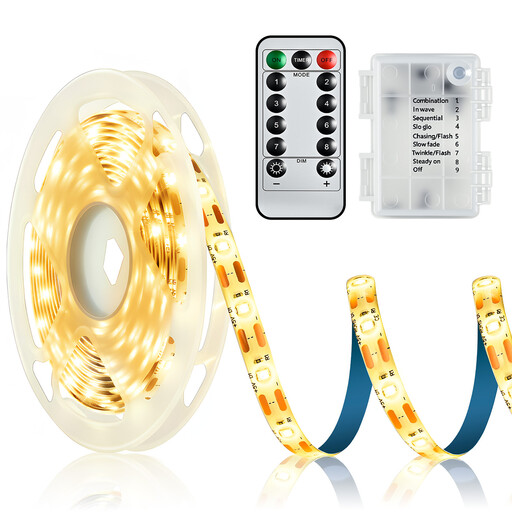
Why This Fits Their Persona: Ideal for anyone looking for a straightforward, battery-powered solution for various locations—from party decorations to indirect shelf lighting, without needing to rely on power outlets.
The product description highlights a strong adhesive backing and an IP65 resin coating. This addresses concerns about weakening adhesion and provides solid protection against moisture.
Battery power allows for maximum placement flexibility. The remote control enables dimming and switching between 8 light modes.
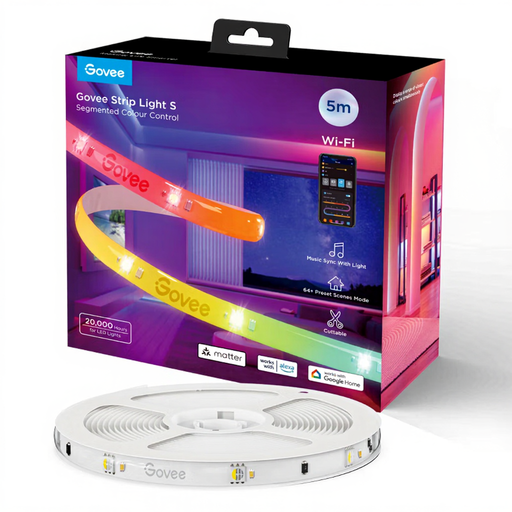
Why This Fits Their Persona: Perfect for creating dynamic gaming room lighting or for seamless integration into an existing smart home system. The RGBIC technology enables complex, flowing light effects.
RGBIC technology solves the problem of uneven colours by allowing control over individual segments. Matter certification ensures future-proof and stable connectivity with various smart home platforms.
Segmented RGBIC colour control for multi-colour effects on a single strip. Comprehensive app control with music sync and universal smart home compatibility through Matter support.
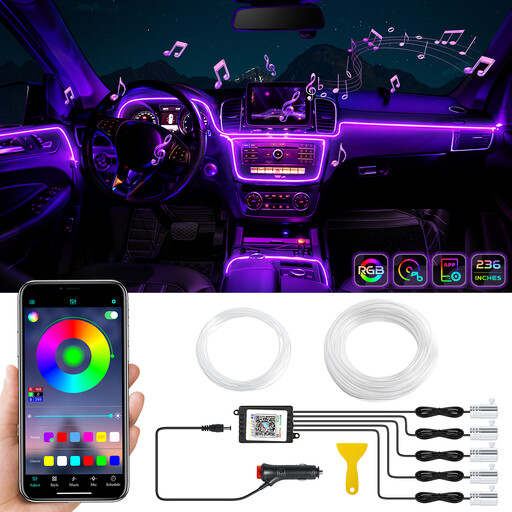
Why This Fits Their Persona: Specifically designed for in-vehicle installation. This kit provides everything needed to give a car's interior custom LED interior lighting, controlled via an app.
As a dedicated 12V kit for cars, it bypasses issues with incompatible power supplies. The design, intended for installation in dashboard crevices, ensures a clean, professional look without loose cables.
Complete kit for vehicle installation, powered by the 12V socket. Control is conveniently handled via an app and includes a sound-active function where the lights pulse to the beat of the music.
We've compiled a complete, up-to-date list of products that fully meet these strict selection criteria and relevant safety regulations.
The LEDs themselves have a very long lifespan, often between 20,000 and 50,000 operating hours. In practice, however, it's other components that are more likely to fail first. These include the power supply, the control electronics, or the adhesive layer, whose durability heavily depends on the mounting surface and environmental conditions.
Most LED strips can be cut to fit a specific length. Look for the designated cut marks (often indicated by a scissor icon). Cutting in the wrong place will interrupt the circuit, causing a section of the strip to no longer light up. Models that cannot be cut are usually explicitly marked as such.
The IP (Ingress Protection) rating is an international standard that classifies the degree of protection a housing provides against the ingress of foreign objects (first digit) and water (second digit). For LED strips, the most relevant ratings are IP20 (no water protection), IP44 (protection against splashing water), and IP65 (protection against water jets). Choosing the right IP rating is crucial for the safety and longevity of the product, especially in damp rooms or outdoor areas.