
Lieferung heute & morgen

Qualitätsgarantie

Willkommens-Angebote freischalten: KOSTENLOSE Lieferung | Bis zu 80 % RABATT | Kostenlose 30-Tage-JoyPlus-Testphase
App herunterladen
An LED strip can add indirect lighting to furniture, TVs or a gaming setup. At first glance, choosing one seems simple: compare the length, colour and price, stick it on and switch it on. In practice, however, a few details can mean that an LED light strip does not adhere reliably, appears too dim or is incompatible with your existing smart home system.
As a Joybuy Product Recommendation Officer, I filter the most important product specifications and explain what shoppers in the UK should look out for before buying.
A classic RGB LED strip can generally display one uniform colour along its entire length. With an RGBIC LED strip, several sections can be controlled independently at the same time. This creates colour gradients or running-light effects. RGBIC is therefore interesting for gaming, parties and dynamic ambient lighting, but it is not automatically necessary if you are simply looking for even backlighting.
RGBCCT adds adjustable white light to RGB colours. Depending on the model, you may be able to change the colour temperature between warm and cooler white, for example. If you also want to use the light functionally, you should check this specification.
A self-adhesive LED strip adheres most reliably to a dry, smooth surface free from dust and grease. Textured plaster, untreated wood or very warm surfaces can make installation more difficult. Before fitting it, measure the intended route and fully unroll the LED light strip.
When going around corners, gentle curves are usually more suitable than sharp bends. The power supply should also remain adequately ventilated. Do not leave a coiled LED strip switched on for extended periods, as heat can build up.
The level of protection is indicated by the abbreviation IP. A model rated IP20 is intended for dry indoor areas. IP44 provides protection against splashing water, but is not suitable for immersion in water. For bathrooms, kitchens, balconies or outdoor areas, the product description, installation location and IP rating must all be compatible.
An LED strip for a car involves additional considerations: a 12-volt system is designed for connection in a vehicle, whereas mains-powered products must not be connected directly to the vehicle’s electrical system.
Do not just estimate the length. Take corners, cable routes and the space needed for the controller and power supply into account. A 5-metre LED strip, for example, can cover the backs of TVs, desks or furniture edges. With products that can be cut, you must only cut at the marked cut points. Cutting in the wrong place can damage the conductive tracks.
Also check whether a power supply is included and what voltage is required. A 230-volt household power supply is not interchangeable with a 12-volt car LED strip.
An LED strip with remote control is sufficient for simple colour and brightness adjustments. An LED strip with app control usually offers additional scenes, timers and speed settings. For smart home users, Wi-Fi, voice assistants and Matter compatibility are relevant.
Matter makes it easier to integrate compatible platforms such as Apple Home, Google Home, Amazon Alexa or Samsung SmartThings. Nevertheless, you should check whether a hub is required, which Wi-Fi band is supported and whether setup takes place through a specific app.
Not every LED strip is designed to light an entire room. Many products are primarily suitable as indirect LED ambient lighting. Specifications such as lumens, wattage and colour temperature help you assess their suitability. A model with warm white light creates a different effect from an LED strip at 6,000 K, which appears more cool white.
Depending on the model, music synchronisation works through an integrated microphone or the app. It responds to sounds, but does not necessarily provide a precise analysis of every audio track.
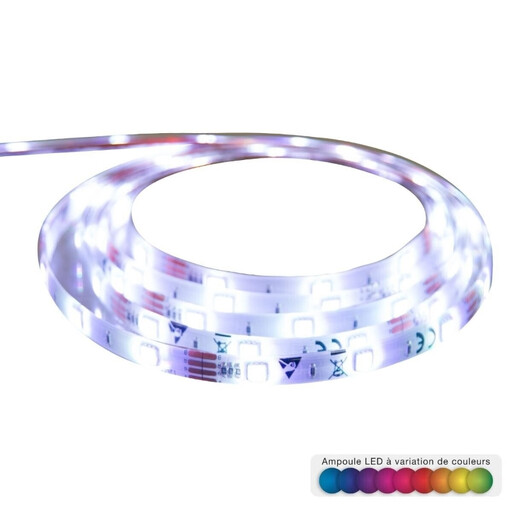
Why this product suits this profile: An uncomplicated solution for shelves, stair railings or behind the TV, with mains power and remote control.
The length, power supply and IR remote control are specified in the product details. The IP20 rating limits use to dry indoor areas.
5 m length, 150 LEDs, self-adhesive design and remote control.
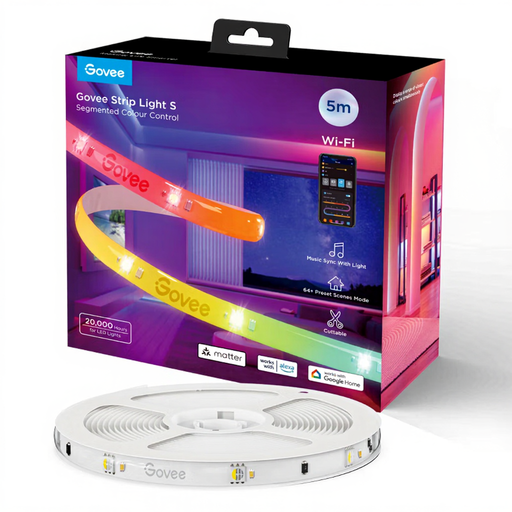
Why this product suits this profile: Suitable for smart home users, gaming rooms and home cinema setups with segmented colour effects.
The product details specify RGBIC segment control, 2.4 GHz Wi-Fi, Bluetooth and Matter. The strip is also designed for dry indoor areas.
24 W over 5 m, 24 LEDs per metre, app control, voice control and 64 stated scene modes.

Why this product suits this profile: For drivers who want to illuminate several areas of their car interior with app control and music synchronisation.
The specifications indicate 12 V, short-circuit protection and several separate lighting areas. When cutting the strip, follow the specified cut points.
6 LED strips, four footwell lights, four door-handle lights, Bluetooth app and dynamic modes.
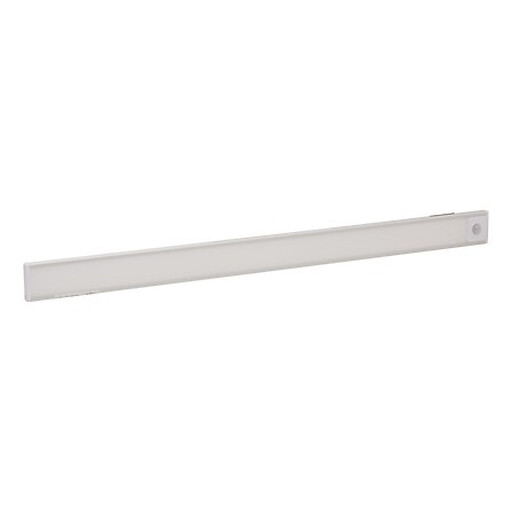
Why this product suits this profile: For cupboards, shelves, hallways and work surfaces where automatic lighting is needed without permanent wiring.
The intended use is clearly limited to dry indoor areas. The integrated sensor has a stated range of approximately 2 m.
3.7-V battery with 2,200 mAh, USB charging, magnetic mounting and automatic lighting for approximately 30 seconds.
We have compiled a complete, regularly updated list of products that fully meet these strict selection criteria and the safety regulations applicable in the EU.
First, plan the route and clean the surface. Apply the strip without sharp bends and press it down firmly section by section. With longer or heavier models, additional mounting clips may be useful. Do not cover the power supply or controller.
The lifespan depends, among other things, on operating time, heat dissipation, the power supply and build quality. A general figure is therefore not particularly meaningful. Ensure adequate ventilation, do not operate the strip while permanently coiled and use only the specified power supply.
Consumption depends on the length, brightness and model. A 5-metre product rated at 24 W uses a maximum of 0.024 kWh per hour of operation at full power. In practice, the figure may be lower when dimming or using dynamic modes. For running costs, the power consumption stated on the power supply or product data sheet is the key figure.