
Lieferung heute & morgen

Qualitätsgarantie

Willkommens-Angebote freischalten: KOSTENLOSE Lieferung | Bis zu 80 % RABATT | Kostenlose 30-Tage-JoyPlus-Testphase
App herunterladen
An LED strip can provide extra light behind your TV, beneath kitchen cupboards, at your desk or in your car. The choice ranges from a simple LED light strip to a connected smart LED strip with app control, voice commands and music synchronisation. But colour options and marketing claims alone won’t tell you whether a lighting solution will work well in everyday use.
An RGB LED strip produces coloured light and is best suited to accent lighting, parties, gaming set-ups or backlighting your TV. A coloured strip isn’t necessarily the right choice for evenly lighting a worktop or hallway.
If you’re looking for softer ambient or accent lighting, pay attention to the colour temperature. A warm white LED strip at around 2,700 to 3,000 kelvin looks different from cool white light at around 6,500 kelvin. Choose a colour temperature that suits where you’ll use it.
A 5 m LED strip is a good option for long furniture edges, ceiling areas or larger TV walls. For a shelf, bed frame or short run beneath a kitchen cupboard, a 2 m model may be more practical. Before you buy, measure the distance and check:
A strip that’s too short will leave gaps; one that’s too long must not be cut just anywhere.
An IP20 rating indicates that a product is intended for use in dry indoor spaces. Products with this rating shouldn’t be used in bathrooms, on balconies or on an unprotected exterior wall. A rating such as IP44 protects against splashes, but doesn’t replace a fully protected connection and doesn’t allow the product to be submerged.
For outdoor Christmas lights, check the rating for the lights themselves as well as the power supply, battery compartment and connection points. If you’re using a battery-powered LED string light, keep the battery compartment out of the water.
RGB products switch between colours, but don’t always produce an even white light. For decorative use, lighting scenes and colour changes are often more important than accurate colour rendering. For kitchens, work areas or cupboard lighting, however, lumens, colour temperature and – if provided – the CRI or Ra value are important.
According to the product details, the Aigostar COB strip has a colour temperature of 3,000 kelvin, an output of 1,800 lumens and an Ra value of at least 80. These figures apply to this specific product and shouldn’t be assumed to apply to other LED light strips.
Many LED strips run on 12 or 24 volts DC. The power supply converts the mains voltage accordingly. Check whether the power supply and controller are included, and whether the plug and connection type suit your set-up.
Don’t leave an LED strip rolled up while it’s switched on, as heat can build up. You must also stay within the stated maximum length. Longer installations may need additional power feeds or suitable connectors.
The adhesive will only hold reliably if the surface is smooth, dry, clean and free from grease. Dust, rough wallpaper or silicone-coated surfaces can reduce adhesion. Before fitting the strip, mark out the position and lay it out along the full route to check the fit.
An aluminium profile may be useful for delicate furniture. It can help dissipate heat and create a clean, defined line of light. With flexible LED light strips, avoid tight bends, pulling on the cables and bending directly over the LED components.
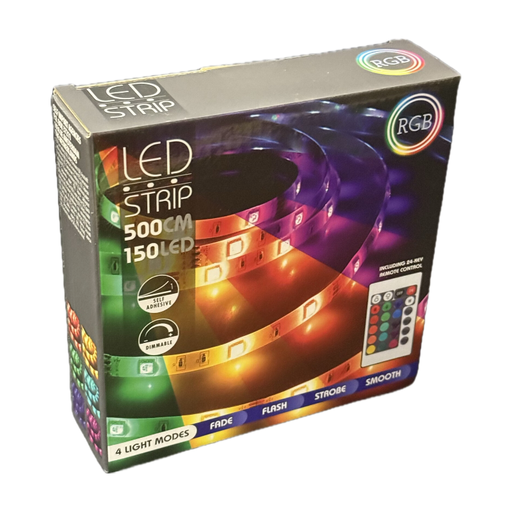
Why it suits this profile: This 5 m RGB strip comes with a 24 V power supply, an infrared remote control and a self-adhesive backing. It’s ideal for simple decorative lighting behind the TV, on shelves or along the ceiling.
The length, voltage, IP rating and included accessories are all clearly stated. The IP20 rating makes it clear that the strip is intended for dry indoor spaces.
5 m length, 150 SMD LEDs, dimmable brightness and control via infrared remote.
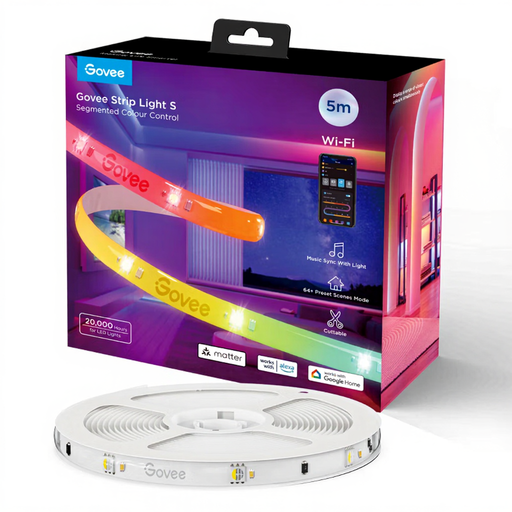
Why it suits this profile: With Wi-Fi, Bluetooth and Matter support, this strip is designed for anyone looking to add LED lighting to an existing smart home set-up.
The control options and indoor use are clearly described. However, despite its coating, the strip is not rated as waterproof.
5 m length, segmented RGBIC colour control, app and voice control, and built-in music synchronisation.
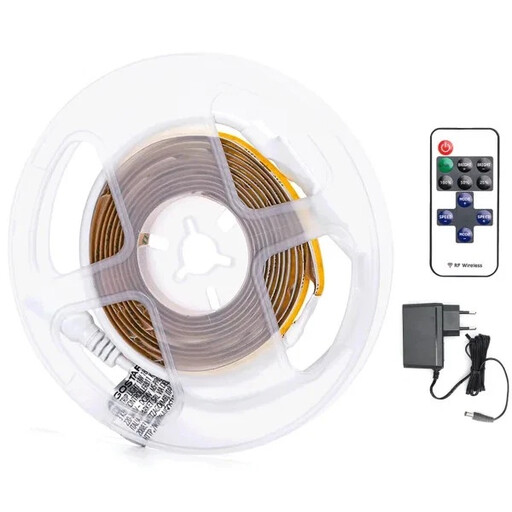
Why it suits this profile: This warm white LED strip is designed to provide even lighting over short indoor runs, such as beneath shelves, inside display cabinets or along furniture edges.
The 2 m length, 3,000 K colour temperature and IP20 rating make it easier to plan for dry indoor spaces.
COB light source, 24 V DC, stated output of 1,800 lumens and dimmable modes via the controller.
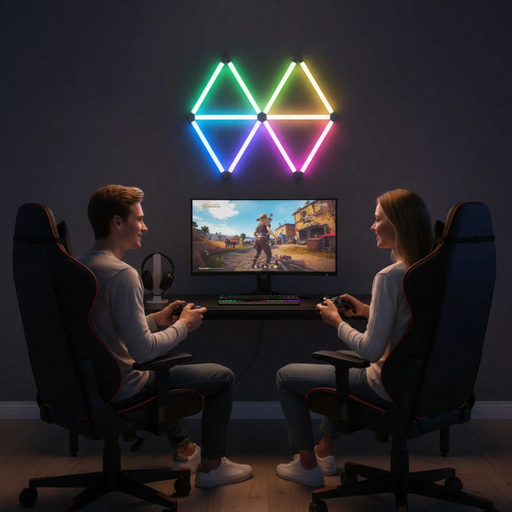
Why it suits this profile: Six flexible, connectable light panels are ideal for gaming rooms, around monitors and TVs, or for creating personalised wall décor.
The product details list app, remote and voice control separately. Installation requires a smooth, dust-free wall and a dry environment.
Smart Life app, compatibility with Alexa and Google Assistant, more than 40 scenes and music synchronisation.
We’ve put together a complete, regularly updated list of products that meet these strict selection criteria and the safety regulations applicable in the EU.
Measure the distance, clean the surface and test the position before peeling off the backing. Remove the protective film a little at a time and press the strip down evenly. Gentle curves work better than sharp bends around corners. Disconnect the power before cutting, and only cut at the marked points.
Its actual lifespan depends on heat, how long it’s used, the power supply, how it’s fitted and the quality of its construction. Claims such as ‘up to 20,000 hours’ are product specifications, not a guarantee for every use. Good heat dissipation, keeping the strip unrolled while in use and using a suitable power supply can all help reduce strain.
Energy use depends on the strip’s length, power rating per metre and how long it’s used. An 18 W model running for one hour uses 0.018 kilowatt hours. To calculate the running cost, multiply this figure by your electricity rate and the number of hours you use it each day. Smart models may also use a small amount of power in standby mode.