
Lieferung heute & morgen

Qualitätsgarantie

Willkommens-Angebote freischalten: KOSTENLOSE Lieferung | Bis zu 80 % RABATT | Kostenlose 30-Tage-JoyPlus-Testphase
App herunterladen
An LED strip light can provide flexible lighting for furniture, shelves, worktops or the wall behind your TV. But many products don’t suit their intended use once they arrive: the strip is too short, the power supply isn’t included, or the light looks different in the room than expected. Before you order, it’s worth checking the technical details rather than relying solely on product images and lighting effects.
The stated length usually refers to the LED strip itself. The power supply, controller and connection cable may be additional. If you’re considering a 5 m LED strip, check whether you’ll be using the full length or whether it can be cut at the marked points.
Another thing to bear in mind: you can’t necessarily extend a strip as much as you like. The power supply, voltage and maximum connection length all need to be compatible. With 24-volt systems, it’s particularly important to check the power supply’s capacity.
A standard RGB LED strip produces red, green and blue light, as well as mixed colours. However, the whole strip is often controlled at the same time. An RGBIC LED strip, by contrast, can display different colours in separate segments, provided the controller and app support this feature.
So, if you’re looking for a flowing colour gradient for a gaming setup or TV wall, look for terms such as ‘segment control’ or ‘IC’, or check which specific scene modes are available. The word ‘multicoloured’ alone doesn’t tell you much about the control options.
Many decorative indoor LED strips have an IP20 rating. This means they aren’t designed to offer any particular protection against water. An IP20 strip shouldn’t be installed close to a sink, shower or outdoor area.
A protective coating doesn’t automatically make a product suitable for damp environments, either. Make sure the installation location, humidity levels and manufacturer’s instructions are all compatible.
A warm white LED strip, at around 2,700 to 3,000 kelvin, is often a good choice for living rooms and bedrooms, as its light has a warmer tone. Light around 4,000 kelvin looks more neutral and works well over worktops. Cool white light at around 6,000 kelvin can provide clear visibility in cupboards or utility rooms.
For a functional LED light bar, lumens are also important. Wattage tells you how much energy the product uses, not directly how bright it is. A product rated at 1,800 lumens and 18 watts will perform differently from a decorative strip with a lower light output.
A USB LED strip is suitable for a desk, shelf or TV unit if there’s a USB port nearby. Longer strips usually come with a mains power supply. Battery-powered models don’t need a socket, but you’ll need to recharge them regularly or replace the batteries.
This simple calculation can help you estimate running costs:
Power in watts × hours of use ÷ 1,000 = kilowatt hours
For example, using an 18-watt strip for four hours a day uses 0.072 kWh per day. The actual cost depends on your electricity tariff.
A self-adhesive backing sticks best to a clean, dry and smooth surface. Dust, grease and rough walls can weaken the bond. Bending the strip tightly right next to the LEDs can damage the circuit board. You should also avoid leaving an LED strip switched on while it’s wound up, as heat can build up.
Depending on what you need, you could choose:
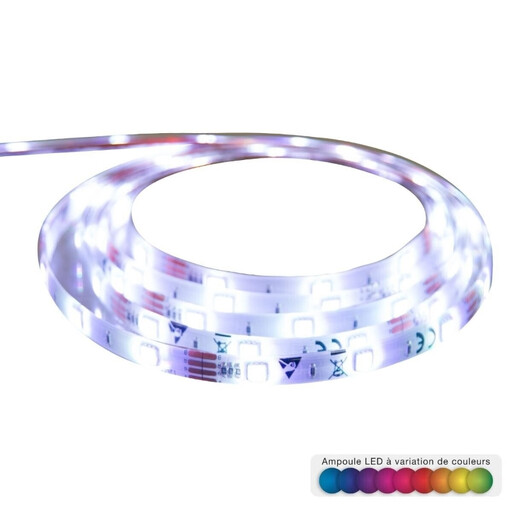
Why this product suits this profile: This 5-metre strip is described as coming with a power supply and infrared remote control. It’s suitable for indoor use on shelves, stair handrails or a TV wall.
The product details clearly state the strip length, power supply and remote control. This makes it easier to gauge the installation requirements before you buy.
5 m length, 150 LEDs, 230-volt mains operation and IR remote control, according to the product description.
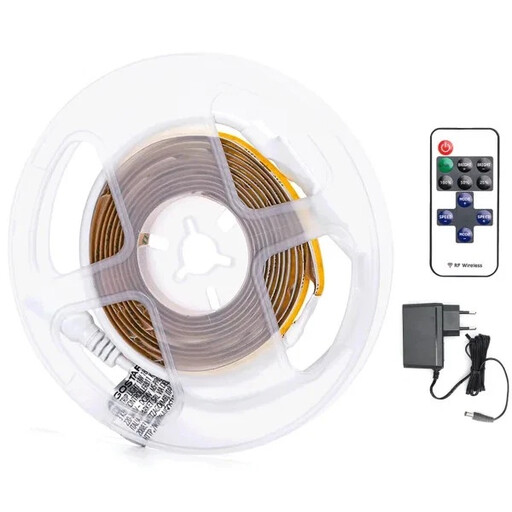
Why this product suits this profile: This warm white COB LED strip is designed to provide even indoor lighting, with clearly specified technical details.
The product details specify 24-volt DC, 18 watts, 3,000 kelvin, 1,800 lumens and IP20. This makes it easier to check that the location and connection requirements are suitable.
COB technology, 2 m length, 140-degree beam angle and a stated colour rendering index of Ra≥80.
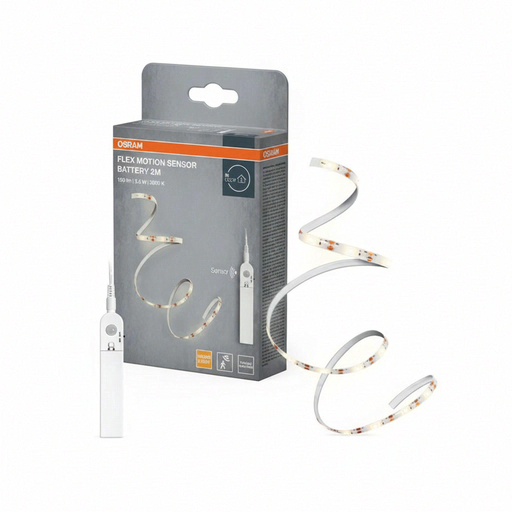
Why this product suits this profile: This 2-metre light with motion sensor is designed to switch on automatically in cupboards, hallways or other secondary spaces.
A motion sensor means you don’t have to switch the light on manually each time. Before installation, make sure the sensor’s detection range suits the location.
2 m length, white light and integrated motion sensor, according to the product name.
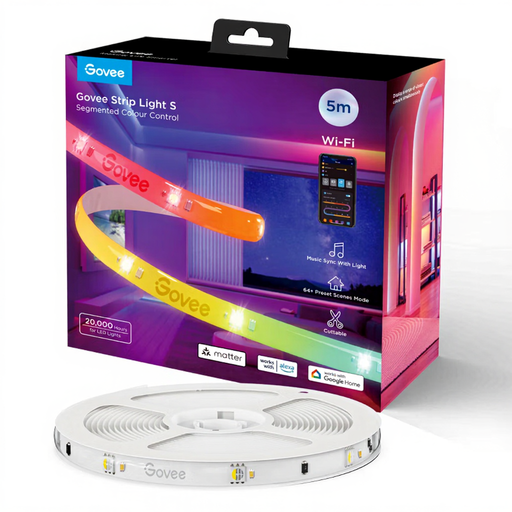
Why this product suits this profile: This 5-metre system combines RGBIC segment control with Wi-Fi, Bluetooth, app control and Matter support for compatible smart home setups.
The product details explicitly state that it’s for indoor use, with a power rating of 24 watts and 24-volt DC. This helps you check that the location and power supply are suitable.
RGBIC segment control, 5 m length, protective coating, plus Wi-Fi, Bluetooth and Matter support, according to the product description.
We’ve put together a complete, regularly updated list of products that meet these strict selection criteria and comply fully with the safety regulations in force in the EU.
The surface should be dry, clean and as smooth as possible. Lay the strip without stretching it, using gentle curves. Before cutting it, check for marked cutting points. Keep the power supply and controller accessible. Don’t leave a coiled strip switched on for extended periods.
Its lifespan depends on LED quality, heat dissipation, how long it’s used and the power supply. A lifespan stated by the manufacturer is a guide, not a guarantee for every installation. Overheating, moisture and physical damage can shorten the product’s lifespan.
The key factors are its power consumption in watts, daily usage time and your electricity price. A 5-metre strip with a higher power rating will use more energy than a shorter LED light bar if they’re used for the same amount of time. For a realistic estimate, check the wattage of the specific model and your own tariff.