
Lieferung heute & morgen

Qualitätsgarantie

Willkommens-Angebote freischalten: KOSTENLOSE Lieferung | Bis zu 80 % RABATT | Kostenlose 30-Tage-JoyPlus-Testphase
App herunterladen
An LED strip with music sync can completely transform a room's atmosphere. Whether for immersive gaming room lighting, dynamic party lights, or atmospheric indirect TV lighting, lights that pulse to the beat of the music create a unique experience. However, the market is flooded with products whose promises often don't match reality.
As your Joybuy Product Recommendation Officer, I'll help you identify the common pitfalls and make an informed decision. We'll focus on the objective features that truly matter.
Many buyers are disappointed after a short time because basic functions don't work as expected. Watch out for these three weaknesses to avoid a bad buy:
To avoid these problems, you should focus on a few core technical parameters. These determine the performance and longevity of your lighting system.
The control method defines the user experience. A simple LED strip with a remote control (usually infrared) is the most basic option. It typically offers only fundamental colour changes and mode settings and requires a direct line of sight to the receiver.
A light strip controllable via an app through Bluetooth or Wi-Fi offers significantly more flexibility.
Models that offer both options are often a great choice, as the remote serves as a quick and easy alternative to the app.
The LED strip's ability to react to music depends on the quality and placement of the microphone.
For reliable and straightforward synchronisation, a system with a high-quality, integrated microphone is usually the more practical solution.
Not all RGB LED strips produce the same lighting effect. A crucial factor is the LED density, which is the number of LEDs per metre.
Furthermore, it's important that the LED strip is dimmable. This feature allows you to adjust the brightness to suit any situation—from bright task lighting to soft mood lighting.
Here are some products tailored to specific needs that meet the quality criteria mentioned above.
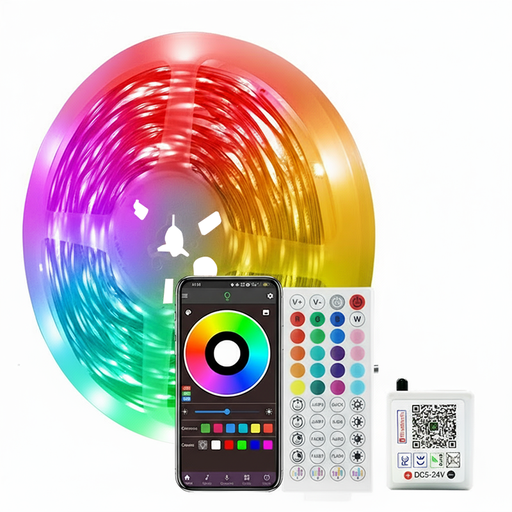
Why This Fits Their Persona: Ideal for beginners or smaller projects like lighting a desk or TV stand. The 5-metre length is sufficient for creating accents without being overwhelming.
It offers dual control via an app and a 40-key remote, reducing reliance on a potentially buggy app. The music sync mode is directly integrated.
Excellent value for money. The combination of app control, a remote, and music mode provides a solid feature set for getting started.
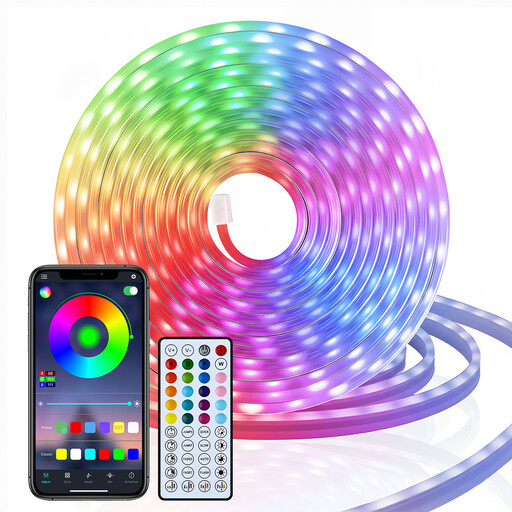
Why This Fits Their Persona: Perfect for professional-looking gaming room lighting. The neon design provides a diffuse, dot-free light that looks great on camera. With a length of 10 metres, it can cover larger areas.
The silicone casing creates a high-quality, uniform light, avoiding the "dotted" look of cheaper strips. The integrated microphone ensures direct and responsive music synchronisation.
The flexible neon construction allows for creative shapes and installations. Control via app and remote offers maximum control over effects and colours.
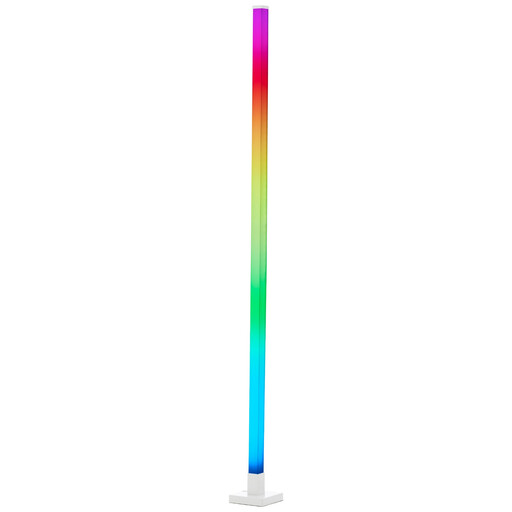
Why This Fits Their Persona: For anyone who wants dynamic lighting but doesn't want to stick strips to walls or furniture. This floor lamp is a standalone, mobile solution for living rooms or party spaces.
As a floor lamp, it completely bypasses the problem of poor adhesive strength. The integrated music sensor and included remote form a closed, perfectly matched system.
Simple installation (just set it up and plug it in). The modern, slim design blends well with various interior styles and acts as a decorative element itself.
We have compiled a complete, up-to-date list of products that fully meet these strict selection criteria and German safety regulations.
How exactly does music synchronisation work on LED strips? Most LED strips with this feature have a small microphone built into the controller. It picks up ambient sounds, and a processor converts the sound waves into light commands. Depending on the mode, the lights react to the rhythm, volume, or frequency of the music. Alternatively, some systems use the connected smartphone's microphone via an app.
Can you cut an LED strip and still use it? Yes, most LED strips can be shortened. They have designated cut marks, usually after every third or sixth LED. It is crucial to cut only at these marks, as doing otherwise will break the circuit and render a segment of the strip unusable. The cut-off portion generally cannot be reused without special accessories (connectors and a separate power supply).
What is the difference between RGB and RGBIC LED strips? Standard RGB LED strips can only display one colour at a time across their entire length. While you can change the colour, the whole strip will light up uniformly. RGBIC (Independent Control) strips have an additional IC (Integrated Circuit) chip that allows multiple colours to be displayed on different segments of the strip simultaneously. This enables more dynamic effects like rainbow gradients or chasing light animations.