
Lieferung heute & morgen

Qualitätsgarantie

Willkommens-Angebote freischalten: KOSTENLOSE Lieferung | Bis zu 80 % RABATT | Kostenlose 30-Tage-JoyPlus-Testphase
App herunterladen
LED strips are ideal for indirect lighting on shelves, cupboards, televisions, worktops or gaming desks. Depending on the model, they can be controlled via remote control, app, voice commands or USB. However, the differences between a basic LED light strip and a smart solution go beyond colour and price.
Anyone who focuses solely on a high number of LEDs or a wide range of colours often overlooks important details. Our buying guide explains which LED strip specifications matter before you buy and which products are suitable for different use cases.
A 5 m LED strip sounds sufficient for many applications. However, before ordering, you should measure the distance along furniture, walls or your TV precisely. The power supply, connecting cable and corners also require space. A strip can only be shortened at the marked cut points provided for this purpose.
Power supply is also important for longer runs. A power supply that is too weak or unsuitable can cause operating problems. Always use the supplied power supply or a model expressly approved by the manufacturer.
A classic RGB LED strip creates colours from red, green and blue. Depending on the model, white may only be produced by mixing colours. An RGBCCT or Tunable White LED strip also offers adjustable shades of white, ranging from warm light to cooler daylight.
RGBIC LED strips can display different colours in individual sections. This creates colour gradients or running-light effects. However, this function is not available on every model and usually requires a compatible app or control box.
Many LED light strips have an IP20 rating and are designed for dry indoor areas. They are not suitable for splashing water and should not be installed in bathrooms, on terraces or in areas with high humidity. Models with an IP44 rating offer greater protection against splashing water, but they are not automatically suitable for immersion in water.
A self-adhesive backing will not hold permanently on every surface either. Dust, grease, textured wallpaper and moisture can impair adhesion. For reliable installation, the surface should be clean, dry and as smooth as possible.
Check that the desired length fits the area and that the LED strip can be shortened at the marked points. When routing the strip around curves, do not bend it sharply directly at the LEDs. A gentle bending radius reduces mechanical strain on the tracks.
A self-adhesive LED strip is practical for smooth furniture surfaces. On delicate walls, mounting clips or a separate profile may be a more suitable solution. An aluminium profile can also help dissipate heat, provided it is designed for the product in question.
Colour temperature is measured in Kelvin:
Brightness is measured in lumens. An LED strip with 300 lumens produces a different amount of light from a compact USB LED light with around 150 lumens. Decorative background lighting often requires less brightness than a worktop.
A dimmable LED strip lets you adjust the light to suit the time of day and how it is being used. Check whether dimming is controlled via remote control, app or voice commands.
An LED strip with a remote control usually works without Wi-Fi and is quick to set up. Wi-Fi LED strips, on the other hand, often offer schedules, scenes and app control. If you want to integrate the strip into a smart home, check which platforms it supports.
Matter LED lighting can simplify integration with compatible systems such as Apple Home, Google Home, Amazon Alexa or Samsung SmartThings. However, setup requirements, the app needed, 2.4 GHz Wi-Fi and the presence of a smart home hub may vary depending on the product. The relevant manufacturer's specifications remain decisive.
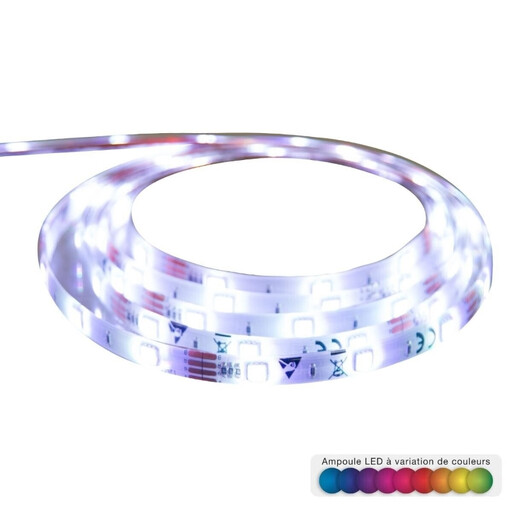
Why this product suits this profile: This set combines a 5 m length, mains operation and an infrared remote control. It is suitable for shelves, stair railings or the back of a television when app connectivity is not required.
The product details explicitly state the length, 150 LEDs, 22 W, 230 V mains operation and IP20 rating. This makes it easier to assess whether it is suitable for dry indoor areas in advance.
5 m length, self-adhesive backing and IR remote control; not networked, so it can be used without smart home setup.
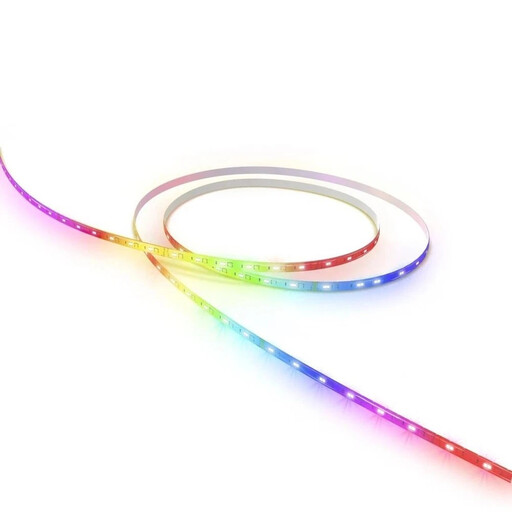
Why this product suits this profile: This model combines RGBCCT, stepless dimming and Matter compatibility. It is aimed at users who want to manage light colour, brightness and automations centrally.
The specifications indicate 2,700 to 6,500 K, IP20, marked cut points and a direct connection to 2.4 GHz Wi-Fi. This means its use is limited to dry indoor areas.
Matter, Apple Home, Google Home, Samsung SmartThings, Alexa and Home Assistant are listed as compatible systems; 5 m length and self-adhesive installation.
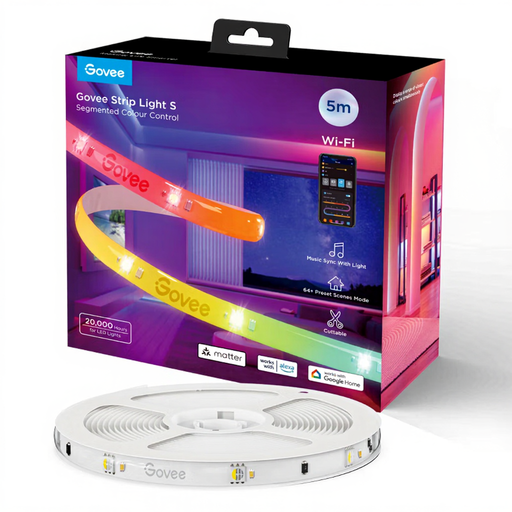
Why this product suits this profile: RGBIC segment control, Bluetooth, Wi-Fi and Matter appeal to users who want to manage dynamic effects for their TV, gaming setup or media area.
The specifications state 24 W, 24 V DC, 2.4 GHz Wi-Fi and a protective coating. The product is designed for dry indoor areas and should not be left rolled up while in use.
RGBIC with multiple colours along the strip, Matter support, plus app, voice and music control according to the product description.
For cupboards, mirrors or small shelves, a compact solution may be more practical. According to the product description, the 42 cm USB light has an integrated 2,000 mAh battery, 4,000 K neutral white light and around 150 lumens. For larger cupboard areas, the 60 cm USB light offers motion detection, magnetic mounting, 6,000 K and a stated battery life of around 4.5 hours. Both models are designed for indoor use.
We have put together a complete, regularly updated list of products that fully meet these strict selection criteria and the safety regulations applicable in the EU.
First, clean the surface to remove dust and grease, then allow it to dry completely. Apply the strip without pulling it taut and avoid sharp bends. On rough or delicate surfaces, profiles or mounting clips may be more suitable than the factory-applied adhesive tape.
Consumption depends on the length, type of LED, brightness and power supply. The available product specifications include, for example, 12 to 18 W for a 5 m RGB set, 22 W for another 5 m model and 24 W for an RGBIC strip. For running costs, the actual operating time is the key factor. You can relate the consumption in watts to the usage time and your electricity tariff.
It is not possible to give a reliable general lifespan without specific information from the manufacturer. Heat, continuous operation, frequent bending, moisture and an unsuitable power supply can affect service life. Install the strip according to the instructions, keep ventilation areas clear and switch it off when you are away for an extended period.