
Lieferung heute & morgen

Qualitätsgarantie

Willkommens-Angebote freischalten: KOSTENLOSE Lieferung | Bis zu 80 % RABATT | Kostenlose 30-Tage-JoyPlus-Testphase
App herunterladen
An LED table lamp should provide enough light for your desk, avoid glare on your bedside table and complement your living room décor. But it’s often only after buying one that you find out whether its controls, power supply and light distribution really suit your everyday needs. So, particularly when an offer includes lots of features, it’s worth taking a closer look at the technical specifications.
Wattage describes power consumption, not the amount of light produced. For brightness, the key measurement is lumens (lm). For example, a 7-watt desk lamp may provide around 360 lm according to its product specifications, while an 8-watt LED table lamp may produce around 400 lm. For focused work, the position of the lamp head, light distribution and adjustability also matter.
With a touch table lamp, ‘dimmable’ can mean several things: preset brightness levels, stepless dimming or a combination of a touch panel and rotary control. If you often switch between reading, working and more relaxed lighting, check the number of brightness levels or the specified dimming range.
A cordless table lamp needs to be recharged regularly. Battery life is usually quoted for a particular brightness setting, and may be shorter at higher light output. A battery-powered lamp is often enough for a bedside table or decorative lighting; a mains-powered option may be more practical for a workspace you use every day.
For reading and office work, clear technical specifications are more useful than vague marketing claims. Look for:
A desk lamp with adjustable colour temperature is a good choice if you want to switch between focused work and warm white light in the evening. For a bedside lamp, compact dimensions and a low, comfortable brightness setting are more important.
A mains-powered LED table lamp provides a constant power supply. Check that the cable is long enough and that there’s a suitable socket where you plan to put it. A rechargeable table lamp should specify its battery capacity, charging port and run time. USB-C is convenient for everyday use, while a built-in USB port on the lamp can be used to charge compatible devices.
For products intended for balconies or patios, the stated conditions of use are also important. ‘For dry outdoor areas’ doesn’t mean the lamp is waterproof. Avoid exposure to damp, rain and splashes, as set out in the product description.
A table lamp should sit on a flat, stable surface. Glass and metal designs can be decorative, but need to be placed securely. In homes with children or pets, consider a stable base, protected controls and keeping the lamp away from water and heat sources.
A flameless LED lamp doesn’t have an open flame, but you should still follow the instructions regarding the battery and heat build-up. Don’t cover or dismantle the lamp, or immerse it in water.

Why this product suits this type of user: This compact black lamp is designed for desks, living areas or bedrooms, and combines touch controls with a charging function.
The product specifications give its power as 8 W, light output as around 400 lm, and describe it as offering warm white light and touch dimming. This gives you key details for comparison.
USB charging port, touch controls and 220–240 V mains power; according to the product specifications, it’s designed for indoor use only.
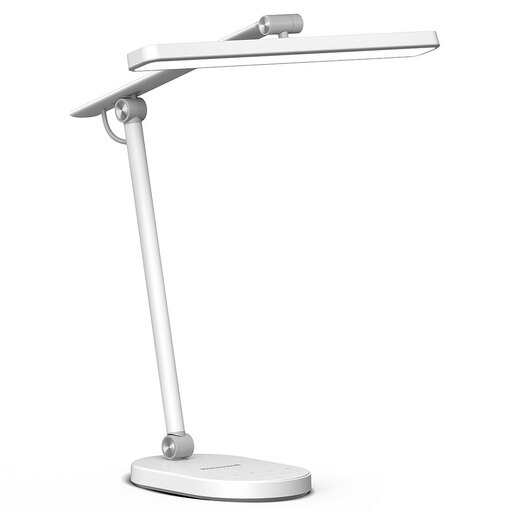
Why this product suits this type of user: For longer reading or working sessions, the lamp offers several adjustable lighting options and automatic adjustment, according to the product description.
Rather than simply saying ‘dimmable’, the specifications list five brightness levels and three colour temperatures, from 3000 to 5000 K.
700 lm, adjustable arm and lamp head, a 60-minute timer and a CRI of 97 according to the manufacturer.
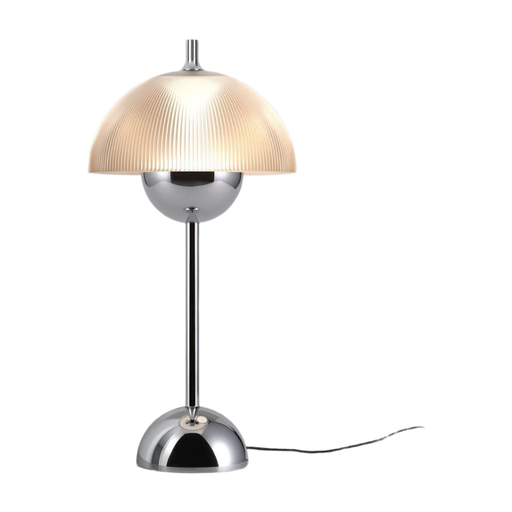
Why this product suits this type of user: Its compact design and transparent, ribbed shade make it suitable for a bedside table, shelf, bedroom or home office.
A set colour temperature of 3000 K and four touch settings make the lighting easier to understand than a design description alone.
Mains-powered, with four-level touch dimming and a memory function according to the product description.

Why this product suits this type of user: This rechargeable table lamp can be placed without a mains cable in the bedroom, living room, hallway or on a dry patio.
The product specifications list a built-in 4000 mAh battery, ten dimming levels and up to 160 hours of use at the lowest brightness setting.
Cordless operation, rotary control, several lighting effects and, according to the product description, use on dry outdoor surfaces.
We’ve put together a complete, regularly updated list of products that meet these strict selection criteria and fully comply with the safety regulations in force in the EU.
Consumption depends on the wattage and how long you use the lamp. An 8-watt lamp running for five hours a day uses 40 Wh per day. To work out the actual cost, multiply the energy used by your electricity rate. If you use the lamp on a dimmed setting, consumption may be lower, depending on the model and technology; check the manufacturer’s specifications for details.
For reading, you’ll need enough light in lumens, a well-directed beam and a suitable colour temperature. An adjustable desk lamp with several brightness settings can be more versatile than a purely decorative light. Position the lamp so that your hand or the edge of the book casts as little shadow as possible.
Its lifespan depends on the LED module, heat dissipation, how long it’s used and the quality of its construction. Some product descriptions state that the LED module can last up to 50,000 hours. This is a manufacturer’s estimate and doesn’t necessarily reflect the lifespan of the whole product or its built-in battery. If you’re buying a rechargeable table lamp, you should also consider how often you’ll need to charge and use the battery.