
Lieferung heute & morgen

Qualitätsgarantie

Willkommens-Angebote freischalten: KOSTENLOSE Lieferung | Bis zu 80 % RABATT | Kostenlose 30-Tage-JoyPlus-Testphase
App herunterladen
An LED table lamp can be used on your desk, bedside table, in the living room or when camping. The choice ranges from a simple reading lamp to a multifunctional lamp with a battery, touch control, RGB colours or wireless charging. It's this very variety that makes comparison difficult: not every advertised extra feature is actually useful for your needs.
With LED lights, the wattage mainly describes energy consumption. For actual brightness, the luminous flux in lumens (lm) is what matters. A lamp with 400 lm is noticeably brighter than a model with 30 lm, even if the design and power consumption look similar.
For a decorative LED bedside lamp, a few lumens are often enough. For reading or working, higher values and a well-directed light source are more practical.
The stated battery life depends on the brightness level, light colour and charge status. A battery-powered table lamp can last significantly longer on a low setting than at full brightness. So check:
A cordless table lamp is especially handy when the plug socket is far away. For a fixed workstation, however, a mains connection may be sufficient.
Touch controls, RGB modes, Bluetooth speakers or Qi charging pads expand the range of functions, but they don't replace a decent basic light. What really matters is stability, light distribution, ease of use and the build quality of any moving parts.
Luminous flux is given in lumens. For a reading lamp on your bedside table or desk, the lamp should illuminate the desired area precisely without causing too much glare. An adjustable neck or a movable lamp head makes positioning easier.
Colour temperature is given in Kelvin (K):
A CRI or Ra value of at least 80 is considered a good benchmark for natural colour rendering. The Aigostar Clip Lamp, for example, states Ra≥80.
A dimmable LED table lamp should offer several clearly distinct brightness levels or allow stepless adjustment. For a bedside table, a low setting is helpful, while reading may require higher brightness.
Also check whether the lamp only adjusts brightness or colour temperature too. The Aigostar Battery Table Lamp offers three colour temperatures: 3000 K, 4000 K and 5000 K. An RGB table lamp, on the other hand, is mainly for coloured accent lighting; RGB colours aren't automatically suitable for focused reading.
A heavy or wide base reduces the risk of tipping over. For small desks, a clip-on lamp can be more practical because it doesn't take up any surface space. Before buying, check the maximum desktop thickness and the reach of the lamp arm.
For camping or use near liquids, the stated IP rating is relevant. The IP54 rating on one of the Aigostar models mentioned refers to the specific product protection and shouldn't be mistaken for full waterproofing. Always refer to the instruction manual and safety notes.

Why this product fits the profile: This compact battery-powered table lamp is designed for bedside tables, shelves, sideboards or small desks and doesn't need a plug socket to operate.
The specifications state 210 lm, 3000 K and a three-step touch dimmer. This makes it easier to judge the choice objectively than by relying on wattage alone.
210 lm, 2 W, warm white 3000 K lighting, USB rechargeable battery and 21 cm height.

Why this product fits the profile: This flexible LED desk lamp offers adjustable colour temperatures and a greater brightness reserve for reading, working and changing room moods.
The product data states 400 lm, three colour temperatures and two batteries of 1800 mAh each. This means the key selection criteria are clearly documented.
400 lm, 4 W, 3000/4000/5000 K, touch dimming, flexible neck and USB charging cable.
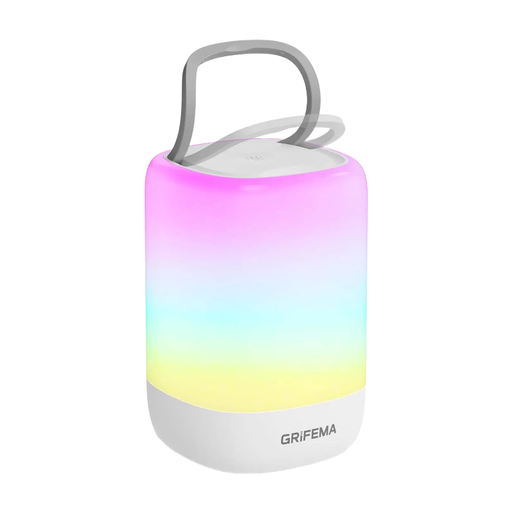
Why this product fits the profile: This compact model is designed for bedrooms, children's rooms, camping and mobile use, combining white light with RGB modes.
Operation is via touch: brightness is adjustable from 100% down to 5%, plus there's a 30-minute timer. This makes the functions easy to verify.
USB-C charging, 1500 mAh battery, seven RGB colours, dimming and a stated weight of 0.27 kg.
We've put together a full, regularly updated list of products that fully meet these strict selection criteria and the safety regulations in force in the EU.
That depends on the distance, the lampshade and the desired coverage. For decorative lighting, lower values are often sufficient. For reading or working, models with a higher luminous flux and an adjustable lamp head are usually more suitable. Glare can be reduced by positioning the lamp to the side and using a diffuser.
The runtime depends on the battery capacity and brightness level. As a concrete guide, the Aigostar Clip Lamp states 3 to 30 hours depending on the setting. The Grifema lamp states up to 15 hours. These figures are manufacturer estimates and can change with age, temperature and usage.
You can estimate the running costs with this calculation: Power in watts × hours of use ÷ 1000 × electricity price per kilowatt-hour. For a 4 W lamp used for two hours a day, that works out at 0.008 kWh per day. For your own calculation, use your current electricity tariff. For battery models, there's a small additional charging consumption.