
Lieferung heute & morgen

Qualitätsgarantie

Willkommens-Angebote freischalten: KOSTENLOSE Lieferung | Bis zu 80 % RABATT | Kostenlose 30-Tage-JoyPlus-Testphase
App herunterladen
An LED table lamp should help you work with focus, provide enough light for reading or add a decorative touch, depending on where you use it. Many models look similar at first glance, but can differ considerably in light output, power supply and controls. If you focus only on the design or a high wattage, you could end up with a lamp that’s too dim for your desk, too bright for your bedside table or impractical for everyday use.
Power consumption in watts tells you how much electricity a lamp uses, not directly how much light it produces. For brightness, the key figure is luminous flux in lumens. An LED desk lamp with 400 lm is a different proposition from a decorative table lamp with 105 lm. The latter may be suitable for accent lighting or as a subtle bedside lamp, but it won’t necessarily replace a task light.
A fixed light colour won’t suit every situation. Warm white light is often used as a pleasant accent in a living room or bedroom, while more neutral or cooler light can provide clearer illumination at a desk. Look for the figure in Kelvin (K) and check whether the colour temperature can be adjusted.
A battery-powered table lamp can be moved around easily, whether you’re using it on a side table or balcony, but it needs regular charging. With a USB table lamp, check whether a mains adaptor is included or whether you’ll only get a USB cable. The product description should also tell you whether you can use the lamp while it’s charging.
When choosing an LED table lamp, compare at least these three details:
A touch table lamp can be easier to operate, but touch controls don’t tell you how much light the lamp actually produces. Touch controls and dimming are not necessarily linked, either.
If you’re choosing a table lamp with a charging function, there are three types to consider:
If the lamp has an integrated LED light source, bear in mind that you may not be able to replace it yourself. Information about the ingress protection rating and indoor use can help you choose a lamp that’s suitable for where you plan to put it.
Measure the space available before you buy. Compact models with a narrow base fit on small bedside tables or shelves, while an LED desk lamp with an adjustable arm needs more room and space to move. For children’s rooms, bathrooms or outdoor areas, check the manufacturer’s guidance on use and the ingress protection rating. A lamp designed for indoor use without the appropriate rating shouldn’t be used in damp or unprotected areas.
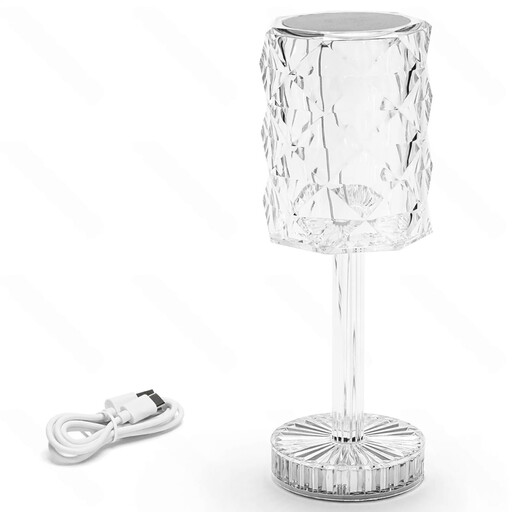
Why this product suits this profile: This compact lamp is designed for decorative use, bedside tables and smaller surfaces. It offers three adjustable colour temperature settings between 2700 K and 6500 K and runs via USB at 5 V.
The product details specify both the light output of 105 lm and the colour temperature. This makes it easier to see that the lamp is primarily intended for accent and mood lighting.
Compact dimensions of 90 × 260 mm, a USB connection and three colour temperature settings.

Why this product suits this profile: This model combines a stated power rating of 8 W with around 400 lm, touch controls, dimming and a USB charging port. It’s a good fit for a permanent workstation or bedside table with access to a power socket.
The product description specifies the light output, dimming function and power supply. You don’t have to rely on wattage alone or a vague promise about the design.
Touch dimming, around 400 lm and a built-in USB charging port in a compact indoor lamp.
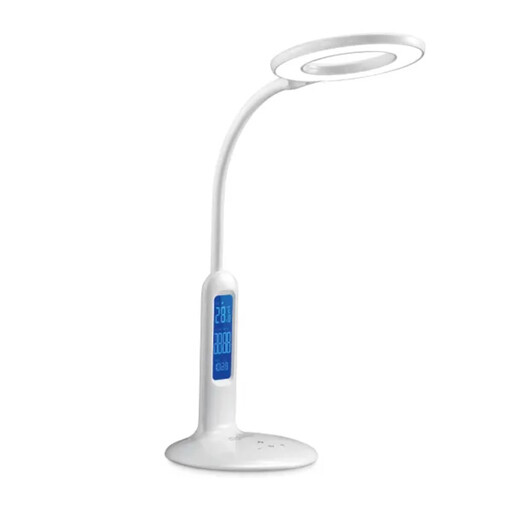
Why this product suits this profile: This LED desk lamp is for anyone who wants to combine lighting with extra features at their workstation or bedside table. It offers 7 W, around 360 lm, an adjustable arm and a colour temperature range from 2700 K to 6500 K.
The adjustable colour temperature and arm make it easier to position the lamp for different tasks and viewing angles. You can adjust the brightness using the touch panel.
CCT range from 2700 K to 6500 K, touch dimming, adjustable arm, and clock, date and temperature display.
We’ve put together a complete, regularly updated list of products that meet these strict selection criteria and the safety regulations in force in the EU.
Lower values may be enough for decorative lighting or a subtle ambient glow. For reading and focused work, the size of the room, the distance from the work surface and the position of the lamp all matter. So compare the stated light output in lumens, not just the power consumption in watts.
Its lifespan depends on factors including how long it’s used, heat dissipation, power supply and design. With built-in LEDs, you may not be able to replace the light source separately. Treat the manufacturer’s lifespan figures as a technical guide, rather than a guarantee of how long the lamp will last in use.
Power consumption depends on the lamp’s wattage and how many hours you use it each day. A 1 W lamp uses less electricity than an 8 W model over the same period. A battery-powered table lamp also loses some energy during charging. For a fair comparison, consider the power rating, how often you’ll use the lamp and how bright you need it to be.