
Lieferung heute & morgen

Qualitätsgarantie

Willkommens-Angebote freischalten: KOSTENLOSE Lieferung | Bis zu 80 % RABATT | Kostenlose 30-Tage-JoyPlus-Testphase
App herunterladen
An LED table lamp should light your room appropriately, use little energy and fit reliably into your everyday routine. Yet some buying decisions can lead to problems later: the lamp is too bright on your bedside table, it doesn’t have a USB port, the sensor responds inconveniently or the design takes up more space than expected.
This buying guide from the Joybuy Product Recommendation Officer takes an objective look at the key features. It covers more than just appearance, looking at light output, colour temperature, controls, power supply and where you plan to use the lamp.
Colour temperature is measured in Kelvin (K). A warm-white table lamp at around 2700 to 3000 K gives off a warm, yellowish light and is often a good fit for a bedroom, living room or bedside table. Values around 4000 K look more neutral and are better suited to a desk or home office. At 6500 K, the light is a much cooler white. This can work well for lighting your way, but may not feel comfortable for everyone beside the bed.
A higher Kelvin value doesn’t automatically mean brighter light. For that, the key measurement is luminous flux, expressed in lumens (lm).
A dimmable table lamp is useful if it has several clearly defined brightness settings. If you’re considering a touch-controlled table lamp, check whether the touch function actually adjusts the brightness or simply switches the lamp on and off.
A memory function is only useful if the lamp returns to your last brightness setting when you switch it on. It’s also worth bearing in mind that the light source in a lamp with integrated LEDs can’t usually be replaced easily.
Before buying, check the lamp’s height, diameter and cable routing against the space available. A decorative table lamp with a wide base can quickly get in the way on a small bedside table. A USB table lamp also needs a suitable power source: a USB mains adaptor, computer, power bank or USB hub may not be included.
For hallways, stairs or children’s bedrooms, a plug-in night light is often more space-saving than a freestanding table lamp.
The lumen value describes the light output. An orientation light with 8 to 40 lm is intended for pathways and areas around sockets, not for focused reading. A desk lamp should light your work area evenly and minimise glare.
The beam angle can also help you assess how the light will spread. An angle of 120 degrees distributes light relatively widely. For a bedside lamp, a diffusing cover is useful, as it helps prevent visible points of light from shining directly into your eyes.
For a bedroom or children’s bedroom, a lamp with a colour temperature of 2700 to 3000 K is often a good choice. A more neutral setting of around 4000 K may be more suitable for a desk. If the lamp has adjustable colour temperature, you can tailor the lighting to different situations.
The CRI or Ra value describes colour rendering. The products featured here specify a value of Ra ≥ 80, which means colours indoors appear more true to life than they would under a light source with no stated rating.
IP20 is a common rating for indoor use. It means the product is intended for dry indoor areas and is not protected against water. An IP20 night light should therefore not be used close to a sink, shower or damp outdoor area.
For mains-powered products, check for a 220–240 V rating and a suitable EU plug. A USB model rated at DC 5 V uses low voltage, but still needs an appropriate power supply. Don’t cover a lamp while it’s switched on, and keep it clear of covers, fabrics and paper.
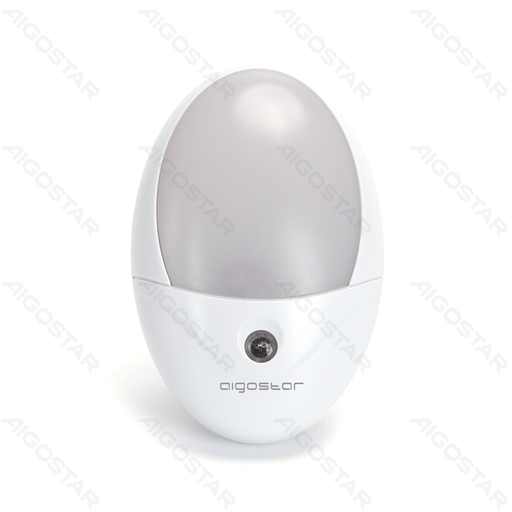
Why it’s a good fit: This compact plug-in model needs no batteries or charging. It switches on automatically when it detects movement in a dark room. With 3000 K and 20 lm, it’s designed to provide orientation lighting in hallways, on stairs or in bedrooms.
The specifications clearly state the sensor type, detection range of up to 7 m, 120-degree beam angle and IP20 rating. This makes it easier to decide where to use the light before you buy.
PIR motion sensor, warm-white 3000 K light, 1 W power consumption and direct operation from a 220–240 V socket.
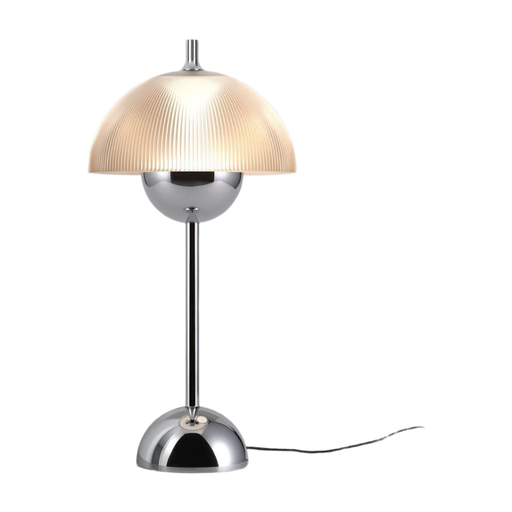
Why it’s a good fit: This compact LED table lamp combines a transparent, ribbed cover with four brightness settings and touch controls. It’s designed for use on a bedside table, shelf, in the living room or in a home office.
The brightness isn’t described with a vague marketing term: you can adjust it across four settings. The integrated LED emits light at 3000 K and is intended for dry indoor spaces.
Four-level touch dimming, memory function, warm-white light and a 360-degree lighting effect from the transparent cover.
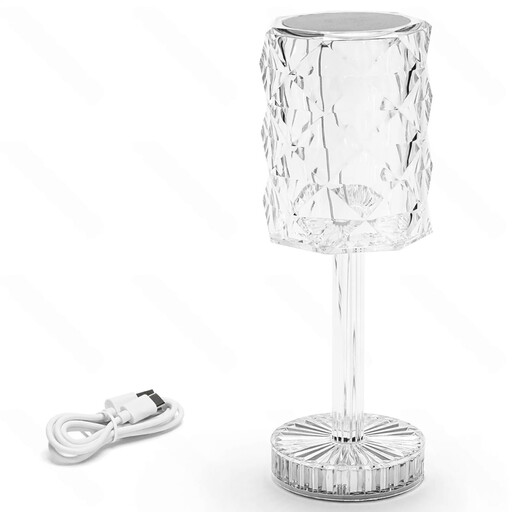
Why it’s a good fit: You can connect this USB table lamp to a laptop, power bank, USB mains adaptor or computer. With 105 lm and an adjustable colour temperature of 2700 to 6500 K, it offers flexible placement on a table, shelf or bedside table.
The power supply is clearly specified as DC 5 V via USB. The adaptor isn’t included, so you can plan for this extra purchase before you buy.
Three light colour ranges or CCT settings, 105 lm, 1 W power consumption and an integrated LED, so there’s no need to buy a separate bulb.
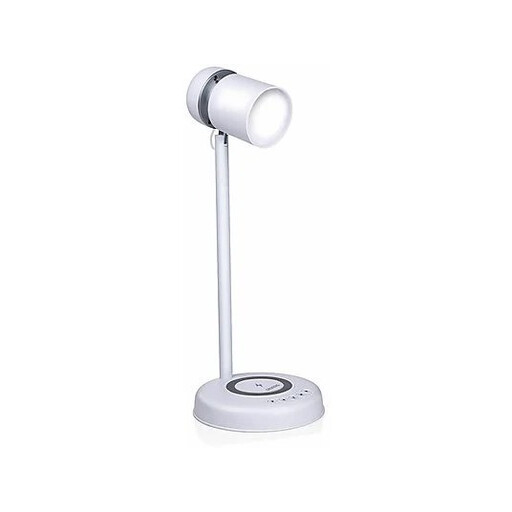
Why it’s a good fit: This desk lamp combines LED lighting with Qi charging, a Bluetooth speaker and USB-A and USB-C outputs. It’s designed for anyone who wants to bring several functions together in one workspace.
The extra features are clearly specified: Bluetooth 5 with a range of up to 10 m, 76 lm, a USB-C input and Qi technology. Before use, check that your smartphone is Qi-compatible.
Qi charging, a Bluetooth speaker, four lighting modes and USB-A and USB-C ports in one table lamp.
We’ve put together a complete, regularly updated list of products that meet these strict selection criteria and fully comply with the safety regulations in force in the EU.
It depends on how you’ll use it. Orientation lights often have a lumen output in the single or double digits. A desk lamp or reading light will benefit from a higher output. As well as the lumen value, consider how evenly the light is distributed and whether the lamp causes glare.
The manufacturer gives the lifespan in operating hours. Product specifications may list, for example, 10,000, 15,000 or 25,000 hours. Treat this as a guide: actual lifespan depends on factors such as heat build-up, operating time and how the lamp is used. With integrated LEDs, the light source usually isn’t designed to be replaced.
The cost depends on the lamp’s power, how long it’s used each day and your electricity tariff. A 1 W light uses 1 kWh for every 1,000 hours of operation. To work out your own costs, multiply the power consumption in watts by the operating hours and your price per kilowatt-hour. Sensor-based models switch on only when needed, while USB lights also depend on the efficiency of the connected power source.