
Lieferung heute & morgen

Qualitätsgarantie

Willkommens-Angebote freischalten: KOSTENLOSE Lieferung | Bis zu 80 % RABATT | Kostenlose 30-Tage-JoyPlus-Testphase
App herunterladen
An LED table lamp can light up your workspace, help you read or provide a decorative source of light. In practice, however, models vary considerably in brightness, colour temperature, controls and power supply. If you focus only on the design or a high wattage, you could end up with a lamp that causes glare where you plan to use it, provides too little light or lacks important features.
This buying guide explains which details to consider before buying a desk lamp, reading lamp or bedside lamp, and which models suit different needs.
Wattage mainly indicates power consumption, not the amount of light produced. Lumens are what determine brightness. For example, a 7 W LED table lamp might produce 360 lm, depending on its design, while another model with a similar power rating could appear quite different.
A moderate level of brightness is often enough for a small bedside table. For focused work, crafting or studying, however, lighting the desk surface should be the priority.
A dimmable table lamp is not automatically suitable for every situation. Warm white light may work well in a bedroom or living room, while neutral white or cooler light is often preferred at a desk. So check whether you can adjust just the brightness or also the colour temperature in kelvins.
A movable arm, gooseneck or swivelling lamp head gives you more ways to use a lamp. However, the design needs to stay stable and allow you to position the light precisely. With a clip-on lamp, you also need to check the maximum desk thickness it can accommodate. A weak or unsuitable fixing can cause the light to slip out of position.
Lumens (lm) indicate luminous flux. Watts (W) show the electrical power rating. Energy consumption in kilowatt-hours is also relevant to running costs. The simple calculation is:
Power rating in kW × hours of use = energy consumption in kWh
An 8 W lamp used for five hours a day consumes 0.04 kWh per day. The actual cost depends on your electricity tariff.
Colour temperature is measured in kelvins (K):
If you want colours to look as true to life as possible when drawing, sewing or crafting, the CRI or Ra value is also worth checking. A higher value indicates better colour rendering, according to the product specifications.
Touch controls can be handy if the lamp is within easy reach. Check whether the touch panel only switches the lamp on and off, or also offers stepless or multi-level dimming.
Depending on the model, a USB port may be for charging a device or solely for powering the lamp. These functions should not be confused. For USB-powered models, check the required voltage and current as well.
IP20 is a common rating for indoor use. It does not mean that the lamp is protected against water. An LED table lamp should be placed on a stable, dry surface and not covered. For lamps with replaceable bulbs, make sure the bulb type, fitting and maximum wattage are compatible.

Why this product suits this profile: This model offers a compact set of essentials for a desk, living area or bedside table. It has touch controls, and the built-in USB port lets you charge compatible devices.
The product specifications give both its power consumption of 8 W and a luminous flux of around 400 lm. This makes it easier to compare with other models than relying on wattage alone.
Touch dimming, warm white light, 8 W power rating and USB charging port.
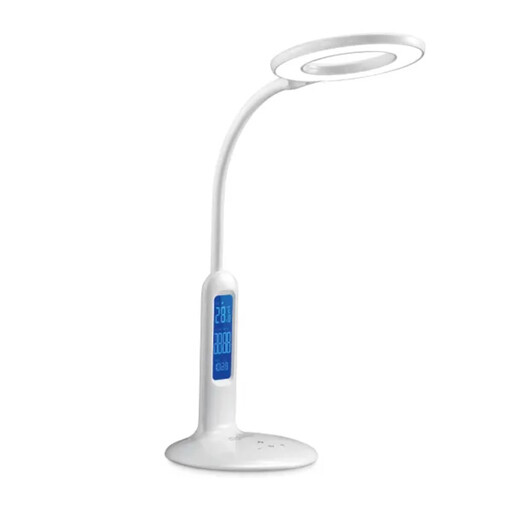
Why this product suits this profile: With adjustable colour temperatures from 2700 to 6500 K, this lamp is well suited to working from home, studying or reading. Its fully adjustable arm lets you direct the light where you need it.
You’re not limited to a single colour temperature. You can adjust both the brightness and colour temperature to suit the time of day and the task at hand.
7 W, around 360 lm, CCT adjustment from 2700 to 6500 K, touch dimming, plus calendar, time and temperature displays.

Why this product suits this profile: This battery-powered clip-on lamp is handy for small work surfaces, shelves, craft tables or anywhere without a nearby socket. Its flexible silicone arm lets you adjust the direction of the light.
The specifications state 160 lm, 4000 K and three brightness levels. This makes it easier to see that the lamp is intended as flexible supplementary lighting than with vague marketing claims.
1200 mAh battery, three brightness levels, flexible arm, 2.5 W power rating and clip-on fixing.
We’ve put together a complete, regularly updated list of products that meet these strict selection criteria and the safety regulations applicable in the EU.
For a small bedside table, a compact, warm white decorative table lamp is often more practical than a large task light. If space is limited, a clip-on lamp or monitor lamp may be a good choice. The latter attaches to your screen and should be positioned so that it does not shine directly into your eyes or onto the monitor.
For a living room or a large workspace, a dimmable floor lamp with a reading arm can complement an LED table lamp. For lamps with an E14 or E27 fitting, check whether the bulb is included. The Brilliant Hobby model, for example, takes a standard bulb, which may be sold separately.
It depends on how you plan to use it. Lower lumen levels are often enough for decorative or ambient lighting. For reading, writing and focused work, consider the area you need to light, the distance from the desk surface and whether you can adjust the brightness.
Its lifespan depends on the LED technology, how it is used, heat dissipation and build quality. Manufacturers may, for example, state a lifespan of 20,000 or 50,000 operating hours. These are technical specifications, not a guarantee that every household will get the same length of use.
LED lamps often have a comparatively low power rating. However, consumption depends on the wattage and how many hours a day the lamp is used. A 7 W or 8 W lamp used briefly will consume a different amount of electricity from one left on for many hours at a time.