
Lieferung heute & morgen

Qualitätsgarantie

Willkommens-Angebote freischalten: KOSTENLOSE Lieferung | Bis zu 80 % RABATT | Kostenlose 30-Tage-JoyPlus-Testphase
App herunterladen
An LED table lamp can serve as a bedside lamp, desk light or decorative mood light. But there are significant differences between models, from RGB functions and touch controls to USB-C charging and adjustable colour temperatures. If you choose based on design alone, it’s easy to overlook important details.
An RGB night light can display lots of colours, but that doesn’t automatically make it suitable for reading or working. Colour-changing effects and ambient lighting are usually the main focus. For a desk or any activity that needs more light, details such as lumens, colour temperature and dimming levels matter more than the number of colours.
A cordless table lamp needs either batteries or a built-in rechargeable battery. Runtime figures often refer to a particular brightness setting, so the actual usage time may be shorter at full power. Check whether the product details specify the battery capacity, charging time and runtime.
Glass, acrylic and plastic vary in weight, ease of cleaning and risk of breakage. A glass lamp, for example, may suit a sturdy chest of drawers, but it’s less practical in a child’s bedroom or if you move it around often. Many decorative models are also designed for dry indoor use only. To use one on a balcony or patio, the product description must explicitly say it’s suitable.
Lumens (lm) measure the amount of light emitted. A low lumen rating is more suited to a decorative LED lamp or night light. For reading, the lamp should be bright enough and ideally have a dimming function.
Colour temperature is measured in Kelvin (K):
A dimmable table lamp offers more flexibility if you want to use it both as a bedside lamp and as accent lighting. With RGB models, also check whether warm white light is available separately.
For a rechargeable lamp, battery capacity, charging time and the type of connection all matter. A USB-C port makes it easier to use cables and power adapters you already own. Still, check the input voltage, such as 5 V.
A table lamp powered by AAA batteries doesn’t need to be near a socket, but you’ll have the ongoing cost of replacement batteries. With a fixed USB power connection, there’s no need to recharge, but the lamp has to stay connected by cable.
Measure the space on your bedside table, shelf or desk before you buy. Compact models around 12 to 26 cm tall are suitable for smaller surfaces. For stability, a sufficiently heavy base and a non-slip underside are useful.
Also check the usage instructions:
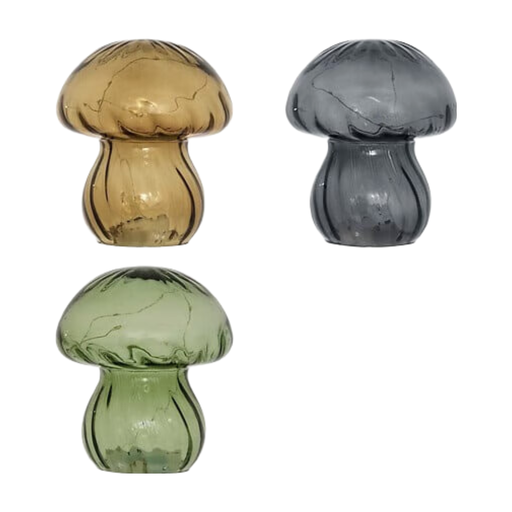
Why this product suits this type of buyer: Its compact mushroom shape makes it a decorative table lamp for a bedroom, living room or shelf. It runs on two AAA batteries.
The power source is clearly stated. There’s no built-in battery whose runtime could be difficult to assess before buying.
Glass construction, a height of 15.5 cm and soft LED light for decorative indoor spaces. Batteries are not included.
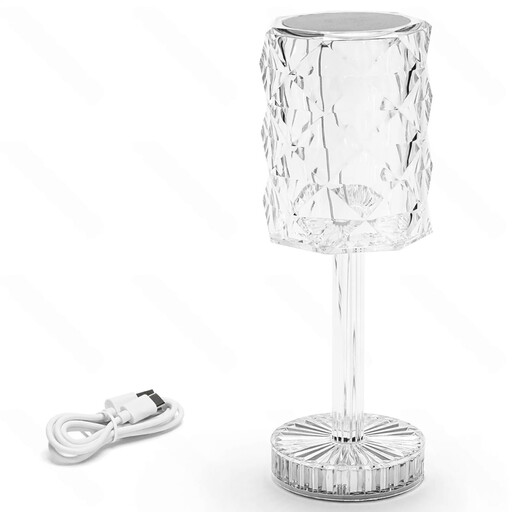
Why this product suits this type of buyer: This lamp combines a specified brightness with three colour temperature ranges and USB power. That makes it easier to choose for a desk, bedside table or shelf.
The product details specify 105 lm, 1 W and a range of 2,700 to 6,500 K. This gives you a clearer idea of the lighting than design details alone.
USB connection, integrated LED and compact dimensions: 90 mm in diameter and 260 mm tall.
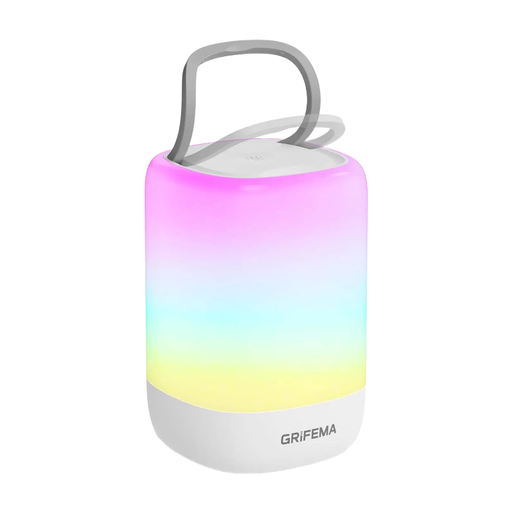
Why this product suits this type of buyer: This model is designed for bedrooms, children’s bedrooms, camping and flexible placement. It combines RGB colours, touch controls and a built-in rechargeable battery.
The description specifies USB-C, a 1,500-mAh battery and up to 15 hours of runtime. It also includes a dimming function and a 30-minute timer.
7 RGB colours, warm white light, stepless dimming from 5 to 100 per cent and a portable ABS/PC housing.
We’ve put together a comprehensive, regularly updated list of products that meet these strict selection criteria and fully comply with the safety regulations in force in the EU.
Warm white, dimmed light is usually a good choice for the bedroom. An LED bedside lamp with a timer or low brightness setting can be useful if you don’t want it left on continuously. In the living room, decorative design can take centre stage.
Colour-changing effects and USB power are useful in a gaming room or office, provided the lamp isn’t your only source of work lighting. On a balcony or patio, use only models whose product details clearly state that they’re suitable for the intended outdoor area. Simply describing a lamp as “portable” or “cordless” doesn’t mean it’s weatherproof.
Consumption depends on the lamp’s wattage and how long you use it each day. A 1 W lamp used for four hours a day would consume around 0.004 kWh per day. To calculate the exact cost, multiply the consumption by your electricity rate. Rechargeable models also use electricity when charging.
The lifespan of integrated LEDs depends on their design, heat dissipation and operating time. The product details should give a specific figure in hours. If the LED isn’t replaceable, you’ll usually need to replace the whole lamp if it fails. Bear this in mind before you buy.
For a bedside table, look for a compact base, warm white light, dimming levels and controls that are easy to reach. A cordless or rechargeable lamp means fewer cables on the surface. In a child’s bedroom, avoid glass models and easily accessible batteries, and follow the manufacturer’s safety instructions.