
Lieferung heute & morgen

Qualitätsgarantie

Willkommens-Angebote freischalten: KOSTENLOSE Lieferung | Bis zu 80 % RABATT | Kostenlose 30-Tage-JoyPlus-Testphase
App herunterladen
A small light should do more than simply look decorative. When choosing LED table lamps, the right brightness, a safe power supply and a suitable design all matter, depending on where the lamp will be used. If you choose based solely on colour or appearance, you may only discover after buying that the lamp is too dim, the cable gets in the way or the battery does not suit your usage habits.
A decorative table lamp does not need to illuminate an entire room. Relatively few lumens are enough for a small accent light. A reading lamp, however, needs more focused and sufficiently bright illumination. The lumen (lm) rating describes the luminous flux: the higher the value, the more visible light the lamp generally emits. Its actual suitability also depends on the beam angle, lampshade and distance from the surface being lit.
A cordless table lamp can run on a rechargeable battery or disposable batteries. With a rechargeable table lamp, you should check the charging time, stated runtime and charging source. A battery-operated table lamp, on the other hand, requires suitable replacement batteries. Claims such as ‘up to’ often refer to a low brightness setting and cannot automatically be applied to daily use at full power.
Glass, fabric and metal can define a lamp’s appearance, but they also affect its weight, cleaning requirements and light distribution. A small table lamp with a delicate glass shade may be suitable for an inaccessible side table, but less appropriate in an area where children often play. The base should also be proportionate to the height, so that the lamp is not easily knocked over.
For ambient lighting in the living room or as a decorative bedroom lamp, a gentle distribution of light is often sufficient. A dimmable LED lamp offers greater flexibility when switching between finding your way around, relaxing and reading. With a reading lamp, the direction of the light and the distance from the book are also important, in addition to the lumen rating.
Light colour is measured in Kelvin. Warm white light is typically found in the lower Kelvin range and is often chosen for bedrooms, bedside tables or cosy living areas. In children’s and baby lighting, the lamp should not be positioned directly at eye level. A low brightness setting can be more practical for finding your way around at night or changing a nappy than strong room lighting.
Check whether the model runs on mains power, USB, an integrated rechargeable battery or disposable batteries.
Lithium batteries should only be charged using the charging source specified by the manufacturer. Avoid moisture, sources of heat and damaged cables. Always consider the stated runtime in relation to the brightness setting being used.
The dimensions determine whether a lamp will fit on a bedside table, shelf or small side table. A height of around 10 to 20 cm is often suitable for compact surfaces, provided the base is stable.
An E27 table lamp has a socket designed for many commonly available light bulbs. Important details include the maximum power, mains voltage and whether a light bulb is included. One example is the Atmosphera Saba: it is designed for indoor use, operates at 230 V, has an E27 socket, features a mechanical switch and is not dimmable. According to the product details, the maximum power is 40 W; a light bulb is not included. The IP20 rating means that the model is not intended for areas exposed to splashing water.
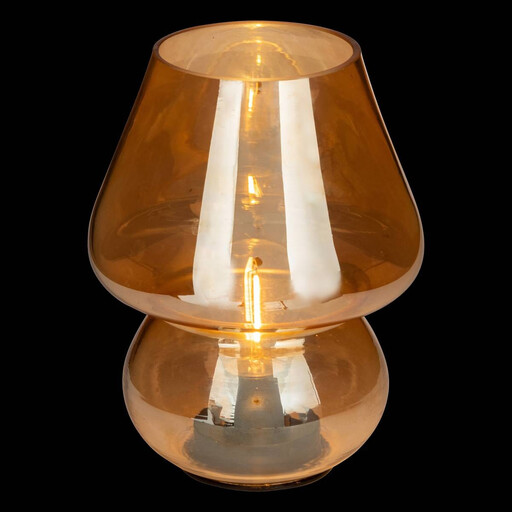
Why this product suits this profile: The compact glass lamp is ideal as a decorative accent light on a coffee table, sideboard or bedside table. It runs on batteries, so no socket is needed where it is placed.
The product details state 30 lumens and a battery life of 48 hours. This makes it easier to assess the lamp realistically as ambient lighting rather than a full reading lamp.
19 cm height, integrated light source and two required batteries according to the product description.
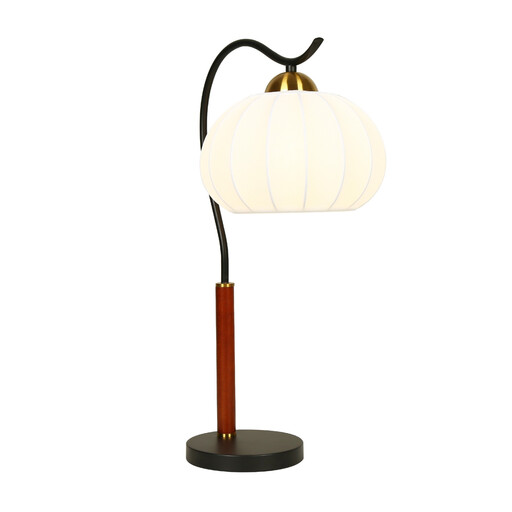
Why this product suits this profile: The combination of fabric shade, wood and metal is aimed at those looking for a classic, stationary table lamp for the living room or bedroom.
The details clearly specify the lamp socket, maximum power, cable type and intended use. This makes it clear before purchase that a mains connection and a suitable E27 light bulb are required.
E27 socket, 40 W maximum power and 1.6 m connection cable according to the product description.

Why this product suits this profile: Readers get a small, flexible reading lamp for the bed, travelling or use on the go. It can be used freestanding or with the clamp.
The product description clearly distinguishes between two brightness levels and a runtime of up to 8 hours. The maximum runtime is therefore not equated with full brightness.
16 lm, 3,000 K, USB charging time of around 1.5 hours and 350° rotation according to the product details.
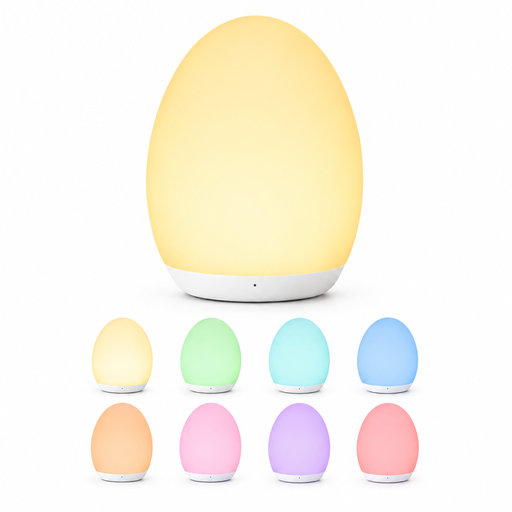
Why this product suits this profile: The model is designed for bedside tables, children’s bedrooms, night-time feeds and travel. Touch controls, warm white light and a timer make it easy to use.
Runtime varies according to brightness: according to the product details, up to 100 hours applies at the lowest setting, while maximum brightness lasts around 7 hours. A 1-hour timer limits the operating time further.
2,000-mAh battery, eight colour modes, dimmable warm white light and compact dimensions of 9.2 × 9.2 × 11 cm.
We have put together a complete, regularly updated list of products that fully meet these strict selection criteria and the safety regulations applicable in the EU.
Low lumen values may be sufficient for decorative ambient lighting. A reading lamp should illuminate the book in a focused and sufficiently bright way. Lumens are not the only consideration: distance, light distribution and adjustability are also important. For example, a product rating of 16 or 30 lumens is more suitable for personal orientation or accent lighting.
With permanently installed LEDs, a traditional light bulb lifespan is often not specified. The actual service life depends on the electronics, heat dissipation, operating time and surroundings. For rechargeable-battery or battery-powered models, the runtime per charge or set of batteries is also important. For this reason, check the manufacturer’s details and only use the lamp in the intended indoor area.
For mains-powered models, energy consumption is determined by the power rating in watts, daily operating time and your electricity tariff. Rechargeable-battery and battery-powered models also incur charging or replacement costs. A low wattage does not automatically mean suitable lighting, however: when making your decision, consider brightness, usage time and intended location together.