
Lieferung heute & morgen

Qualitätsgarantie

Willkommens-Angebote freischalten: KOSTENLOSE Lieferung | Bis zu 80 % RABATT | Kostenlose 30-Tage-JoyPlus-Testphase
App herunterladen
LED table lamps should do more than simply create a pleasant atmosphere. Depending on where they are used, suitable brightness, easy operation, a stable base and an appropriate power supply all matter. However, choosing based solely on design or a high wattage often means overlooking important details.
With LED lights, wattage primarily indicates energy consumption. The luminous flux in lumens determines the actual brightness. An LED desk lamp with 400 lm provides noticeably different illumination from a decorative table lamp with 90 or 105 lm, even if the wattage appears similar.
Use these figures as a guide:
The brightness you need also depends on the size of the table, the light level in the room and the position of the lamp.
A cordless table lamp requires either an integrated rechargeable battery or batteries. Before buying, check whether a charging cable, power adapter or USB cable only is included. With USB models, an adapter is often not supplied.
Also pay attention to:
A rechargeable table lamp is particularly suitable for flexible placement. For a permanent desk setup, a USB table lamp with a continuous power connection may be more practical.
A table lamp for indoor and outdoor use must be explicitly suitable for outdoor areas. The protection rating is indicated by the IP code. IP44, for example, protects against solid foreign objects measuring 1 mm or more and against water splashes from various directions. This does not mean that the lamp is waterproof or suitable for prolonged exposure to rain.
For balconies, patios or gardens, you should therefore check:
Light colour is measured in kelvin. 2700 to 3000 K produces warm white light for living areas and bedside tables. 4000 K appears more neutral and is suitable for workspaces. Values around 5000 to 6500 K look cooler and may be useful for certain activities or practical, task-focused lighting.
A dimmable table lamp can be adapted more easily to different situations. With CCT models, not only the brightness but also the colour temperature can be changed. Check whether the lamp is operated using a touch button, switch or remote control, and whether the setting is saved after the lamp is switched off.
A compact battery-powered table lamp is easy to move, but a narrow or lightweight base can make it more likely to topple over. For a desk, a stable base and adjustable lamp neck are useful. With a bedside lamp, the height should suit the position of the bed so that the light source does not shine directly into your eyes.
Measure the intended space before buying. Dimensions such as diameter and height are more informative than general descriptions such as “compact” or “space-saving”.
A USB table lamp can be powered from a laptop, power bank or USB mains adapter. With a battery-powered table lamp, check the charging indicator and cable length. Additional features such as colour changing, Qi charging or Bluetooth can be useful, but they also increase the number of components. Consider whether you will actually use these functions.
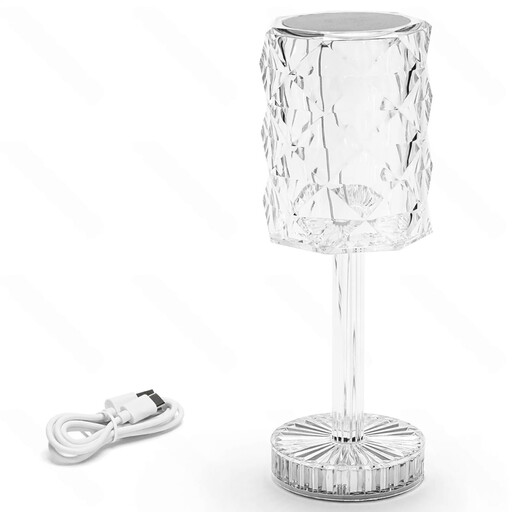
Why this product suits this profile: This compact ambient lamp requires a USB power source and provides subtle 105 lm lighting for a shelf, bedside table or desk.
The stated brightness of 105 lm makes its use as accent lighting clear. The product data also indicates indoor use and a non-replaceable LED.
2700 to 6500 K, USB connection, 90 mm diameter and 260 mm height.
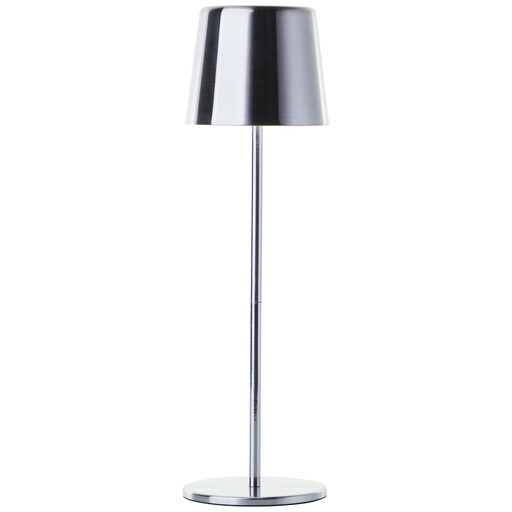
Why this product suits this profile: This battery-powered table lamp is specified for indoor and outdoor use, combining an aluminium finish with dimmable CCT lighting.
The IP44 rating defines the intended protection against water splashes. This makes the lamp suitable for sheltered outdoor areas, but it should not be left unprotected in the rain for prolonged periods.
300 to 6500 K, 300 lm, continuously variable touch dimmer, USB-A charging and 37 cm height.

Why this product suits this profile: This rechargeable table lamp is designed for changing work and reading situations. It features a flexible lamp neck and touch controls.
With 400 lm, three colour temperatures and a stated battery capacity of 2 × 1800 mAh, the key selection criteria are clearly specified. Nevertheless, the IP54 rating should be checked against the intended place of use.
3000, 4000 and 5000 K, 4 W power, 1 m charging cable and adjustable lamp neck.
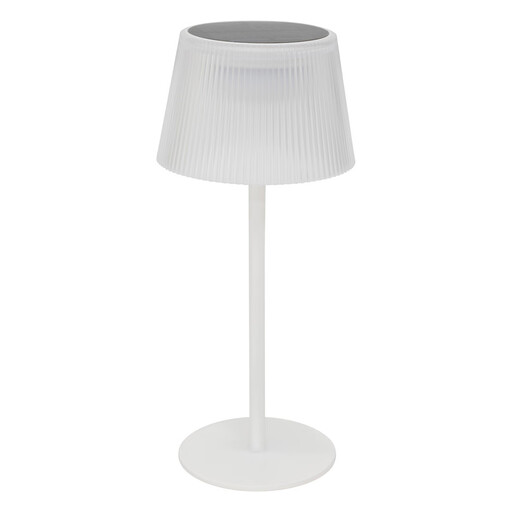
Why this product suits this profile: As a solar table lamp for outdoor use, it requires no permanent mains connection when there is sufficient sunlight. It provides warm white light for tables and patios.
The data states a charging time of 5 to 6 hours, IP44 protection and an operating time of 6 hours. This makes it easier to plan its weather- and daylight-dependent use realistically.
90 lm, 30 cm height, integrated lithium-ion battery, timer and warm white LED.
We have put together a complete, regularly updated list of products that fully meet these strict selection criteria and the safety regulations applicable in the EU.
For decorative purposes or as an LED bedside lamp, 90 to 150 lm may be sufficient. For reading and working, 200 to 400 lm is often suitable. The distance from the work surface, light distribution and an available dimming function are also important.
The lifespan depends on the LED module, electronics, usage and heat dissipation. With integrated LEDs, the light source usually cannot be replaced by the user. A product specification such as 25,000 hours is a technical guideline from the manufacturer, not a guarantee of a specific service life in the home. With battery-powered models, the battery may lose capacity sooner.
LED lights generally require little electrical power when operating. Consumption depends on wattage, brightness level and daily usage time. A 4 W lamp that is switched on for five hours a day uses approximately 0.02 kWh per day. Battery, solar and USB models also incur charging losses. The key consideration is therefore the combination of luminous flux, operating time and selected brightness level.