
Lieferung heute & morgen

Qualitätsgarantie

Willkommens-Angebote freischalten: KOSTENLOSE Lieferung | Bis zu 80 % RABATT | Kostenlose 30-Tage-JoyPlus-Testphase
App herunterladen
An LED twin-head outdoor wall light can direct light onto your driveway, garage, shed or patio. Two independently adjustable heads are useful because you can aim the light at different areas. However, high lumen figures, unclear IP ratings and unsuitable electrical connections can often lead to the wrong purchase.
Wattage alone tells you little about how well an outdoor area will be lit. Lumens, beam angle, mounting height and the direction of the two heads all play a part. A very bright floodlight can cause glare, while areas outside the beam remain in darkness.
For waterproof garden lighting, the IP rating should be clearly stated in the technical specifications. Without a specific IP code, it’s unclear how well the housing is protected against dust and water. A light fitted beneath an eaves overhang will also face different conditions from one mounted on a fully exposed outdoor wall.
Some outdoor wall lights are designed for a hard-wired connection. This also applies to the LUTEC model described here, which is rated at AC 120 V, 60 Hz. Before buying in Germany, check that the voltage, frequency and connection type are compatible with your existing installation. A hard-wired product should be installed and checked by a suitably qualified electrician.
4000K LED outdoor lighting is generally perceived as neutral white and suits front doors, patios and general courtyard lighting. 5000K daylight white has a cooler appearance and may be a good choice for garage entrances, sheds or areas where good visibility is especially important. The right option depends on your surroundings and personal preference; it isn’t automatically a measure of quality.
The lumen figure describes the light output, while the wattage indicates how much electrical power the light uses. A model rated at 1,800 lumens and 20 watts, like one of the products below, gives you more useful information than a vague claim such as “extra bright”. For a more precise plan, also consider the mounting height, distance from the wall and the area you want to illuminate.
An LED twin-head floodlight should be easy to aim precisely. According to the product specifications, both heads on the first model can be adjusted by up to 180 degrees. Die-cast aluminium housing, a powder-coated finish and glass covers are all relevant material details for outdoor use. Even so, they don’t replace a clearly stated IP rating.
When choosing a black outdoor wall light, also check that the finish, screw points and cable routing are suitable for the mounting surface. Before buying, check the wall material, available wiring and the space needed for both beams.
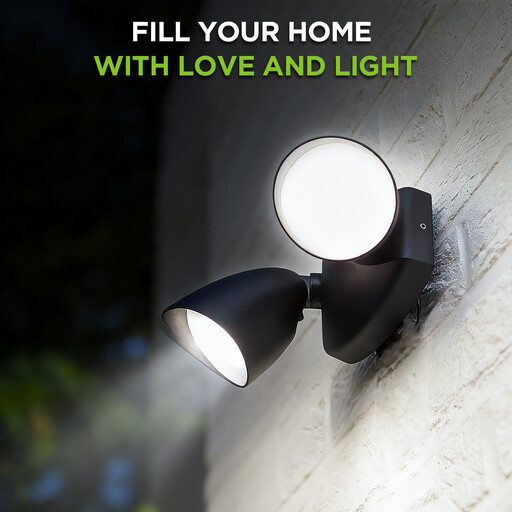
Why this product suits this profile: The combination of 20 watts, 1,800 lumens and 4000K is a good fit if you’re looking for neutral-white lighting for a courtyard or garden, with two light heads.
The product name gives specific figures for light output, power consumption and colour temperature, rather than relying on a vague brightness claim.
1,800 lumens, 20 watts, 4000K and a housing described as having a full metal design.
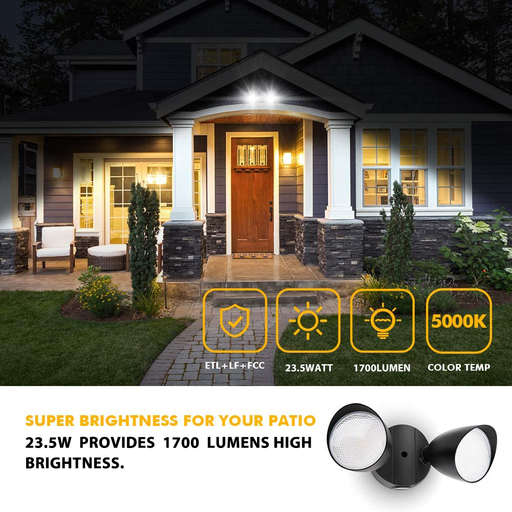
Why this product suits this profile: The black finish, two adjustable heads and 5000K daylight-white light make this an interesting option for garages, sheds and modern exterior walls.
The product details specify the materials, glass covers and adjustability of the two heads. You’ll still need to check that it’s electrically compatible in Germany before buying.
Die-cast aluminium, toughened glass, black powder-coated finish and two LED heads adjustable by up to 180 degrees.
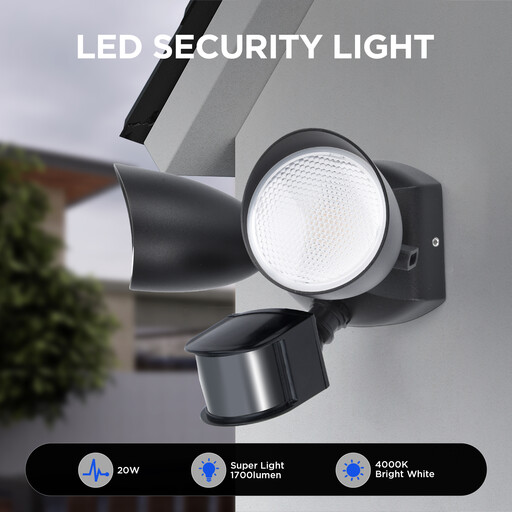
Why this product suits this profile: The integrated sensor and two light heads are useful if you’re looking for an outdoor LED security light for paths, driveways or entrances.
The sensor is listed as a specific product feature. Before installation, check the detection range, on-time and positioning against the full instructions.
20 watts, 1,700 lumens, 4000K, an integrated sensor and a twin-head design.
Before installation, check the mains voltage, wall surface and cable routing. For hard-wired lights, switch off the circuit at the consumer unit. Aim the heads only once the light has been securely fixed, to avoid putting unnecessary strain on the bracket or cable.
You can estimate electricity consumption using this simple formula:
Power in watts × hours of use ÷ 1,000 = kilowatt-hours
A 20-watt light used for two hours a day will consume around 14.6 kilowatt-hours a year. Actual costs depend on your electricity tariff and how long the light is used. With sensor operation, it may be on for less time if the settings suit your property.
We’ve put together a complete, regularly updated list of products that meet these strict selection criteria and fully comply with the safety regulations applicable in the EU.
4000K gives a neutral-white light and suits many entrances, patios and courtyards. 5000K produces a cooler daylight-white effect and may be preferable for garages, sheds or driveways. Choose an option that works with your existing lights and the effect you want to create.
Its actual lifespan depends on the LED module, heat dissipation, hours of use, ambient temperature and protection against moisture. Without specific manufacturer data, there’s no reliable one-size-fits-all figure. Regular visual checks and cleaning with a soft, damp cloth can help keep it working properly.
A hard-wired light should be installed by a suitably qualified electrician. Before buying, check the voltage, frequency, connection type and installation location. A light with electrical specifications that don’t match is not suitable for connection to the German mains supply.