
Lieferung heute & morgen

Qualitätsgarantie

Willkommens-Angebote freischalten: KOSTENLOSE Lieferung | Bis zu 80 % RABATT | Kostenlose 30-Tage-JoyPlus-Testphase
App herunterladen
An LED wall light can provide extra illumination in your living room, bedroom, hallway or stairwell while taking up very little space. In practice, however, poor purchases often happen not because of the design, but because of unsuitable light data, missing measurements or installation that wasn't properly planned beforehand. That's why the Joybuy Product Recommendation Officer filters the relevant product features and highlights what private individuals, renovators and interior designers in the UK should look out for.
The power consumption in watts describes energy usage, not directly the brightness. For comparison, the luminous flux in lumens is what matters. A light fitting with 12 W can give out very different amounts of light depending on the LED technology and design. For a decorative wall light, moderate brightness is often sufficient, whereas a hallway or staircase needs more even illumination.
An LED wall light in warm white 3000K creates a cosier lighting effect and usually suits living rooms and bedrooms. For work areas or functional zones, neutral white light at around 4000 K may be more appropriate. Cool light at 6500 K looks noticeably more clinical and should be used deliberately.
With 3CCT models, you can select the colour temperature between 3000 K, 4000 K and 6500 K. This is practical, but it doesn't replace thoughtful room planning: on the products mentioned, the setting is made via an integrated switch and not necessarily conveniently from the wall switch.
A black wall light or a modern aluminium wall light might look the part, but it also needs to be mechanically and electrically suitable for the room. For damp rooms, the IP rating is important. IP44 offers protection against splashing water and solid foreign objects above a certain size, but it is not protection against direct water jets or submersion.
With recessed lights, there are additional typical planning mistakes:
When choosing an LED wall light, at least three specifications are important:
A light with warm white illumination is often suitable as LED lighting for living rooms, bedrooms, hallways and bathrooms, provided the brightness and IP rating suit the particular room. For the bathroom, you also need to check that the specific installation area and IP rating meet local requirements.
A dimmable light can adjust the brightness from bright illumination to subtle evening lighting. However, this only works with a compatible dimmer. With integrated LEDs, the information about the dimming technology and the dimmer used must match.
3CCT LED spotlights offer three colour temperatures. This feature is particularly interesting when a room is used for different purposes. Bear in mind that the colour temperature is usually set before installation or via a small switch on the product itself.
Flat models are suitable for low ceilings or limited cavity space. The dimmable LED recessed spotlights and flat LED ceiling spotlights in the range differ significantly in diameter and ceiling cut-out. Examples from the product data:
These measurements are not interchangeable. Always measure an existing cut-out before ordering.
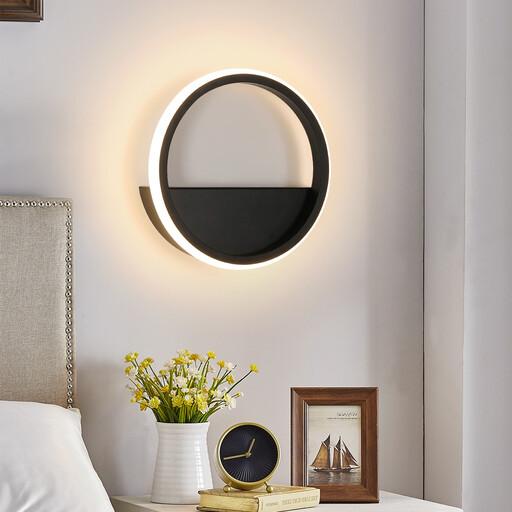
Why this product fits the profile: The round, black design and warm white 3000 K illumination are suitable for living rooms, bedrooms, hallways or stairwells. The integrated 12 W LED is designed for straightforward indoor installation.
The product details clearly state the colour temperature and power consumption. This makes it easier to match the light fitting to your planned room and desired atmosphere.
12 W power consumption, round shape, black finish and 3000 K warm white light.
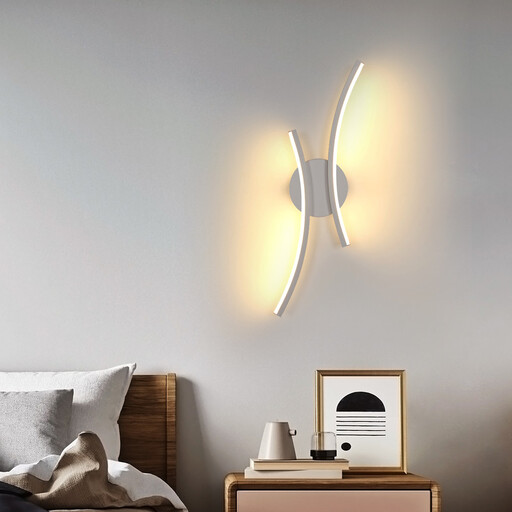
Why this product fits the profile: The curved aluminium design with light directed upwards and downwards is intended for modern living areas, bedrooms, hallways and studies. According to the product details, the profile is 5 cm deep.
The stated shallow depth reduces the risk of the wall light protruding too far into narrow passageways. Before installation, check the wall connection and fixing surface.
20 W, warm white light at 3000 K, 5 cm depth and aluminium construction according to the product description.
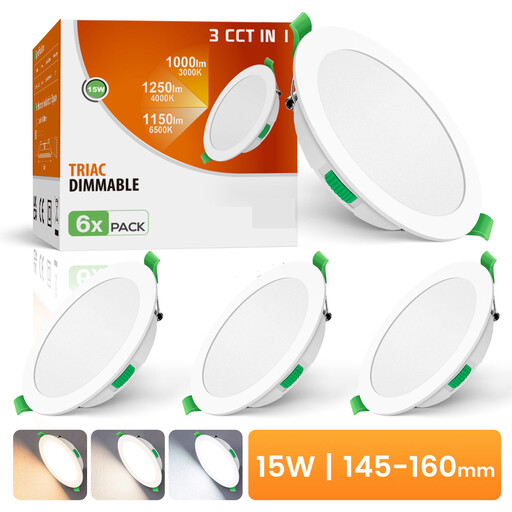
Why this product fits the profile: This set of six recessed spots is aimed at renovators fitting out multiple ceiling cut-outs. You can choose between 3000 K, 4000 K and 6500 K; according to the product details, the brightness can be adjusted from 10 to 100 percent using a compatible leading-edge or trailing-edge dimmer.
The product data lists the colour temperatures, dimming range, IP44 protection and the required ceiling cut-out of 145–160 mm. This helps reduce installation and control errors in advance.
1200 lm, 3CCT selection, dimmable from 10–100 percent and IP44 according to the product description.
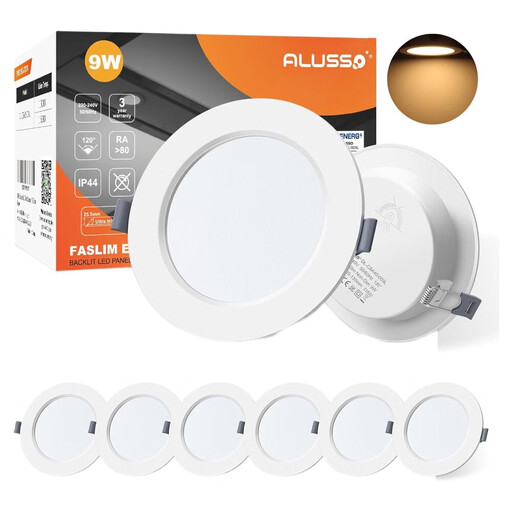
Why this product fits the profile: The six flat spots are intended for bathrooms, kitchens and utility rooms. With a 25.5 mm recess depth and a required cut-out of 115–135 mm, they are suitable for ceilings with limited installation height.
The "not dimmable" note prevents false expectations about light control. At the same time, the IP rating, colour temperature and ceiling cut-out are clearly stated.
690 lm per spot, warm white 3000 K light, IP44 and 25.5 mm recess depth according to the product data.
We've put together a complete, regularly updated list of products that fully meet these strict selection criteria and the safety regulations in force in the EU.
The lifespan depends on the LED technology, heat dissipation, operating time and ambient temperature. For several of the recessed lights mentioned here, an average lifespan of 25,000 to 30,000 hours is stated. This is a manufacturer or product data value and not a guarantee for every individual use. With integrated LEDs, if a fault occurs, the entire light fitting may need to be replaced.
The running costs depend on the wattage, daily usage time and electricity tariff. A simple calculation is: wattage ÷ 1000 × hours of operation × electricity price. For example, a 12 W light uses 0.12 kWh over ten hours of operation. For an accurate cost calculation, you'll need your personal unit rate per kilowatt hour.
LED recessed spots IP44 are protected against splashing water and can be suitable for certain areas in bathrooms. However, IP44 does not mean the light is intended for direct water jets or installation in every wet zone. The installation location, protection zone, mains connection and national installation regulations must all be taken into account. Installation at 230 V should be carried out by a qualified electrician.