
Lieferung heute & morgen

Qualitätsgarantie

Willkommens-Angebote freischalten: KOSTENLOSE Lieferung | Bis zu 80 % RABATT | Kostenlose 30-Tage-JoyPlus-Testphase
App herunterladen
An LED outdoor wall light with a motion sensor can automatically illuminate an entrance, patio or garden path without the need to install a permanent cable. Rechargeable models with a battery, USB connection and magnetic mounting are particularly practical. However, outdoor lights vary considerably in terms of protection, brightness and intended use.
The IP44 rating indicates protection against solid foreign objects measuring 1 mm or more, as well as splashing water from various directions. An IP44 LED outdoor light is therefore suitable for sheltered outdoor areas, but it is not automatically protected against powerful jets of water, standing water, accumulated snow or immersion.
This means the following should be considered when mounting it:
A 300-lumen outdoor light produces significantly more light than a small orientation light with, for example, 18 or 20 lumens. However, that does not mean it is suitable for every application. Higher brightness may be useful for a short path by the front door, while lower light output is sufficient in a bedroom, hallway or under a cupboard.
Also pay attention to the beam angle and the position of the motion sensor. A light with a narrow beam can leave a larger area only partially illuminated, even if its lumen rating is adequate.
A wireless outdoor light with a battery needs to be recharged regularly. How long the battery lasts depends, among other things, on the number of activations, the lighting duration per activation and the ambient temperature. A supplied USB cable makes charging easier, but it does not replace a suitable power source.
Before buying, check the following:
For paths, entrances and patios, 300 lumens is a clearly visible level of brightness. Warm-white outdoor lighting at 3000 K produces a yellowish, warm tone and usually feels less cold in a home environment than neutral-white light. Higher outputs may also be useful for functional security lighting, while less is often sufficient for subtle marking.
Wattage alone is not a suitable comparison value. With LED lights, you should primarily compare the luminous flux in lumens, the colour temperature in Kelvin and the intended area of use.
A motion sensor for an entrance area should be positioned so that people move across its detection zone. If the sensor points directly towards the direction of travel, movement may be detected later, depending on the sensor technology.
Also bear the following in mind:
A magnetic LED light is particularly flexible, but on non-metallic walls it cannot be secured by the magnet alone. For rented homes, a mobile LED wall light with a suitable bracket can be a practical alternative.
For outdoor use, a sealed housing, suitable mounting materials and a clearly stated IP rating are important. With permanently connected lights, electrical connections and installation work must only be carried out by appropriately qualified individuals. Battery-powered models avoid this installation work, but they must be charged and stored according to the manufacturer’s instructions.
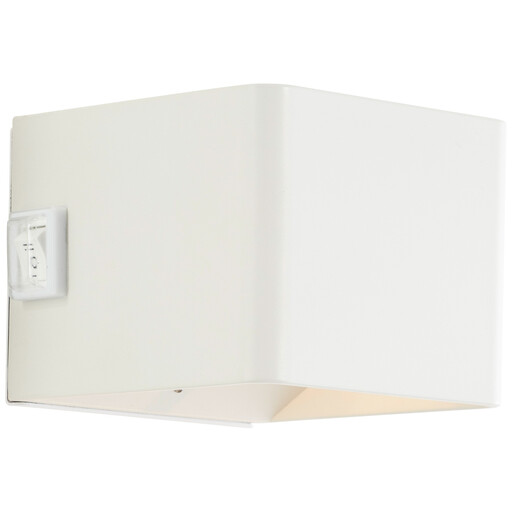
Why this product suits this profile: This compact light combines an integrated battery, USB charging, a motion sensor and 300 lumens. It is suitable for tenants and private households looking for an outdoor light without a permanent power connection.
The specifications clearly state the luminous flux, colour temperature, battery, USB connection and IP44 rating. This makes it easier to assess the brightness and charging method before buying.
300 lm, 3000 K, integrated battery, USB-A cable, magnetic mounting, toggle switch and IP44 rating.
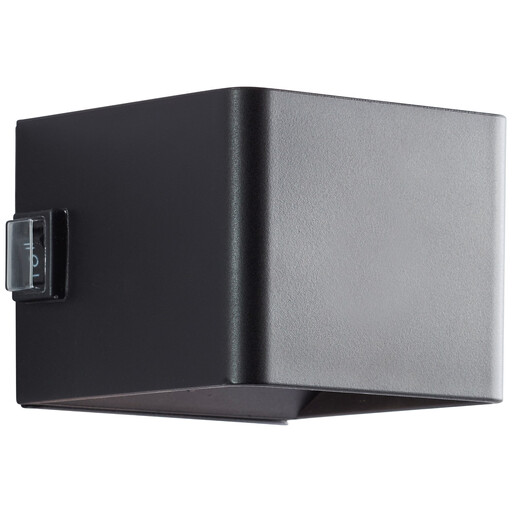
Why this product suits this profile: The black version features the same clearly stated core specifications and complements dark façades, metal railings and modern patio areas.
The IP44 rating is not treated as meaning that the housing is waterproof. A sheltered location and attention to exposure to water remain important when mounting the light.
300 lm at 3000 K, integrated motion sensor, battery, USB charging, magnet and compact dimensions of 8 × 10.3 × 10.1 cm.
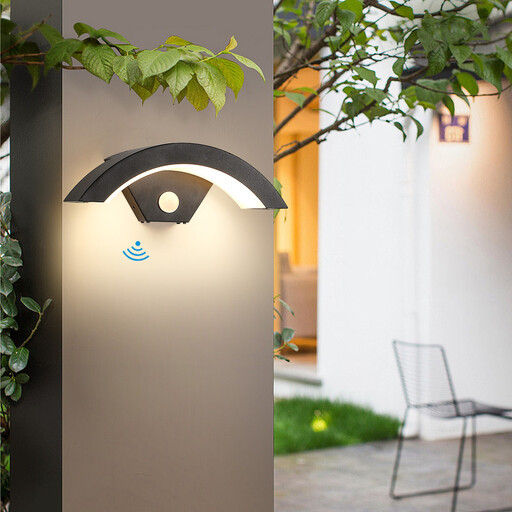
Why this product suits this profile: This model is aimed at homeowners looking for a permanently mounted solution for a façade, garage, driveway, balcony or stair area, with a permanent power connection available.
The product description states that it is designed for permanent operation and outdoor installation. This makes it clear that it is not a wireless outdoor light with a battery.
24 W, 3000 K, light and motion sensors, plus a housing made from die-cast aluminium with a matt finish according to the product description.
We have compiled a complete, regularly updated list of products that fully meet these strict selection criteria and the safety regulations applicable in the EU.
An automatic light should illuminate the area without unnecessarily detecting neighbours or passing pedestrians. Point the sensor towards your own path, front door or driveway. If you live in rented accommodation, agree any drilling, wall plugs and permanently attached brackets with your landlord beforehand.
For a battery-powered model, we recommend:
For an entrance area or short path, 200 to 300 lumens can be a suitable level of brightness. The required brightness depends on the mounting height, beam angle, length of the path and existing ambient lighting. Small night lights with 18 to 20 lumens are generally intended for indoor use or subtle guidance.
There is no one-size-fits-all battery life. It depends on the battery capacity, lighting duration per activation, temperature and daily use. A motion sensor can reduce energy consumption because the light does not remain on continuously. Before buying, check whether the manufacturer provides specific battery-life information.
A battery-powered LED light uses relatively little energy while charging; actual consumption depends on how often it is charged and the battery capacity. With permanently connected models, wattage and daily operating time are also relevant. The motion sensor limits the time the light remains on if automatic switch-off is provided.