
Lieferung heute & morgen

Qualitätsgarantie

Willkommens-Angebote freischalten: KOSTENLOSE Lieferung | Bis zu 80 % RABATT | Kostenlose 30-Tage-JoyPlus-Testphase
App herunterladen
LED wall lights combine practical illumination with decorative design options. Depending on their shape and construction, they can be used as wall lights for living rooms and bedrooms, hallway lighting or stairwell lighting. Smart models add RGB colours, app control and music synchronisation for gaming areas or party rooms.
However, it is worth taking a close look at the technical specifications and installation requirements before buying. Not every modern LED wall light is suitable for every room, wall or lighting concept.
Shop photographs can distort the light colour. For a warm-white LED wall lamp, the Kelvin rating is key:
A light with 3,000 K creates a different atmosphere from a model with 6,500 K, even if the two look similar.
The wattage describes energy consumption, not brightness alone. For a meaningful comparison, lumens, beam direction and installation height are also important. A light with 1,500 lumens may be suitable for a hallway or stairwell, while a weaker light is better used as accent lighting.
Indirect wall lighting also distributes light differently from a fixture that shines directly forwards. So check whether you need general lighting, reading light or simply decorative wall lighting.
When choosing smart wall lighting, check in advance which app and voice assistants are supported. Terms such as WiFi LED light, music synchronisation or RGB control do not necessarily mean that the product will work with your existing smart home system.
Other important points include:
Warm-white light of around 3,000 K is often chosen for living rooms and bedrooms. A dimmable LED wall light offers additional flexibility, provided that the dimming function is actually listed in the technical specifications. With integrated LEDs, also bear in mind that the light source may not be replaceable separately if it fails, depending on the design.
For rooms where colours should appear as natural as possible, the colour rendering index, Ra or CRI, is relevant. A higher stated value indicates more nuanced colour reproduction. If this information is missing, it should not be replaced with assumptions.
Measure the available wall space before buying. A slim wall light is ideal for narrow hallways, while larger, curved models have a stronger visual impact as a design feature on an open wall.
Distinguish between:
For self-adhesive LED strips, the wall should be dust-free and even. An adhesive connection is not equivalent to a secure mechanical fixing.
Aluminium housings can help dissipate heat, but they do not replace checking the manufacturer’s specifications. Pay attention to the installation instructions, power supply, cable routing and the intended indoor area. Products without a stated suitability for damp areas should not be used where they are exposed to direct splashing water.
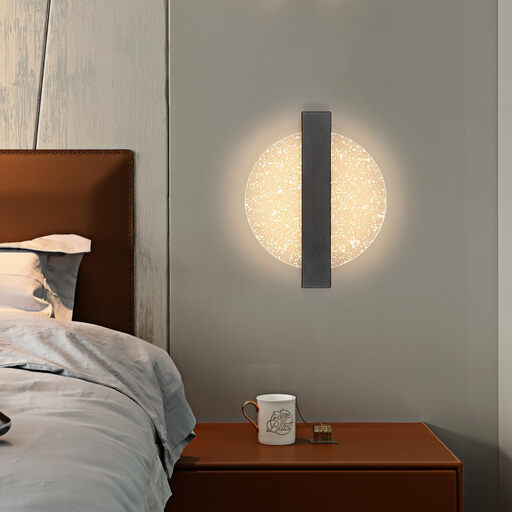
Why this product suits the profile: The round 12W light with 3,000 K is suitable for living rooms, bedrooms, hallways and stairwells when warm-white light is wanted without app control.
The stated colour temperature means you do not have to judge the lighting effect solely from product photographs. Its intended use in indoor spaces is clearly specified.
12W LED, 3,000 K warm white, round shape and a stated luminous flux of 1,500 lumens.
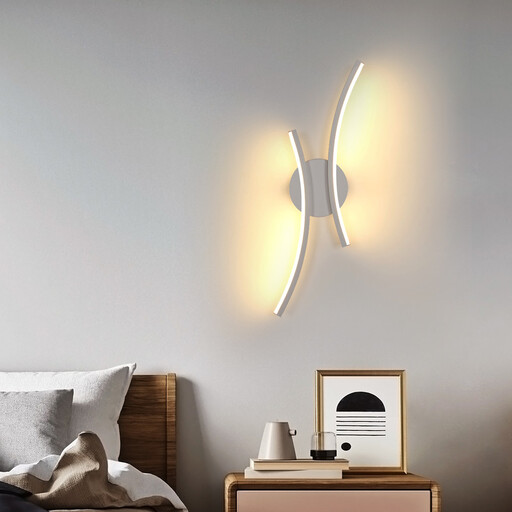
Why this product suits the profile: The curved aluminium light with upward and downward illumination will appeal to buyers who want to combine practical lighting with wall design.
The light colour is clearly specified as 3,000 K. The approximately 5 cm-deep profile supports space-saving wall installation.
Aluminium construction, curved shape, upward and downward light, plus warm white at 3,000 K.
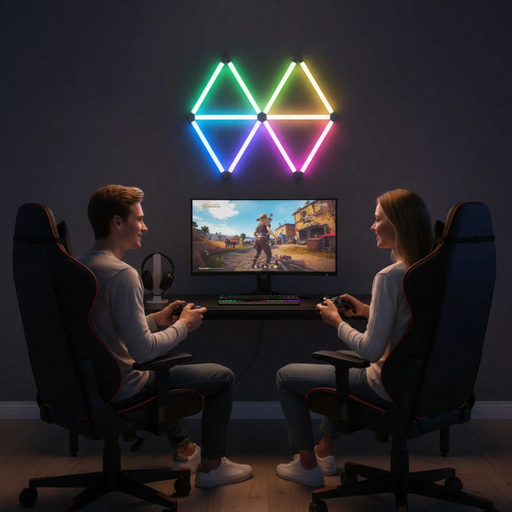
Why this product suits the profile: The six-piece set is designed for gaming rooms and TV backlighting, as well as users who want to control RGB LED wall lighting via an app, remote control or voice assistant.
The supported control methods are clearly specified: Smart Life app, remote control, Alexa and Google Assistant. Installation requires a smooth, dust-free surface.
Six flexible LED strips, 16 million RGB colours, over 40 dynamic scenes according to the product description, and music synchronisation.
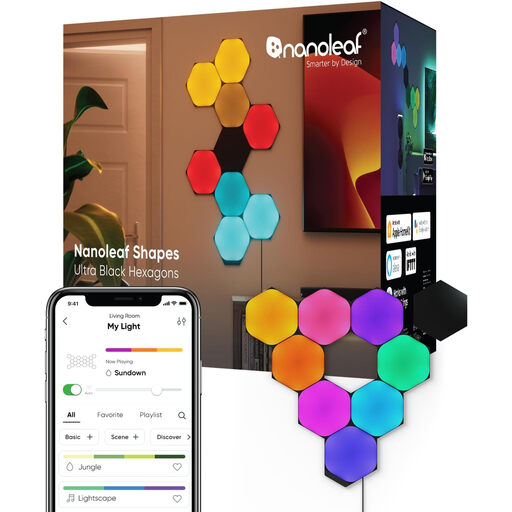
Why this product suits the profile: The modular hexagonal panels are ideal for individually designed walls and can be controlled by touch, via the app or through Alexa, Google Assistant and Apple HomeKit.
Compatibility with several platforms is clearly stated. Even so, check before installation that WiFi, the app and your preferred voice assistant are available.
Nine LED panels, dimmable, RGBW colours, 1,500 lumens according to the product data, and WiFi control.
With hardwired models, the electrical connection should be carried out by a qualified electrician. For adhesive solutions, first clean the surface with a dry cloth and check whether the wallpaper, plaster or paintwork can bear the load. Flexible LED strips must not be bent excessively.
Power consumption is the key factor in running costs. A 6W light uses less electrical energy than a 27W model over the same operating period; the actual cost depends on how long it is used and your electricity tariff. With multiple lights, such as a six-piece RGB set, the system’s total power consumption should be taken into account.
We have put together a complete, regularly updated list of products that fully meet these strict selection criteria and the safety regulations applicable in the EU.
That depends on the size of the room, the distance from the wall and the beam angle. For a narrow hallway, a light with a stated luminous flux of around 1,000 to 1,500 lumens may be sufficient. Less is often enough for purely accent lighting. Several lights should be spaced evenly.
Lifespan depends on the LED chips, heat dissipation, power supply and daily operating time. Do not rely solely on advertising claims; check the specific lifespan stated for the product in question. With non-replaceable LEDs, the entire light may need to be replaced if a fault occurs.
WiFi control creates a small additional standby power consumption. However, the main factors affecting ongoing consumption are wattage, the number of lights and operating time. Automations such as schedules can help prevent unnecessary operating periods.