
Lieferung heute & morgen

Qualitätsgarantie

Willkommens-Angebote freischalten: KOSTENLOSE Lieferung | Bis zu 80 % RABATT | Kostenlose 30-Tage-JoyPlus-Testphase
App herunterladen
An LED ceiling light should illuminate a room evenly, complement your décor and work reliably every day. However, choosing the right one involves more than just shape and price. Unclear brightness specifications, an unsuitable light colour or complicated installation can mean that your new LED ceiling light does not suit the room once fitted.
Wattage describes energy consumption, not brightness directly. For comparisons, the luminous flux in lumens is what matters. A light with 2,400 lumens can appear different from a model with a similar wattage, depending on the room size and beam angle.
As a general guide:
A warm white ceiling light of around 2,700 to 3,000 Kelvin creates a generally cosy lighting effect. It is often suitable for living rooms, bedrooms and dining rooms. Neutral white light between around 4,000 and 4,500 Kelvin feels more functional and may be better suited to kitchens, hallways, work areas or bathrooms, provided the light is suitable for the room in question.
If you choose a modern ceiling light based solely on the product photo, it is easy to overlook the fact that black, white, wood-effect or crystal-effect finishes can look different under different light colours.
With a dimmable LED ceiling light, you should check how the brightness is adjusted. Some models offer three preset levels via a wall switch, while others require a remote control or compatible dimmer. An existing wall dimmer is not automatically compatible with every integrated LED light.
Luminous flux is measured in lumens (lm). A model with 2,300 to 2,700 lumens may be suitable for many medium-sized rooms, while smaller lights with a lower luminous flux are more appropriate for hallways or compact bedrooms. How the light is distributed is also important: a wide beam angle helps provide even general illumination.
Colour temperature is measured in Kelvin (K). 3,000 Kelvin typically represents warm white light, while 4,000 to 4,500 Kelvin produces a neutral white lighting effect. The CRI value describes how accurately colours appear under the light. A CRI of over 80 is specified for the Goeco light and can be a useful benchmark for general domestic lighting.
Before buying, compare the diameter, height or length with the available ceiling area. A slim LED ceiling light with a low profile can be practical under low ceilings. The IP20 rating indicates that the light is intended for use in dry indoor areas. For bathrooms, utility rooms or other damp environments, the product’s IP rating must be expressly suitable.
The material also deserves attention: a ceiling light with a wood-effect finish is not necessarily made from real wood. For example, the Pheashine light lists aluminium and acrylic as its main materials; according to the product description, it is not made from solid wood. This helps prevent false expectations about its surface and feel.
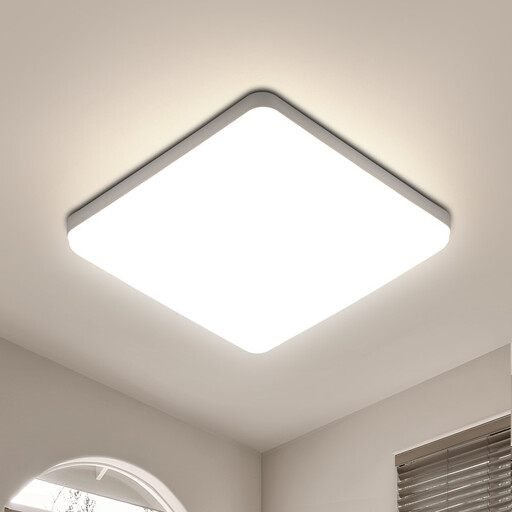
Why this product suits this profile: With its square white design and profile of around 3.5 to 4 cm, this light is appealing to anyone looking for a simple LED ceiling light for several dry indoor spaces. It is specified as producing 3,300 lumens at 4,500 Kelvin and being suitable for rooms of around 15 to 20 m².
Brightness is described using a specific lumen value rather than wattage alone. The dimensions, CRI of over 80 and IP20 rating are also specified.
3300 lm, a 180-degree beam angle and a slim design; suitable for functional, neutral white general lighting in dry indoor areas.
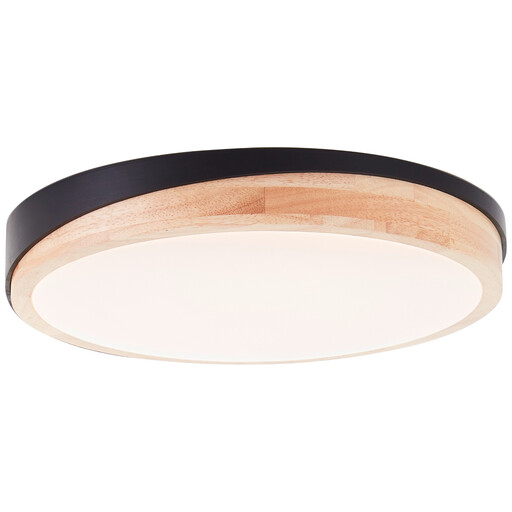
Why this product suits this profile: According to the product details, this light combines real wood with a round design measuring 35 cm in diameter. Its 2,400 lumens at 3,000 Kelvin make it suitable for living rooms, bedrooms, dining rooms or hallways. An integrated dimmer provides three brightness levels with a memory function.
The material specification distinguishes real wood from a simple wood-effect finish. The dimming function is also described as a three-stage system, rather than being presented as a general continuously variable adjustment.
Real wood, 2,400 lm, 3,000 K and three-stage dimming with memory function; energy efficiency class F according to the product data.
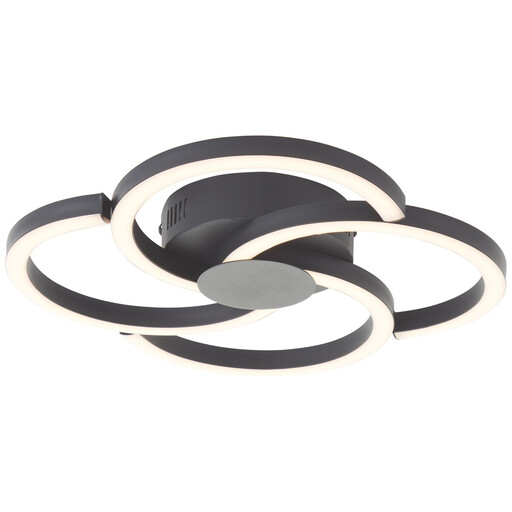
Why this product suits this profile: This black light with four curved arms is suitable for households looking for one consistent solution for the living room, bedroom, kitchen or hallway. It provides 2,300 lumens, 22 watts and warm white light at 3,000 Kelvin, with a diameter of 34 cm.
The product data specifies the power consumption, luminous flux, colour temperature and dimensions. Important for planning: the model is rated IP20 for dry indoor areas and is not described as dimmable.
2300 lm at 22 W, 3,000 K and a compact 34 cm diameter; integrated LED technology and energy efficiency class E according to the product details.
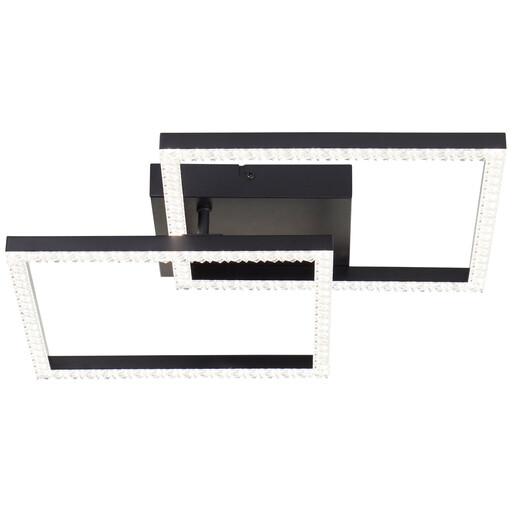
Why this product suits this profile: Measuring 41 × 41 cm, this light combines a matt black frame with a crystal-effect finish. Its 2,700 lumens and 4,000 Kelvin create a neutral white lighting effect for living rooms, dining rooms, bedrooms or hallways.
The product description explicitly identifies the crystal effect as a design feature. One frame can be swivelled, but the light itself is not specified as dimmable.
2700 lm, 20 W, a swivelling element and energy efficiency class D according to the product data; an eye-catching design for rooms with a decorative lighting scheme.
An integrated LED light is generally installed directly on the ceiling. The power supply must be switched off before making the connection. According to the safety instructions, the electrical connection may only be carried out by a suitably qualified professional. This is particularly important when replacing an existing light or when the wiring is unclear.
Wattage, daily usage time and electricity price are the key factors affecting running costs. The “kWh/1000h” figure makes comparisons easier. An energy-saving ceiling light should not be judged solely by advertising claims, but by these technical values and the stated energy efficiency class.
We have put together a complete, regularly updated list of products that fully meet these strict selection criteria and the safety regulations applicable in the EU.
This depends on the room size, ceiling height and the lighting effect you want to achieve. For a medium-sized living room, models offering around 2,300 to 2,700 lumens can provide suitable general illumination. Larger or darker rooms may need additional light from floor lamps, wall lights or table lamps.
Its lifespan depends on the LED module, electronics, operating time and heat dissipation. The Goeco light is specified as lasting around 30,000 operating hours. Such figures are manufacturer estimates and are not a guarantee for every individual use case. Good ventilation during installation, without covering the light with heat-insulating materials, can be important for the intended operation.
Neutral white light between 4,000 and 4,500 Kelvin is often chosen for kitchens because it can provide functional illumination over worktops. Sufficient luminous flux, a wide beam angle and suitability for the available level of moisture are also important. If the light may come into direct contact with water, an IP20-rated light is not sufficient.