
Lieferung heute & morgen

Qualitätsgarantie

Willkommens-Angebote freischalten: KOSTENLOSE Lieferung | Bis zu 80 % RABATT | Kostenlose 30-Tage-JoyPlus-Testphase
App herunterladen
LED lighting has become standard in homes, home offices, children's rooms, gardens and garages. The range extends from E27 LED bulbs and dimmable table and floor lamps to smart LED lamps with app or voice control. However, high lumen ratings, terms such as “eye protection” and seemingly straightforward smart-home functions can make comparisons difficult.
Before buying, you should therefore check whether a light fixture is genuinely suitable for its intended location, the existing electrical installation and your preferred control options.
A high lumen rating describes the luminous flux, but says little on its own about how the light is distributed. A lamp with a narrow beam angle can illuminate a small area very brightly, while a fixture with a wide beam angle distributes light more evenly throughout the room. For workstations, dining tables and reading chairs, beam angle, light distribution and installation height are therefore just as important as the lumen output.
Also check whether the stated figure applies to a single lamp or a complete set. With outdoor floodlights, the total output of a two-pack may be listed differently from the output per floodlight.
At the same brightness, LED technology often uses less energy than traditional incandescent bulbs. However, ongoing costs depend on the actual wattage, daily operating time and electricity price. The energy efficiency class should also be taken into account. Some products in this selection, for example, are labelled with energy efficiency class F.
A long service life is only beneficial if the fixture is suitable for its intended application. An indoor light with an IP20 rating must not be used in bathrooms, on terraces or in unprotected outdoor areas.
“Smart” may refer to Wi-Fi, Bluetooth Mesh, a separate hub or compatibility with a specific voice assistant. Before buying, check the following:
A lamp compatible with Alexa is not automatically fully controllable through every existing smart-home system.
As a general guide, you can match the intended use to the colour temperature:
With dimmable LED lamps, do not look only at the maximum brightness. The stated dimming range is equally important. According to the product specifications, the Honeywell HWL-02E Pro, for example, can be dimmed from 10 to 100 per cent. The manufacturer also states 10,400 lumens, 4,000 Kelvin and a CRI of at least 97. These figures are manufacturer specifications and should be compared with the requirements of your room.
The CRI or Ra value describes colour rendering. Ra 80 is considered a common benchmark for many residential lights; higher values may be useful for workstations, creative activities or areas where accurate colour assessment is important.
For replaceable light sources, the fitting and voltage must match. An E27 LED bulb fits an E27 socket, while GU10 LED spotlights are designed for GU10 bases. In Germany, 220–240 volts is standard for many household lighting fixtures.
For recessed spotlights, pay close attention to:
According to the product data, the Aigostar Smart LED recessed spotlights with Bluetooth Mesh are designed for indoor use and rated IP20. The specified ceiling cut-out for the 6-watt model is 100 to 110 millimetres; the 9-watt model requires 120 to 130 millimetres. Connection to the mains installation should be carried out by a qualified electrician.
The IP rating indicates protection against dust and water. For outdoor applications, the specific installation conditions are crucial: overhead cover, splashing water, the direction of rainfall and the connection box can all affect the requirements.
The Grifema LED outdoor floodlight is described as offering IP66 protection, 2,200 lumens in a two-pack and an adjustable 180-degree bracket. Even so, electrical connections must be protected against moisture and securely installed. An outdoor light should never be selected solely because it has a high lumen rating.
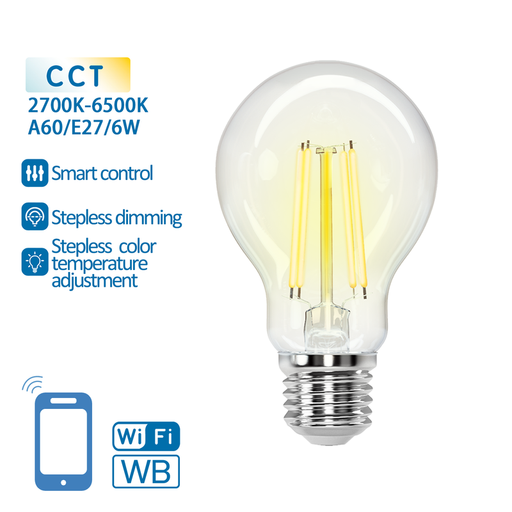
Why it is a good fit: Ideal for rental properties, bedrooms or floor lamps with an existing E27 socket. According to the product description, it can be controlled via an app as well as through Alexa or Google Home.
The E27 socket makes replacement straightforward. Before buying, check that a stable 2.4 GHz Wi-Fi connection is available at the installation location.
According to the product data: 850 lumens, 6 watts, 2,700–6,500 Kelvin and 360-degree light distribution.
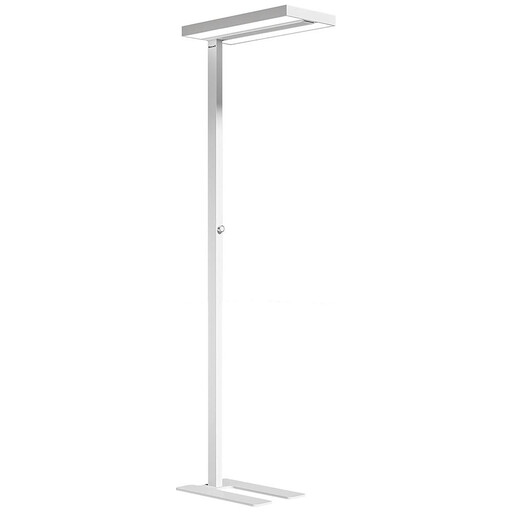
Why it is a good fit: Suitable for larger rooms or work areas where both upward and downward illumination are desired.
The stated voltage is 110 volts. In Germany, the voltage and mains compatibility must be confirmed clearly before purchase.
According to the product description: dimmable from 10 to 100 per cent, 4,000 Kelvin, CRI 97 and separate upward and downward light output.
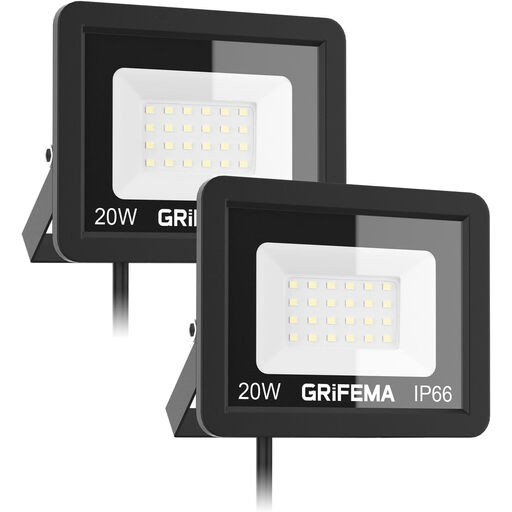
Why it is a good fit: Ideal for gardens, garages, courtyards or terraces where an adjustable bracket and protection against dust and water are required.
The IP66 rating is clearly specified. Nevertheless, cable connections, the mounting surface and the power connection must all be protected against moisture.
According to the product data: 2,200 lumens per set, 6,500 Kelvin, IP66 and 180-degree adjustment.
For indirect lighting at your desk, the Yeelight Aries Monitor Light Bar is another suitable option. According to the product name, it is dimmable and designed for gaming, home offices and studying. If you are looking for flexible lighting moods, consider the Hama Smart LED Table Lamp with RGBW lighting, app control, voice control and Matter compatibility. For decorative wall lighting, LED wall lights with 3,000 Kelvin are worth considering; with GU10 systems, individual light sources can still be replaced.
The category includes further products for direct lighting, including LED ceiling lights, spotlights and functional fixtures for a range of rooms.
That depends on the size of the room, wall colours, fixture height and the desired light distribution. For a workstation, a targeted light is often more effective than a single extremely bright ceiling lamp. Multiple light sources can reduce shadows and make it easier to adapt the lighting to different activities.
Service life is specified in hours and depends on heat generation, switching cycles, the power supply and operating conditions. A fixture rated for, say, 15,000 or 30,000 hours does not automatically replace every other lamp, as actual usage and ventilation are also critical.
No. The light source and dimmer must be technically compatible. Check the specifications for leading-edge or trailing-edge control, as well as the stated minimum load range. If the light flickers or fails to switch on reliably, the installation should be inspected and, where necessary, adjusted by a qualified electrician.