
Lieferung heute & morgen

Qualitätsgarantie

Willkommens-Angebote freischalten: KOSTENLOSE Lieferung | Bis zu 80 % RABATT | Kostenlose 30-Tage-JoyPlus-Testphase
App herunterladen
An LED night light with motion sensor should provide light automatically at night without staying on continuously. In practice, however, models vary considerably in terms of sensors, brightness, power supply and installation. If you only look at the number of LEDs or a high lumen rating, you may easily end up with a product that does not work reliably where you need it.
This buying guide explains which technical specifications are relevant for UK households and which models suit different usage scenarios.
A PIR sensor responds to movement. A dusk sensor, on the other hand, measures the ambient brightness. Many products combine both functions: the light only switches on when it is dark and movement is detected. A dusk sensor on its own is more suitable as a permanent orientation light, for example in a hallway or children’s room.
So pay close attention to the exact wording:
An LED motion sensor night light with 400 lumens can illuminate a hallway or staircase much more strongly than an orientation light with 18 or 20 lumens. For a night-time trip to the bathroom, a low, glare-free brightness may be more comfortable. A wardrobe or work surface, however, requires more light.
The lumen (lm) rating describes the total luminous flux. How the light is distributed is also important. For example, a PMMA light guide panel can help to distribute light more evenly. High light output without a dimming function can be impractical in a bedroom or children’s room.
A battery-free night light plugs directly into a socket and requires neither battery replacement nor charging. However, it may occupy a socket and cannot always be positioned flexibly around furniture or cupboards.
A USB rechargeable night light, on the other hand, can be charged using a suitable USB power adapter, laptop or power bank. Battery life depends on the battery, brightness setting and how often the sensor is triggered. Also check whether a charging cable is included and which charging connection is used.
The range should suit the installation location. For a short hallway, 3 to 5 metres is often sufficient. A larger detection area may be useful in a longer passageway or on a staircase. Specifications such as a 120° detection angle describe how wide an area the sensor can detect movement across.
Bear in mind that doors, furniture, curtains and the installation angle can affect detection. A sensor night light should be positioned so that people enter the detection area either from the side or directly.
Colour temperature is measured in Kelvin:
A dimmable night light offers more flexibility. Models with several brightness levels or continuous touch control can be set brighter during the day and more subtly at night. For babies and children, pay particular attention to indirect or evenly distributed lighting. However, no medical or therapeutic effects can be inferred from the light colour.
Magnetic holders, adhesive strips or hooks are suitable for cupboards, shelves and kitchens. A cupboard light with motion sensor should be as flat as possible so that doors and drawers continue to operate without problems. With an LED under-cabinet light with sensor, the dimensions and distance from the work surface are important.
For bathrooms and damp areas, the stated IP rating must be suitable for the environment. The indoor models listed here are not intended for direct contact with water or outdoor use. Socket night lights must not be covered, as this can affect heat dissipation and sensor operation.

Why this product suits this profile: This socket night light offers five brightness levels and is designed for children’s rooms, hallways, staircases and other indoor areas.
The combination of motion and dusk sensors reduces unnecessary activation in daylight. The brightness can be adjusted to suit the location.
0,5 W power consumption, warm white light at 2.700 K and a stated detection range of up to 3 m at 120°.
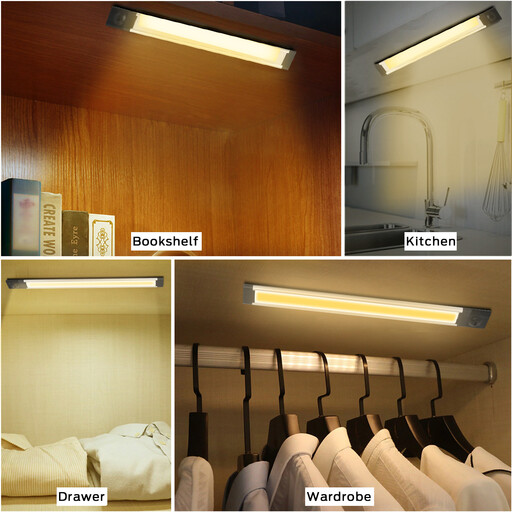
Why this product suits this profile: This elongated light is designed for bedrooms, nurseries, hallways, cupboards and stair walls, and can be installed without drilling.
The brightness can be adjusted using gesture control. This means the stated light output of 400 lm can be reduced depending on the situation.
36 Epistar 4014 SMD LEDs, adjustable colour temperature from 2.800 to 6.500 K, plus magnetic mounting and a hanging hook.

Why this product suits this profile: Two flat lights with USB charging are suitable for kitchen units, wardrobes, shelves and longer work areas.
The slim 10 mm-deep housing is designed for confined areas inside furniture. USB charging avoids the need to replace disposable batteries regularly.
41 LEDs, PIR detection with a stated range of 3 to 5 m, a 1.100-mAh battery and three colour temperature ranges.
We have put together a complete, regularly updated list of products that fully meet these strict selection criteria and the safety regulations applicable in the EU.
Before installation, check that the sensor covers the route you want to illuminate and that the light is positioned to avoid glare. For a bedroom night light or a children’s room, a low brightness setting is recommended. In hallways, on staircases or in bathrooms, the light should not be obstructed by doors or furniture.
For adhesive installation, the surface must be clean, dry and free from grease. Magnetic mounts make it easier to remove the light for charging, but require a suitable metal surface or an included holder. Socket models plug directly into a suitable 220- to 240-volt socket. Cleaning and maintenance should always be carried out with the power disconnected, using a soft, dry cloth.
The stated power consumption of the models mentioned is, for example, 0,5 or 1 watt. Actual consumption depends on how often the sensor is triggered and how long the light remains on. A combined PIR and dusk-sensor system can reduce unnecessary switching during daylight. USB models also require power to recharge the battery.
For a hallway that only needs to be lit when someone walks through it, a PIR motion sensor is usually the better choice. A dusk sensor is suitable when a faint orientation light is needed continuously. Combined systems offer both functions, switching on only when it is dark and movement is detected.
Service life depends on the LED module, electronics, operating time, heat dissipation and surroundings. Permanently installed LEDs often have a stated technical service life, while USB night lights also require consideration of battery ageing. Ensure that heat can dissipate freely, do not cover the sensor or light, and only use suitable chargers.