
Lieferung heute & morgen

Qualitätsgarantie

Willkommens-Angebote freischalten: KOSTENLOSE Lieferung | Bis zu 80 % RABATT | Kostenlose 30-Tage-JoyPlus-Testphase
App herunterladen
An LED night light with motion sensor can illuminate the way to the bathroom, children’s room or stairs at night, without you having to search for the main light switch. However, not every model is suitable for every location. Unclear sensor specifications, an unsuitable light colour or an impractical power connection often result in disappointing purchases.
This buying guide explains which technical specifications really matter and what families, older people and households with hallways, cupboards or stairs should look out for.
A motion-sensor night light responds to movement. A night light with dusk sensor, on the other hand, switches on or off depending on the ambient light level. Some models combine both functions: they only light up in darkness and also respond to movement.
This combination is often practical in a hallway. A dusk sensor on its own, however, can remain permanently lit once it gets dark. This is suitable for plug-in models, but may not always be desirable in a bedroom or children’s room.
Brightness is often specified in lumens (lm). Depending on the room, lower levels are usually sufficient for orientation lighting. A model with 400 lumens is more of a versatile supplementary light than a subtle night light.
Colour temperature is also important:
Marketing terms such as ‘soft’ or ‘eye-friendly’ should not replace technical specifications. The key factors are light colour, lumens, beam angle and any dimming function.
An LED plug-in night light does not require batteries or charging. It is particularly suitable for fixed locations such as hallways, bedrooms or children’s rooms. However, it may block an adjacent socket or be awkwardly positioned around furniture.
A battery-powered night light can be flexibly mounted on cupboard sides, walls or stairs. Buyers should check whether batteries are included and how often they are likely to need replacing. A rechargeable night light reduces the need for disposable batteries, but must be charged regularly via USB.
Pay attention to the stated detection range, detection angle and automatic switch-off time. A model with a range of 3 metres may be sufficient for a short hallway, while a wider angle may be more practical on a broader staircase.
Mounting height is also important. The sensor should not be obstructed by furniture, curtains or decorations. With a night light featuring a dusk sensor, the light sensor must not be aimed directly at another light source either.
A dimmable night light can be adapted more effectively to different situations. A low setting may be preferable when getting up during the night, while a little more light may be needed in the hallway. Models with several brightness levels or continuous adjustment are particularly practical.
The design should also be checked for plug-in models. Dimensions such as 75 × 56 × 73 millimetres can determine whether the light switch or a second socket remains accessible.
Many models in this category are intended exclusively for indoor use. IP20, for example, means that there is no specific protection against water. A night light for the bathroom should therefore not be used in areas exposed to splashing water unless the product specifications explicitly permit this.
Cleaning and maintenance should always be carried out with the light switched off or unplugged. Do not open, cover or structurally modify the product. CE and RoHS information can be taken into account when choosing a product, but does not replace checking whether it is suitable for the intended location.
The following models differ in terms of sensor type, power supply, brightness and mounting. The information is based on the respective product details.
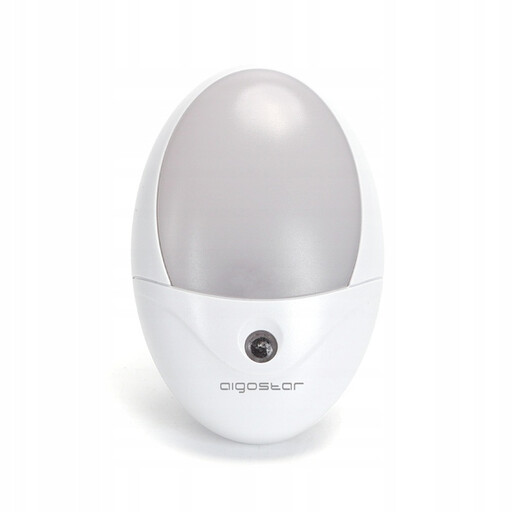
Why this product suits this profile: This plug-in model uses an automatic day-night sensor and requires neither batteries nor USB charging. With 20 lm and 3000 K, it is designed as an orientation light for hallways, bedrooms or children’s rooms.
The sensor type and the condition for switching on in darkness are clearly described. Buyers should not expect motion activation here, but rather automatic background lighting.
20 lm, 3000 K, 120° beam angle, 1 W power consumption and IP25 according to the product details.
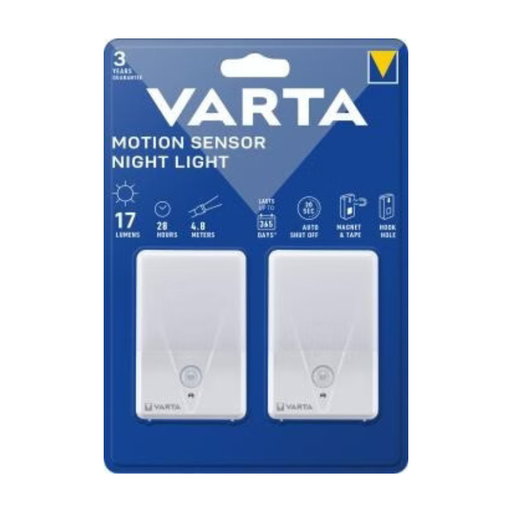
Why this product suits this profile: This battery-powered night light offers several mounting options and is suitable for hallways, bathrooms, cupboards and stairs without an accessible socket.
The power supply and automatic switch-off after 30 seconds are clearly specified. According to the description, the required 3 AAA batteries are not included.
Twin pack, 17 lm, 3 m range, 120° detection angle, plus mounting with a screw, magnet or adhesive strip.
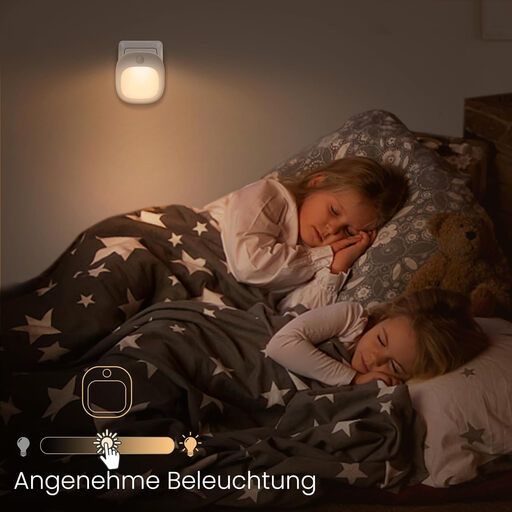
Why this product suits this profile: This rechargeable night light is ideal for households looking to equip several rooms without fixed sockets and adjust the light colour and brightness to suit their needs.
The charging method, battery capacity and sensor conditions are specified. This makes it easier to weigh up the need for regular charging against avoiding disposable batteries.
Set of 2, 500-mAh battery, up to 10 hours in sensor mode, 3 colour temperatures and 5 brightness levels.
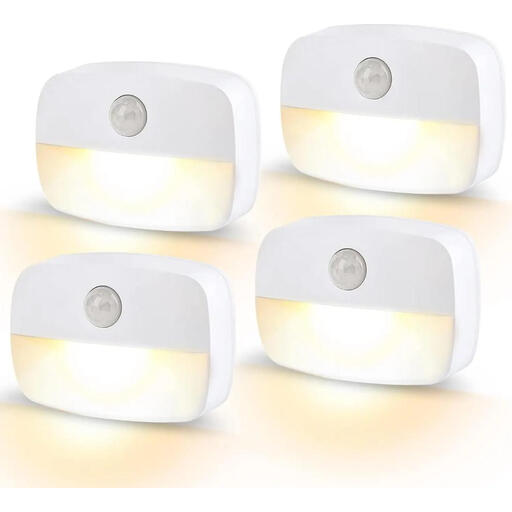
Why this product suits this profile: The set of 4 can be used for a cupboard, hallway, staircase and bathroom at the same time. The adhesive-strip mounting is designed for clean, dry surfaces.
The required 3 AAA batteries per light are not included. This makes the ongoing costs transparent before purchase, so they can be budgeted for.
4 lights, 35 lm, 120° detection angle, automatic switch-off after 20 seconds and 3200–2800 K warm white light.
We have put together a complete, regularly updated list of products that fully meet these strict selection criteria and the safety regulations applicable in the EU.
Position the light so that the sensor covers the area where movement is expected and is not obstructed by furniture or textiles. For adhesive mounting, the surface must be clean, dry and smooth. Plug-in models should be positioned so that the switch and adjacent sockets remain accessible.
Service life depends on the LED module, electronics, operating time and power supply. Product specifications such as 10,000 or 25,000 hours refer to the manufacturer’s stated figures and are not a guarantee of identical service life in the home. With battery and rechargeable models, energy consumption per activation is also relevant.
Power consumption is specified in watts. Models using 0.3 to 1 W require comparatively little electrical power while operating; actual consumption depends on how often and for how long the light is activated. A sensor with automatic switch-off can limit the lighting duration. With a battery-powered night light, regular battery costs arise instead of electricity consumption from a socket.