
Lieferung heute & morgen

Qualitätsgarantie

Willkommens-Angebote freischalten: KOSTENLOSE Lieferung | Bis zu 80 % RABATT | Kostenlose 30-Tage-JoyPlus-Testphase
App herunterladen
An LED outdoor wall light should reliably illuminate your front door, patio or garden while complementing the building. However, product images and advertising claims do not always show whether a light is suitable for its intended installation location. The wrong purchase is often caused by an insufficient protection rating, unsuitable light output or a complicated power supply.
This buying guide explains which technical details really matter when choosing an LED outdoor lamp, outdoor wall light or LED outdoor wall lamp. We then match selected models to different user profiles.
The protection rating is indicated by the IP code. An IP44 outdoor light is protected against solid foreign objects measuring 1 mm or more and against splashing water from various directions. It is suitable, for example, for a partially sheltered entrance, a covered patio or an exterior wall with a roof overhang.
However, IP44 does not mean that the light should be permanently exposed to a powerful jet of water or installed in a hollow where water can collect. Higher protection ratings may be advisable for particularly exposed locations. It is also essential that cable connections, seals and wall installation are carried out correctly.
Power consumption in watts primarily describes electricity usage. For brightness, luminous flux in lumens is more informative. For example, an integrated 11-watt light may deliver 950 lumens, while a smaller 4-watt rechargeable light may only reach 300 lumens.
Use the following as a guide:
The actual effect also depends on the beam angle, installation height and wall colour.
Many modern models have a permanently installed LED module. This reduces the complexity of the light’s construction, but it also means that when the module reaches the end of its service life, the complete light will usually need to be replaced. If you want to remain flexible in the long term, you can choose an outdoor wall light with an E27 socket and replace the bulb separately.
3,000 Kelvin produces warm white light and is often well suited to entrances, patios and seating areas. For paths or security areas, neutral white light can provide clearer visibility. Models with up-and-down lighting distribute light upwards and downwards, showcasing a structured exterior wall to attractive effect.
Also check whether the light shines directly at eye level. A frosted glass cover or diffuser can help reduce glare.
An outdoor light with a motion sensor switches on when movement is detected. This is practical for entrances, garages and stairs. Before buying, check the detection range and the available settings for on-time and sensitivity. A motion sensor does not replace sufficient general lighting if the area is meant to remain illuminated continuously.
A dimmable outdoor wall light requires a compatible LED dimmer. Some models do not include the dimmer. Before installation, check that the existing switch and the light are technically compatible.
Rechargeable and solar lights are useful where no mains connection is available. However, their brightness and operating time depend on the charge level, sunlight and ambient temperature. Permanently connected lights, on the other hand, require professional electrical installation.
Aluminium, metal, plastic and glass are frequently combined. A coated metal surface can complement your chosen style, while glass covers help distribute the light. Check the dimensions of the installation surface and the distance to the connection box. On narrow walls or beside doors, compact models measuring around 12 to 16 cm wide may be a better fit.
When connecting to 220–240 V, installation should be carried out by a qualified electrician. The power supply must be disconnected before maintenance work. A soft, dry or slightly damp cloth is usually sufficient for cleaning; abrasive cleaners and high-pressure water can damage surfaces and seals.
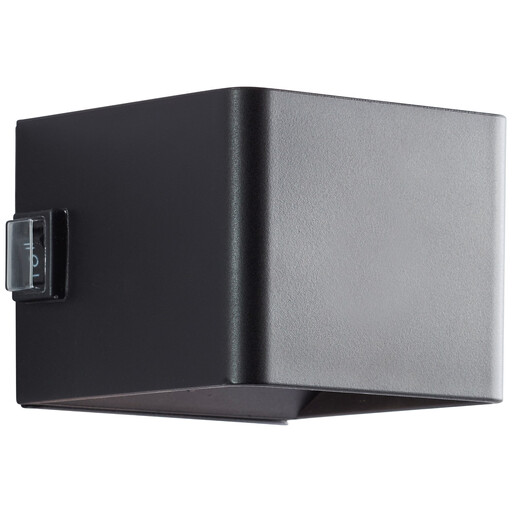
Why this product suits this profile: The portable rechargeable light is designed for tenants, small entrance areas and locations without a permanent power connection. It delivers 300 lumens at 3,000 Kelvin and can be attached using a magnet.
The rechargeable battery avoids complex cabling work. Nevertheless, the IP44 rating should be combined with a sheltered installation location.
Integrated motion sensor, USB charging, toggle switch and magnetic mounting with a power consumption of 4 watts.
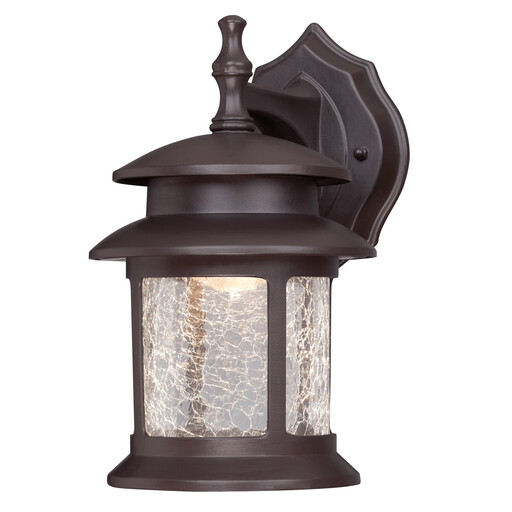
Why this product suits this profile: This model combines an aluminium housing, crackle-effect clear glass, warm white light and a dimmable integrated 9-watt LED.
The technical specifications state a luminous flux of 1,000 lumens from the light source, 3,000 Kelvin and IP44. This makes it easier to compare brightness and installation location before buying.
Dimmable with a suitable LED dimmer, an average service life of 35,000 hours according to the product specifications, and a 220–240-volt connection.
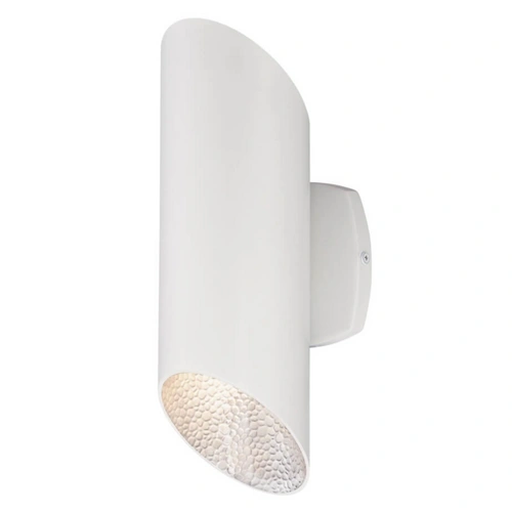
Why this product suits this profile: The white aluminium light is 12 cm wide and uses two integrated 7.5-watt LED modules for space-saving up-and-down lighting.
The width is clearly specified. Its dimmability is also stated, although the compatible dimmer is not included.
Modern white aluminium, IP44 protection rating and a dimmable, non-replaceable LED light source.
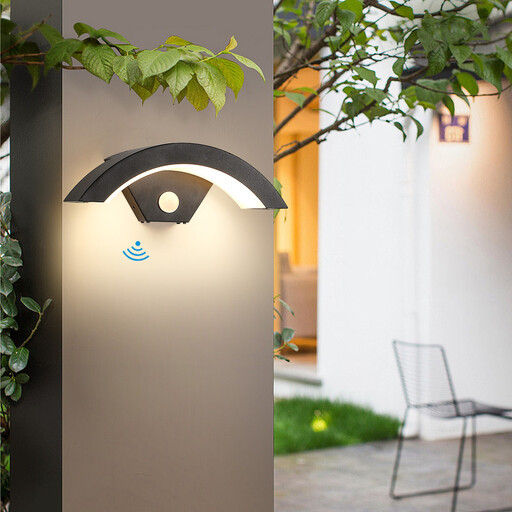
Why this product suits this profile: The U-shaped design with light and motion sensors is aimed at users who want to illuminate entrances, garages, driveways or paths automatically.
The sensor reduces unnecessary operating time. Before buying, check the detection range, orientation and exact IP protection rating in the product details.
24 watts, matt die-cast aluminium and a combined light and motion sensor according to the product description.
We have put together a complete, regularly updated list of products that fully meet these strict selection criteria and the safety regulations applicable in the EU.
IP44 is often used for partially sheltered outdoor areas. This means that the light is protected against splashing water. A higher protection rating may be advisable for exposed installation locations subject to heavy weather. The manufacturer’s specifications and professional sealing of the installation are key.
Consumption depends on the wattage and operating time. A 10-watt light uses 0.1 kWh in ten hours of operation. Motion sensors and timers can reduce the actual operating time. For a fair comparison, you should consider not only the wattage but also the luminous flux in lumens.
Service life depends on the LED module, power supply, heat dissipation, switching cycles and ambient temperature. Manufacturers may provide average figures, but these do not automatically guarantee an individual service life. With permanently integrated LEDs, it is also important to note that the module may not be replaceable separately, depending on the design.