
Lieferung heute & morgen

Qualitätsgarantie

Willkommens-Angebote freischalten: KOSTENLOSE Lieferung | Bis zu 80 % RABATT | Kostenlose 30-Tage-JoyPlus-Testphase
App herunterladen
An LED outdoor wall light should reliably illuminate your entrance, patio or garden while using as little energy as possible. In practice, however, some common marketing claims can lead to poor purchases: a higher wattage does not automatically mean more light, a motion sensor is not suitable for every location, and the term “weather resistant” is no substitute for checking the IP rating.
This buying guide explains which specifications really matter before purchasing an outdoor light with a motion sensor, solar outdoor lighting or a decorative wall light.
Wattage describes energy consumption, not the amount of light directly. For brightness, the luminous flux in lumens is the key factor. For example, a 4-watt light may provide 300 lumens, while an 11-watt light can deliver 950 lumens. When choosing entrance lighting or a security light, you should therefore first check how many lumens are needed for the area.
A weather-resistant wall light should have a clearly defined IP rating. With an IP44 outdoor light, the first digit indicates protection against solid foreign objects measuring 1 millimetre or more. The second digit indicates protection against splashing water from different directions.
IP44 is suitable for many sheltered outdoor areas, but it does not mean that the light is protected against high-pressure water, permanently standing moisture or every possible installation situation. The installation location and the manufacturer’s instructions remain decisive.
An outdoor wall light with a light sensor switches on depending on the ambient brightness. A motion sensor, by contrast, responds to movement within its detection range. Automatic activation can be useful on a driveway. On a patio where people spend longer periods, frequent switching on and off can be irritating.
Solar outdoor lighting also has certain requirements: the solar panel needs sufficient daylight. A shaded balcony or a permanently covered entrance can significantly reduce charging performance.
A permanently connected LED outdoor wall light requires a suitable electrical connection. Electrical work on outdoor installations should only be carried out by a suitably qualified professional.
Portable models with an integrated battery can be positioned flexibly and charged via USB. However, you need to take the charge level and operating temperature range into account. With an integrated, non-replaceable LED unit, you should also check what maintenance and replacement options the manufacturer provides.
Solar lights do not require an external power cable, but they depend on their location and the amount of sunlight received each day. For string lights such as the M.TK Copper Wire Lamp, an IP44 rating is specified for protection against splashing water; the solar panel should be cleaned regularly with a dry cloth.
Metal and plastic housings can differ in terms of weight, care requirements and corrosion resistance. Suitable corrosion-protected screws are needed for installation on a façade. Before buying, check the dimensions, wall area and cable routing.
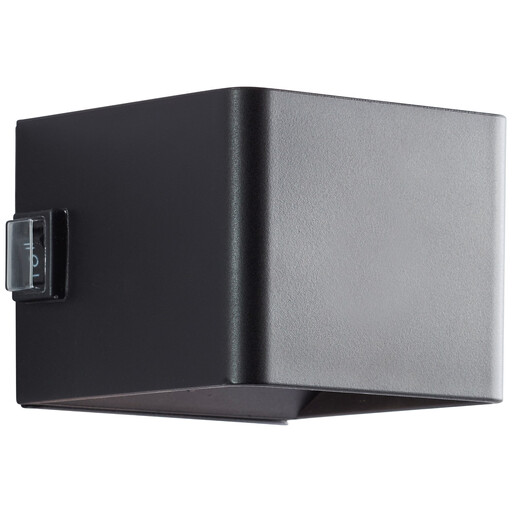
Why this product suits this profile: This portable LED wall light has an integrated battery, charges via USB and does not require a fixed electrical connection. It is suitable for smaller entrance areas, patios or garden spaces.
The stated 300 lumens and IP44 rating make it easier to assess the performance than wattage alone. The motion sensor is integrated rather than merely offered as optional accessory.
4 watts, 300 lumens, 3,000 Kelvin, integrated battery, USB connection, magnetic mounting and IP44 rating.
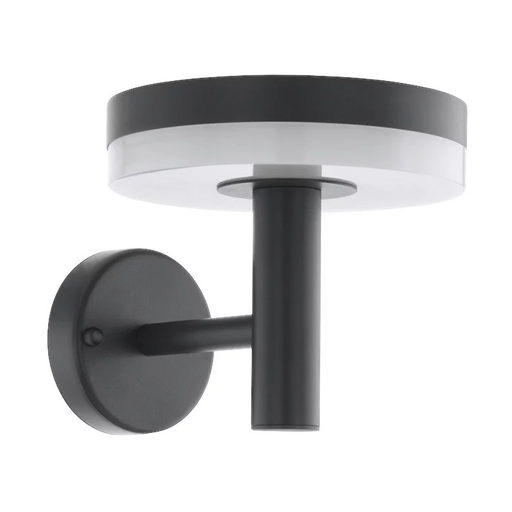
Why this product suits this profile: This permanently installed light combines a metal and plastic housing with an anthracite finish and warm white light. It is suitable for entrances, patios, paths and garden areas with a permanent power connection.
The combination of 950 lumens and 3,000 Kelvin provides clear points of comparison. The integrated LED unit is designed for energy efficiency; according to the product information, it is not replaceable.
11 watts, 950 lumens, warm white light at 3,000 Kelvin and a design intended for permanent outdoor installation.
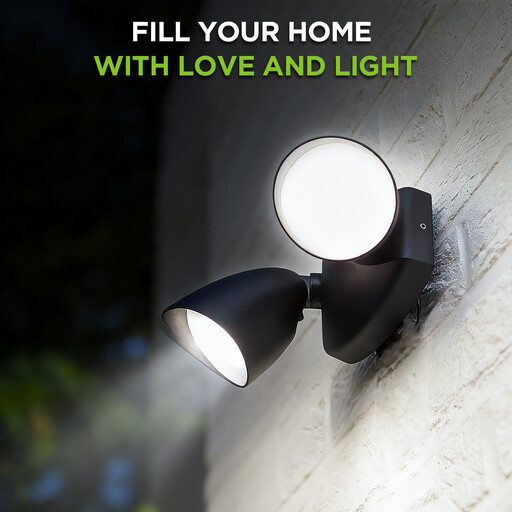
Why this product suits this profile: This twin-lamp outdoor light is designed to illuminate large areas such as courtyards, garages, gardens or driveways. The light is specified as neutral white at 4,000 Kelvin.
Rather than focusing solely on wattage, the product specifies 1,800 lumens and 20 watts. The two light heads help distribute the light precisely.
1,800 lumens, 20 watts, dual-head design, metal construction and 4,000 Kelvin.
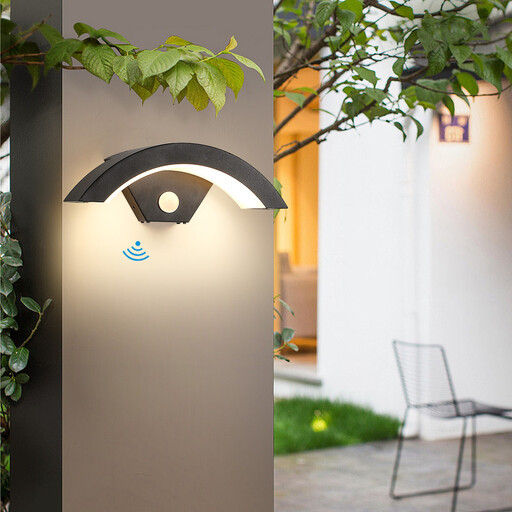
Why this product suits this profile: The U-shaped design with a matt aluminium housing is aimed at users looking for a permanently installed light for a veranda, balcony, staircase, garage or driveway.
A light sensor and motion sensor are explicitly listed as features. This makes it easier to check whether automatic activation is suitable for the intended installation location.
24 watts, warm white light at 3,000 Kelvin, U-shaped design, aluminium housing, plus light and motion sensors.
We have put together a complete, regularly updated list of products that fully meet these strict selection criteria and the safety regulations applicable in the EU.
Before ordering and installing, the following points can help:
That depends on how it will be used. For basic orientation on a balcony or at a sheltered entrance, 300 lumens may be sufficient. For a larger patio, garage or driveway, 950 to 1,800 lumens provide considerably more light. Beam angle, installation height and the desired light distribution are also important.
A light with an IP44 rating is protected against splashing water and may be suitable for many sheltered outdoor areas. However, it should not be installed where water remains for long periods or hits the housing under high pressure. The manufacturer’s specific installation instructions are binding.
The cost depends on the power rating, daily operating time and electricity tariff. A 4-watt light operating for one hour per day uses 4 watt-hours per day in theory. A 20-watt light uses 20 watt-hours over the same period. Motion and light sensors can reduce the actual operating time; with solar lights, direct mains operation is not required, but performance depends on charging capacity.