
Lieferung heute & morgen

Qualitätsgarantie

Willkommens-Angebote freischalten: KOSTENLOSE Lieferung | Bis zu 80 % RABATT | Kostenlose 30-Tage-JoyPlus-Testphase
App herunterladen
Magnetic building blocks for children combine open-ended building with shapes, colours and spatial thinking. However, sets can vary considerably in the number of pieces, how the magnets are enclosed, the materials used and how they are stored. A large box or terms such as “STEM” and “Montessori” don’t, on their own, tell you how practical a set will be for everyday play.
Before buying, parents should look beyond the price. What matters is whether the set suits their child’s motor skills, the space available and their age.
A set with a high piece count may contain lots of small or very similar elements. For children aged 3 and over, shapes that are easy to handle and clear ways to join them are often more important than a large number on the box. So check:
A set with 28 larger pieces may be easier to get to grips with, while 100 or 150 pieces will need more space and sorting.
Magnets can hold constructions together, but they pose a serious risk if swallowed. Swallowing more than one magnet can cause severe injuries, so safety warnings are particularly important.
Look for:
Even a product with smooth edges isn’t automatically suitable for younger children. Children under 3 should generally not use magnetic construction toys, particularly where the supplier provides a specific warning.
STEM toys for children can introduce geometry, proportions and problem-solving through play. But a product isn’t automatically educationally valuable just because it’s labelled “STEM” or “Montessori”. More meaningful features include:
For creative building blocks aimed at children aged 3 and over, the information on the product page and packaging should match. The age recommendation isn’t a developmental assessment; it’s a guide to small parts, handling and the complexity of play.
The magnetic sets covered here are listed as suitable from age 3. As they contain small, strong magnets, adult supervision is sensible, especially the first time they’re used. Damaged pieces should be removed from the child’s play area.
ABS plastic is commonly used for magnetic tiles and other construction sets. Practical features to look for include smooth edges, an even finish and a casing that securely encloses the magnets. Claims such as “non-toxic” or “BPA-free” should be treated as information provided by the manufacturer and don’t replace the legally required product information.
According to the product details, the XINQIYUAN set is made from ABS plastic, has smooth edges and uses ultrasonic welding. The description also refers to CPC and ASTM safety standards. These details come from the product description, so check them against the current markings on the specific item before buying.
The dimensions matter too. The stated size of a building block in the XINQIYUAN set is 5.5 cm. TOKKY lists an individual piece size of 2.5 cm for its 100-piece pixel set. Different systems aren’t necessarily compatible with one another.
A box or bag is useful for families with limited storage space. Having somewhere to put the pieces helps prevent them getting lost and makes them easier to sort. In most cases, clean magnetic building blocks with a soft cloth, following the manufacturer’s instructions. Avoid harsh cleaning products and soaking them in water for long periods.

Why this product suits this profile: With 28 pieces and a stated block size of 5.5 cm, this set offers a manageable introduction to magnetic building. A storage bag is included.
The piece count is clearly stated, and the product description gives specific information about small parts, magnets, damage and supervision.
28 pieces, 5.5 cm blocks, a storage bag and, according to the supplier, ABS plastic with smooth edges.
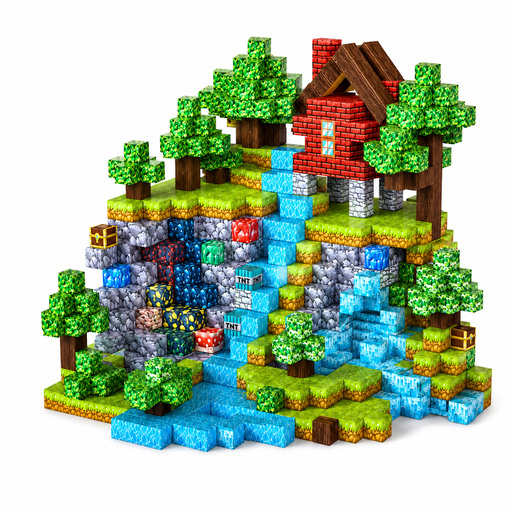
Why this product suits this profile: According to the product description, families who build regularly and want to expand their collection get 150 pieces, with compatibility across other sets.
Rather than relying only on marketing claims, the description mentions rounded corners, enclosed magnets and regular checks for damage.
150 pieces, rounded edges, ABS material according to the supplier, and the option to expand the set.
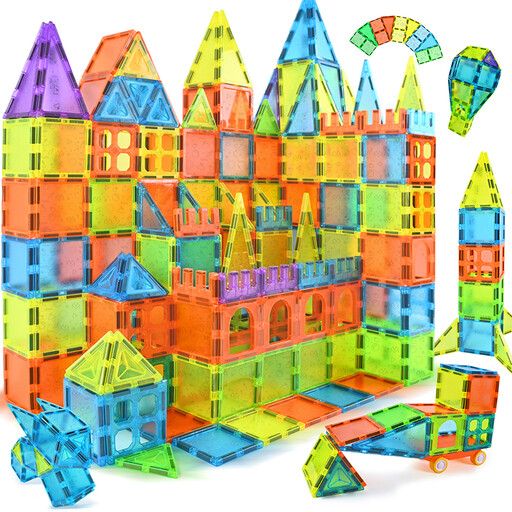
Why this product suits this profile: This set is suited to children who build frequently and want to switch between flat patterns and geometric 3D shapes.
The product information specifically lists the material, ultrasonic welding, rounded edges and care instructions, making it easier to check the details before buying.
122 pieces, 2D and 3D building possibilities, plus ABS plastic and no batteries required, according to the supplier.
We’ve put together a complete, regularly updated list of products that fully meet these strict selection criteria and the safety regulations in force in the EU.
A simple routine can help magnetic construction toys last longer:
For shared STEM learning, parents can set simple challenges: build the tallest structure possible, make a symmetrical pattern or design a bridge using a set number of pieces. This keeps play open-ended without promising a specific learning outcome.
Many sets are listed by the supplier as suitable from age 3. However, they contain small, strong magnets and can become dangerous if their casings are damaged. The age recommendation, safety warnings and regular checks are therefore important. Children should be supervised while playing.
Their lifespan depends on the materials, construction and how they’re handled. Throwing them, standing on them, bending them sharply or exposing them to moisture can damage the casings or connections. If you spot cracks, loose magnets or open casings, stop using the set.
A smaller set of around 28 to 50 pieces is enough for first models. For larger houses, towers or scenes built together, sets with 78, 100, 122 or 150 pieces are more practical. The mix of shapes and compatibility of the individual pieces matter just as much as the number.