Biscuit bakers using several trays
If you’re planning to make lemon biscuits for guests, compare the tray area and how many batches you’ll need to bake. Dr. Oetker’s example recipe makes 50–60 biscuits.


You don’t automatically need an extra countertop oven: first check whether the oven in your holiday home has a suitable baking tray and a heating mode that works with your recipe. If there isn’t a suitable oven, choose a freestanding mini oven based on the tray size and a safe place to put it, rather than capacity alone. A smaller tray may mean baking more batches if you’re making a larger quantity. Dr. Oetker’s lemon biscuit recipe lists conventional heat or fan-assisted heat as options. The heating mode and clearance around the oven must be suitable for the instructions for your specific model.
If you’re planning to make lemon biscuits for guests, compare the tray area and how many batches you’ll need to bake. Dr. Oetker’s example recipe makes 50–60 biscuits.
You need a freestanding oven, but you’ll also need to check the clearance and positioning instructions for the specific model, not just its external dimensions. For example, Steba’s instructions for the KB M19 specify a gap between the oven and the kitchen wall.
You want to match the oven’s heating mode to your recipe. Dr. Oetker’s lemon biscuit recipe lists conventional heat and fan-assisted heat as alternatives; not every compact model offers both.
First check whether the oven in your holiday home is up to the job. If you need another appliance, compare the tray area, a safe place to put it and the heating mode your recipe calls for.
| What to look for | What to check before buying | Who it matters most to |
|---|---|---|
| Tray area and number of batches | The tray’s dimensions and what’s included; whether the usable area is big enough for the quantity you plan to bake. | If I’m baking lots of biscuits, I want to know how much dough will fit on one tray and how many batches I’ll need. Around 36% of consumers put tray area and the amount that fits in each batch first. |
| A safe place to put it | Compare the external dimensions with the available space, and check the clearance requirements in the instructions for that exact model. | With limited worktop space, I need to be able to position the oven with the required clearance around it. That’s why around 29% of consumers prioritise finding a suitable spot. |
| The right heating mode | Check whether the specific model offers conventional heat or fan-assisted heat, and what temperature range it has. | If I’m following a particular recipe, I want to be able to select the heating mode it calls for. Around 21% of consumers put the right heating mode for their recipe first. |
| Cleaning and accessories | Check what’s included, whether there’s a removable crumb tray and whether a suitable replacement tray is available. | Occasional bakers may want to consider the cost, cleaning and replacement parts too. Around 14% of consumers put these considerations ahead of other buying criteria. |
The oven’s internal capacity doesn’t tell you how large the baking tray is. What matters for the quantity you plan to make is the usable area of the tray.
Compare the tray dimensions and what’s included with the exact model variant. Only plan to bake on multiple levels at once if the instructions for your specific model explicitly say you can.
A smaller tray may mean you need to bake more batches.
A countertop oven needs more than just the space it sits on: clearance requirements and hot surfaces can affect whether the spot you have in mind is suitable.
Before buying, check the external dimensions and positioning instructions for your chosen model. For example, Steba specifies a 10 cm gap between the KB M19 and the kitchen wall behind it; this doesn’t automatically apply to other appliances.
According to the technical specifications, the Severin TO 2067 doesn’t have a fan function. So if a recipe offers different heating modes, the oven will only suit the method you want to use if it actually has that setting.
Check the operating modes in the technical specifications for the full model name and compare them with your recipe.
The freestanding BG 1055/E and BGE 1580/E models offer different oven capacities to suit different space and tray requirements.
The freestanding TO 2067 may be worth considering if conventional heat is sufficient for your chosen recipe.
The KB M19 is a freestanding oven that the manufacturer says is designed for smaller portions and compact kitchens.
According to the manufacturer, the MBG 3727 is a freestanding multi-function oven with a 25 l capacity.
The CBG7341B1 compact built-in oven is an example for kitchens with a suitable built-in space, not for freestanding use.
This selection includes freestanding mini ovens for baking in a holiday home, with a range of capacities and features.
 No image available
If you’re looking for a freestanding oven for baking, check whether the included tray is large enough for the quantity you plan to make.
32 l; 1,600 W; temperature range 100–250 °C; 60-minute timer; removable crumb tray.
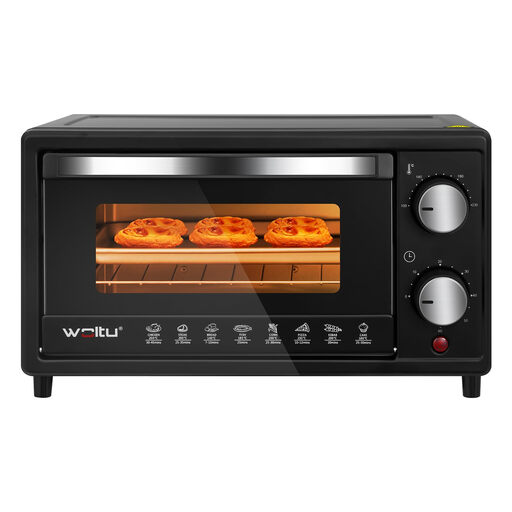 No image available
If you’re looking for a smaller appliance, compare the available tray area with the quantity you’d like to bake in each batch.
10 l; temperature range 100–230 °C; programmable timer up to 60 minutes. The product description lists upper and lower heating elements.
 No image available
If you’d like to use different heating modes, check whether the model’s specifications suit your recipe.
28 l; temperature range 100–230 °C; mechanical 60-minute timer. The product description lists upper heat, lower heat or a combination of both.
Follow your recipe and the oven’s instructions. After preheating, Dr. Oetker’s lemon biscuit recipe calls for around 180 °C with conventional heat or 160 °C with fan-assisted heat, a baking time of 10–12 minutes and the middle shelf. This is an example from a recipe, not a setting tested for every mini oven.
It depends on the positioning instructions for the specific model; the dimensions alone don’t mean it’s approved for use in an alcove. Steba explicitly says the KB M19 is not a built-in oven, warns that its surfaces get hot and specifies a 10 cm gap between the oven and the kitchen wall behind it. These instructions don’t apply to other models.
Only plan to do so if the instructions allow it for your exact model variant. A reply from Rommelsbacher support mentions preheating and a fan-assisted programme for the BG 1580/E; this doesn’t automatically confirm that the differently named BGE 1580/E can be used on multiple levels.
Follow the cleaning instructions for your model, let hot parts cool down and disconnect the appliance from the mains as directed. Steba’s instructions say to unplug the KB M19 after use; Rommelsbacher lists a removable crumb tray for the BGE 1580/E.
In Germany, your statutory rights apply against the seller and are separate from any voluntary guarantee. The Verbraucherzentrale says that, as a rule, new goods are covered for two years from purchase or delivery. Keep your proof of purchase and check any guarantee terms separately.