For a lentil cottage pie to cover several lunches, first check whether the filled dish and the number of portions you want to make will fit in the oven in one go. If you have a suitable space, a built-in fan oven could work; if not, consider a freestanding fan-assisted mini oven, provided your dish and its handles will fit. Check the usable dimensions, the required clearance and the available heating functions. A capacity figure in litres alone does not confirm that your dish will fit or that the oven will cost less to run. If you’re preparing portions in advance, it’s also important to cool them quickly and store them in the fridge.
Who are these oven options for?
Batch cooking for the week
If you want to prepare several lunches at once, the size of your casserole dish and the number of portions you need are particularly important. Germany’s Federal Centre for Nutrition describes meal prepping for several days as one way to prepare meals in advance.
Baking without space for a built-in oven
If you’re making smaller quantities and don’t have a suitable space for a built-in oven, you’ll need a freestanding appliance that fits on your available worktop and can be safely positioned with the clearances specified in its instructions.
Choosing heating functions for different oven dishes
If you make other oven dishes as well as casseroles, you may want to choose between fan-assisted and conventional top-and-bottom heat. The settings available depend on the model.
What should you look for when buying?
For this purchase, focus on the dish and number of portions, a safe space for installation or positioning, the heating functions and the ongoing running and cleaning effort.
| What matters when buying |
What to check |
Who is it most relevant to? |
| Dish size and weekly batch |
Measure the dish, including its handles and height, then compare its dimensions with the usable oven cavity or a stated maximum dish size. Rommelsbacher lists round dishes up to 29 cm in diameter for the BGE 1580/E. |
If I’m baking several lunches in one go, the filled dish needs to fit. Around 36% of consumers put dish size and batch size first. |
| Safe space for positioning or installation |
Measure the worktop or recess, allow room for the door to open and check the instructions for the exact model. The Steba instructions require a 10 cm gap from the wall for the KB M19 and prohibit installing it as a built-in oven. |
If I don’t have a suitable space for a built-in oven, I need a freestanding appliance that can be positioned with the required clearances. For around 29% of consumers, a safe space for positioning or installation is the main consideration. |
| Heating functions |
Check whether the specific model really offers fan-assisted and conventional top-and-bottom heat, and which shelf position the instructions recommend for a deep casserole. Rommelsbacher lists these functions for the BGE 1580/E; Severin describes them for the TO 2058. |
If I make other casseroles too, I want to be able to choose the right heating function for the recipe. Around 21% of consumers prioritise the heating functions available. |
| Energy use and cleaning |
For household ovens with the relevant energy label, compare consumption per standard cycle on a like-for-like basis; the wattage alone doesn’t show how much energy is used for one casserole. Also check the cleaning options and available accessories. |
If I batch cook often, the time and effort involved each time, as well as cleaning, matter to me. Around 14% of consumers prioritise running costs and care. |
Built-in fan oven
A good fit if: you have a suitable recess and want to bake a large dish or a bigger batch in one go.
Things to consider: the recess dimensions and electrical connection must be suitable. A large oven cavity doesn’t guarantee that several deep casserole dishes will fit.
Freestanding fan-assisted mini oven
A good fit if: you don’t have a suitable space for a built-in oven and have confirmed that your dish fits the specific appliance.
Things to consider: you’ll also need space for the appliance and its safety clearances. Smaller dishes may mean baking in several batches.
Keep using your existing oven
A good fit if: your dish, batch size and preferred heating function already work with your current appliance.
Things to consider: a mini oven isn’t necessarily more economical simply because it’s smaller.
Avoid common buying mistakes
-
Comparing only the capacity in litres with your dish
The oven capacity doesn’t tell you the usable length, width and height at the shelf position you’ll use. Your filled dish may therefore be too big, even if the capacity in litres looks suitable.
Measure the dish, including its handles, and compare its dimensions with the usable oven cavity or the stated maximum size for that exact model.
-
Positioning a countertop oven like a built-in oven
Required clearances can make a space that looks suitable unsafe to use. The Steba KB M19 instructions prohibit built-in installation and require a 10 cm gap between the back of the oven and the kitchen wall.
Check the instructions for your chosen appliance against the space available on your worktop and around nearby walls and furniture.
-
Assuming a lower wattage or smaller size means lower energy costs
Power rating, energy use per standard cycle and the electricity used for a particular weekly batch are different things. Germany’s consumer advice centre explains that the standard cycle is used to compare the heating functions listed.
Compare figures only when they’re based on the same method, and consider how many baking cycles your dish and portion size will require.
-
Planning to keep cooked portions unrefrigerated throughout the working week
Choosing an oven doesn’t replace the need to cool prepared meals and store them in the fridge. Germany’s Federal Institute for Risk Assessment recommends cooling hot food quickly to below 7 °C for longer-term storage.
Plan how you’ll cool and refrigerate your meals, including when you’re taking them to work.
Brands to consider
Bosch
Built-in ovens for kitchens with a suitable recess; the HBA272BB3 is one example with a larger cavity.
- Bosch lists a 71 l capacity, 3D hot air on up to three levels, and pyrolytic and hydrolytic cleaning for the HBA272BB3.
- The number of levels doesn’t tell you whether several deep casserole dishes will fit at the same time. Check the appliance’s installation dimensions.
Rommelsbacher
Freestanding mini ovens; the BGE 1580/E could suit a suitably sized medium dish if you don’t have space for a built-in oven.
- Rommelsbacher lists a 30 l capacity, round dishes up to 29 cm in diameter, switchable fan assistance and selectable heating functions for the BGE 1580/E.
- The stated diameter doesn’t confirm that a rectangular dish with handles will fit. Also check the external dimensions and positioning requirements.
Severin
Freestanding ovens and toaster ovens; the TO 2058 offers a larger, compact cavity for casserole dishes that fit.
- Severin lists a 42 l capacity, four shelf levels and top-and-bottom heat and fan assistance, which can be combined, for the TO 2058.
- The capacity doesn’t confirm that your dish will fit or that several levels can be used at once for deep casserole dishes.
Steba
Compact countertop ovens for smaller dishes; with the KB M19, you can compare the internal and external dimensions with your kitchen and dish.
- Steba lists a 19 l capacity, switchable fan assistance and separately selectable top-and-bottom heat for the KB M19.
- According to Steba, the internal dimensions are 23,5 × 31 × 25,5 cm (H × W × D). The instructions prohibit built-in installation and require a 10 cm gap from the kitchen wall.
Joybuy products for casseroles
This selection includes built-in ovens and freestanding ovens described as suitable for baking or casseroles.
 No image available
Bosch HBG578ES3 built-in oven, 60 cm, AirFry and 3D hot air
For larger batches of casseroles, if you have a suitable built-in recess.
The product listing gives a 71 l capacity, 3D hot air, top-and-bottom heat and five heating methods. Pyrolytic cleaning is also listed.
View at Joybuy
 No image available
WOLTU BF12sz mini oven, 32 l
A freestanding option if your dish fits in the cavity and you want a countertop appliance.
The product title lists 1.600 W, a temperature range of 100–250 °C and a 60-minute timer. A crumb tray is also included in the listing.
View at Joybuy
 No image available
WOLTU mini convection oven, 28 l
For freestanding baking, provided the dish and available space are suitable for the appliance.
The product title lists a 28 l capacity. According to the product description, it has three heating modes for top heat, bottom heat and combined heat, as well as temperature control and a 60-minute timer.
View at Joybuy
 No image available
Haier H6 ID23T3HTB built-in oven, 78 l
For larger oven dishes, if the installation dimensions suit your existing recess.
The product listing gives a 78 l capacity, nine cooking functions and hydrolytic cleaning.
View at Joybuy
 No image available
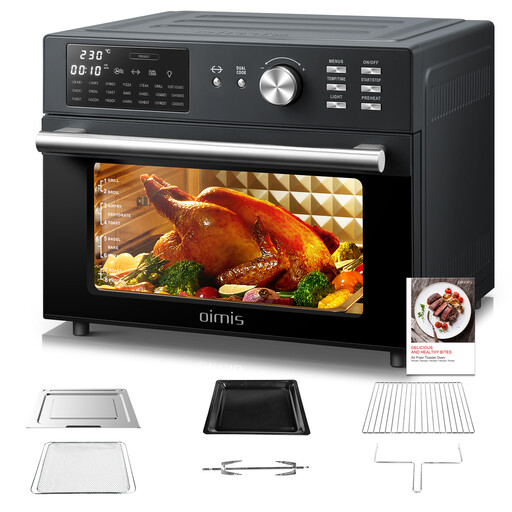
OIMIS Air Fryer Toaster Oven, 30 l
A freestanding option for casseroles, provided the dish and available space are suitable for the appliance.
The product description lists 360° air circulation and casseroles as a recommended use. The product title lists 21 presets, 1.800 W, a rotisserie and a dehydrating function.
View at Joybuy
Frequently asked questions
Is the capacity in litres enough to tell me whether my casserole dish will fit?
No. Measure the length, width and height of your dish, including the handles, and compare them with the usable internal dimensions or a stated maximum size for the specific model. Rommelsbacher lists the BGE 1580/E for round dishes up to 29 cm in diameter; that doesn’t confirm that every rectangular dish will fit.
Can I install a freestanding mini oven in a kitchen cupboard?
Only if the instructions for that specific appliance expressly allow it. The Steba instructions prohibit using the KB M19 as a built-in oven and require a 10 cm gap between its back and the kitchen wall. Follow the instructions for other models.
How should I store portions for packed lunches?
Cool the portions quickly and store them in the fridge. Germany’s Federal Institute for Risk Assessment recommends cooling hot food quickly to below 7 °C for longer-term storage. Germany’s Federal Centre for Nutrition recommends using sealable containers and thoroughly reheating hot meals before eating; make sure you can keep them cool while travelling too.
How do I compare energy use and cleaning effort?
For household ovens with the relevant energy label, consumption per standard cycle is a way to compare the respective heating functions. The European Commission lists small ovens as exempt from the scope of the relevant ecodesign regulation, so check which labelling rules apply to the specific appliance. Also, don’t equate wattage with the electricity used for one casserole, and compare which parts can be cleaned or replaced.


