
Lieferung heute & morgen

Qualitätsgarantie

Willkommens-Angebote freischalten: KOSTENLOSE Lieferung | Bis zu 80 % RABATT | Kostenlose 30-Tage-JoyPlus-Testphase
App herunterladen
Educational toys for children should do more than keep them occupied. They should suit their age, stage of development and everyday life. But parents, grandparents and carers face a huge choice: Montessori toys, motor skills toys, sensory toys, baby activity centres and creative construction toys all differ considerably in their materials, how they’re used and their safety requirements.
Labels such as “Montessori”, “supports early development” or “educationally valuable” aren’t reliable selection criteria on their own. Look for clear, verifiable details: recommended age, dimensions, materials, features and safety warnings. A motor skills toy, for example, may be suitable for a toddler, while magnetic building blocks may only be suitable for children aged three and over because they contain small parts and magnets.
A baby activity centre with lights, sounds and moving parts may seem versatile. But in practice, a toy with too much going on can quickly overwhelm children or take up more space than expected. So check that the features suit your child, and consider whether you’ll use the product in your living room, their bedroom or on the go.
Small parts, magnets, batteries and detachable accessories need particular attention. Age recommendations aren’t just a guide. Before buying, read the product warnings, check where the toy is intended to be used and find out whether your child needs supervision. With magnetic building blocks, there’s an important point to remember: swallowed magnets can cause serious injuries. Damaged parts must be removed straight away.
For babies from birth, soft toys to grasp and explore by touch are a good option, provided they don’t have loose small parts. A baby activity centre for ages six to 36 months should be stable when standing, or suitable for use as a floor play panel if the manufacturer says so.
For children aged one and over, simple cause-and-effect toys, shape sorters, sound panels and turning mechanisms can be engaging. A wooden Montessori toy with a hammer, gears or fishing game can bring together a range of hand movements. From the age of three, children can enjoy busy boards, role play, magnetic building blocks and more complex construction activities. For children aged six or eight and over, robotics, science and creative sets are all worth considering.
Look for rounded edges, sturdy joints and a surface that can be cleaned according to the manufacturer’s instructions. For wooden toys, it’s helpful to know what type of wood they’re made from and how they’ve been finished. The 4-in-1 wooden motor skills toy, for example, is described as having edges that have been polished several times and water-based, odourless paint. However, the product description also says that small parts require adult supervision.
For plastic products, material details such as ABS or BPA-free are useful, but they don’t replace checking the full safety information. Electronic educational toys also need suitable batteries or a way to recharge them. An adjustable volume control can be handy day to day, especially in flats or during longer play sessions.
Measure the space available before you buy. A wall-mounted busy board can save floor space, but it must be fitted correctly. Magnetic building blocks need to be stored in a container that closes securely, so no pieces end up under the furniture. For travel, compact cubes, card readers or small grasping toys are usually easier to carry than a large activity table.

Why it suits this profile: This compact activity cube brings together eight play modes, including a piano, guitar, telephone, gears and windmill, in a space measuring 23 × 23 × 24 cm. It’s a good fit for smaller homes and works as a portable educational toy for babies and toddlers.
The recommended age of 1 to 3 years, stated dimensions and material information make it easier to choose than a vague promise to support early development.
Compact design, eight hands-on and interactive play areas, and a carry handle. The product information states that it’s made from ABS, is BPA-free and has rounded edges.
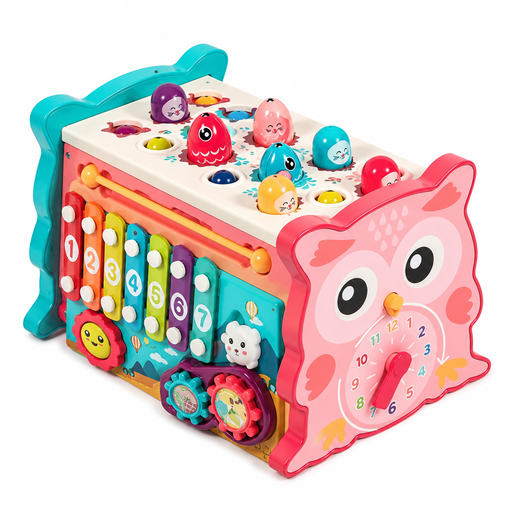
Why it suits this profile: Designed for children aged 1 to 3, this toy combines a hammer bench, xylophone, fishing game and gears. It’s a good choice for families looking for a tactile motor skills toy with several distinct activities.
The four types of play are clearly described, and the toy doesn’t need batteries. You can see exactly what it offers, without relying solely on lights or sound effects.
The product description states that it’s made from natural solid wood, has rounded edges and is finished with water-based, odourless paint. Remember that small parts require supervision.

Why it suits this profile: This 76-piece set is for children aged three and over who enjoy building and creating their own shapes. It’s suitable for playing alone or in groups at home or in childcare settings, and makes a creative construction toy.
The product information gives the number of pieces, their individual size of 3.75 cm and a warning about magnets. This makes it easier to decide whether the set and age recommendation are right for you.
76 ABS plastic pieces with enclosed magnets, and compatible with other standard sets according to the product description. Check regularly for damaged pieces.
We’ve put together a complete, regularly updated list of products that meet these strict selection criteria and fully comply with the safety regulations in force in the EU.
Age-appropriate toys to grasp, explore by touch and make sounds can be suitable for babies, as long as they don’t have loose small parts. An activity centre should be sturdy and used according to the manufacturer’s instructions. For newborns, a soft musical toy designed for use from birth may be suitable, provided it’s securely attached and only used under supervision.
How long a toy lasts depends on its materials, construction, use and care. Wooden toys can stay in good condition for a long time if stored somewhere dry and checked regularly. Electronic products also depend on batteries or rechargeable batteries. Check magnetic building blocks regularly for cracks in the edges and casing.
Not necessarily. Simple motor skills toys without electronics can help develop several skills. When weighing up the cost, also consider whether a toy can be expanded, whether replacement parts are available, how much care it needs and how long it’s likely to be used. A smaller set that gets played with regularly may be more useful day to day than a larger toy with features that go unused.