What should you look for when buying?
Start by comparing your editor layout with the space available on your desk. Then decide whether colour previews, a laptop connection or refresh rate matters most for your work.
| Priority |
What to look for when buying |
Who is this most important to? |
| Usable editor space |
Compare QHD and 4K with your actual editor windows and a text size that’s easy to read. |
When I use the scene view, tools and preview side by side, a readable layout matters to me. Around 28% of consumers put usable editor space first. |
| Fit on your desk |
Measure the space available and check the stand’s depth, height adjustment and whether you might need a suitable mount. |
With a small desk, I want to know whether the screen and stand will fit and can be adjusted. Around 22% of consumers prioritise how well a monitor fits their desk. |
| Colour preview |
Decide on your output target and check the colour mode and manufacturer specifications for the exact model. |
When I assess colours for a particular output target, I need the right colour modes, not just a colour gamut figure. Around 17% of consumers make colour preview their top priority. |
| Laptop connection |
Check whether your laptop supports video output over USB-C and whether the charging power is sufficient for your needs. |
With my laptop, I want to connect video and charging as simply as possible. Around 17% of consumers put the laptop connection first. |
| Motion handling |
Check the refresh rate for the input you’ll use, and whether your computer and connection can deliver the refresh rate you want. |
If I regularly test levels in motion, my monitor, connection and computer all need to work together. Around 16% of consumers prioritise motion handling for playtesting. |
Monitor ranges to help guide your choice
The details below apply to the models listed and come from the manufacturers; they are not independent measurements of individual units.
Dell
Dell offers two different QHD options in the P2725DE and S2725DSM, aimed at laptop work and playtesting respectively.
- Dell lists a USB-C hub and 90 W power delivery for the P2725DE; the model is rated at 100 Hz.
- The S2725DSM is specified at 144 Hz. This refresh rate does not apply to the P2725DE.
ASUS
The ProArt PA279CRV is a 27-inch 4K model designed for detailed previews and featuring specified colour modes.
- For this model, ASUS lists sRGB and DCI-P3 modes, along with 96 W USB-C Power Delivery.
- According to ASUS, the typical refresh rate is 60 Hz; manufacturer colour specifications are not measurements of the individual unit you buy.
BenQ
The PD2705Q is a QHD model for sRGB-focused previews and USB-C setups.
- BenQ lists 100% sRGB and USB-C with 65 W Power Delivery for the PD2705Q.
- The model is rated at 60 Hz; its colour gamut coverage is a manufacturer specification, not an independent measurement of the individual unit.
LG
The LG 27UP850K-W is a 27-inch 4K alternative with USB-C and an adjustable stand.
- LG lists a typical value of 95% DCI-P3 for this model.
- If you want to use the colour specification in your workflow, check the colour mode you need and preview it on your own setup.
Philips
The 276B9/00 is a 27-inch QHD model with USB-C and an adjustable stand.
- Philips describes charging a compatible laptop over USB-C.
- Check that your laptop is compatible; the manufacturer’s description doesn’t automatically prove an advantage for colour-critical level design.
Monitors for editor work and playtesting
The models listed include QHD, UWQHD and 4K options for editor layouts, detailed previews and playtesting. Compare resolution, refresh rate and connections in line with your computer and desk.
 No image available
Z-Edge AGEX QHD monitor, 27-inch, white
A QHD option for an editor layout where playtesting is also part of the picture.
27 inches; 144 Hz; 1 ms MPRT; Fast-IPS panel; height-adjustable stand; DisplayPort and HDMI.
View at Joybuy
 No image available
TCL 32x3A OLED monitor, 32-inch, 4K UHD
A 4K option for detailed previews; the stated refresh rate varies by resolution mode.
OLED+; 3840 × 2160 pixels; 240 Hz at 4K and 480 Hz in FHD mode.
View at Joybuy
 No image available
MSI PRO MP273UPDE E6, 27-inch 4K monitor
A 4K option if you want to create your own layout for editor windows and previews.
27 inches; 4K UHD; IPS; 60 Hz; HDR Ready.
View at Joybuy
 No image available
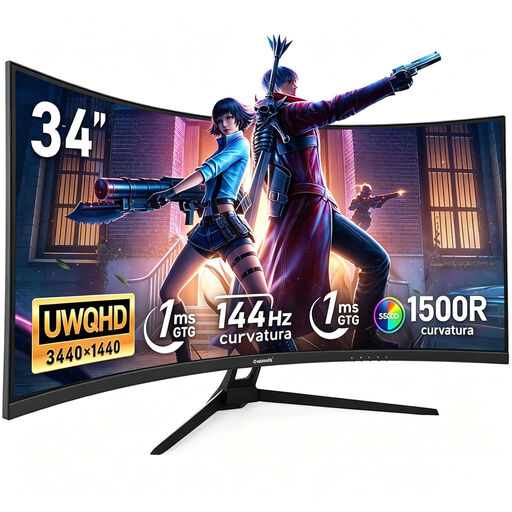
Gawfolk curved UWQHD monitor, 34-inch
The wide UWQHD format is an option if you want to arrange several editor windows side by side.
3440 × 1440 pixels; 144 Hz; 1500R curvature; VA panel; 100% sRGB; no speakers.
View at Joybuy
 No image available
MSI MAG 272QPDE QD-OLED X24, 27-inch, QHD
A QHD option for high-refresh-rate playtesting; check separately whether the USB-C charging power suits your laptop.
QD-OLED; 2560 × 1440 pixels; 240 Hz; Adaptive-Sync; USB-C Power Delivery up to 15 W.
View at Joybuy
Frequently asked questions
Do I need a 4K monitor for Unity level design?
No, 4K isn’t a requirement for the Unity Game View: Unity describes it as a preview of the built application. Compare QHD and 4K using your window layout, and check that text and panels remain easy to read at your chosen scaling setting.
How should I set up a monitor in a student room?
Check the space available and the adjustment range of the specific model, then position the screen to suit your eyesight and build. The Federal Institute for Occupational Safety and Health offers guidance on adapting screen work to individual needs.
Can a USB-C monitor automatically provide my laptop with video and power?
Only if both your laptop and monitor support the functions you need. Compare your laptop’s video output and charging requirements with the specifications for the specific model: BenQ lists DisplayPort Alt Mode and 65 W for the PD2705Q, while Dell lists a USB-C hub with 90 W power delivery for the P2725DE.
Does wide colour gamut coverage guarantee accurate colours in the finished game?
No, a manufacturer’s colour gamut specification doesn’t prove how the finished game will look on other devices. Decide on your output target, use the appropriate colour mode and check the preview on the intended target devices.
Is a high refresh rate important for playtesting?
It can be useful if you regularly test levels in motion and your computer and connection can deliver the refresh rate you want. However, a higher refresh rate at the same QHD resolution doesn’t automatically give you more editor space, and it won’t replace the connections or colour modes you need.


