
Lieferung heute & morgen

Qualitätsgarantie

Willkommens-Angebote freischalten: KOSTENLOSE Lieferung | Bis zu 80 % RABATT | Kostenlose 30-Tage-JoyPlus-Testphase
App herunterladen
Choosing a new television that is equally suited for demanding gaming and an immersive home cinema experience can be a challenge. Especially in the premium segment, where technical specifications like refresh rate, panel technology, and connectivity options are crucial, expert guidance is useful. An LG OLED Gaming TV often combines the features relevant to both use cases: perfect blacks for cinematic depth and extremely fast response times for competitive gaming.
This article serves as a guide. We will introduce a selection of LG OLED models and explain the technical features that could be important for your purchasing decision. The goal is to provide you with a factual basis to find the right device for your needs.
Before we look at specific models, here are some technical aspects that play a central role when selecting a TV for gaming and home cinema.
For smooth motion, especially in fast-paced PC games, a high refresh rate is essential. A 144Hz TV can display up to 144 frames per second, resulting in a visibly smoother picture and reduced motion blur. To avoid visual artifacts like screen tearing, synchronisation between the graphics card and the TV is important. An OLED TV with G-Sync (for Nvidia graphics cards) or AMD FreeSync Premium ensures that the TV's refresh rate dynamically adapts to the frames output by the graphics card. This is an essential feature for PC gamers.
For owners of current game consoles like the PlayStation 5 or Xbox Series X, the HDMI 2.1 standard is indispensable. Only this standard supports the full bandwidth for 4K gaming at 120 Hz. Additionally, HDMI 2.1 enables key features like VRR (Variable Refresh Rate), which is the console equivalent of G-Sync/FreeSync, and ALLM (Auto Low Latency Mode), where the TV automatically switches to the mode with the lowest input lag as soon as a game is launched. A good TV for PS5 should therefore have multiple HDMI 2.1 ports.
OLED technology is known for its self-lit pixels, which enable perfect blacks and thus infinite contrast. This not only benefits the atmosphere in films but also makes games appear more detailed and three-dimensional. LG OLED evo is an evolution of this technology. According to the manufacturer, evo panels use optimised materials and more advanced control to achieve higher peak brightness. This can be particularly advantageous in bright rooms or when displaying HDR content, making the TV a great choice as a home cinema TV.
Here you will find a selection of models that cover different requirements and budgets.
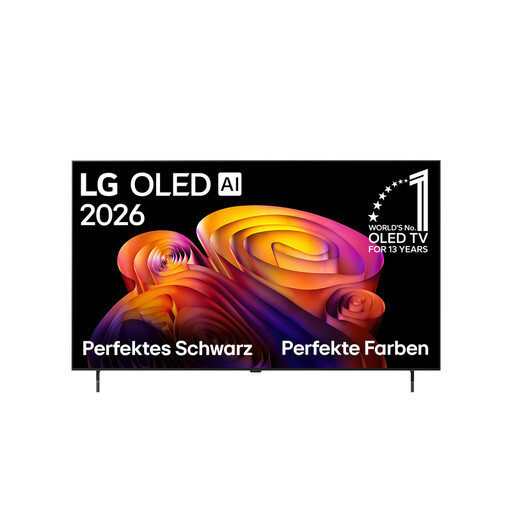
Why it stands out: This model positions itself as a powerful all-rounder for gamers. It combines a native 144 Hz refresh rate with comprehensive support for Nvidia G-Sync and AMD FreeSync, making it an excellent choice for PC and console players. The α8 Gen3 4K AI processor optimises picture and sound in real-time.
Advantages:
Who is it for? For gamers looking for a responsive and future-proof TV in the popular LG OLED 55-inch size, optimised for both competitive PC gaming and the latest consoles.
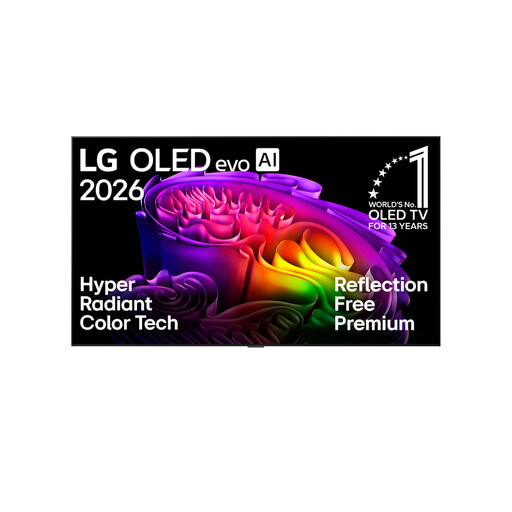
Why it stands out: With its massive 83-inch screen and LG OLED evo panel, this model is designed for the ultimate home cinema TV experience. The 165 Hz refresh rate and support for Dolby Vision and Dolby Atmos create an immersive atmosphere for films and games. Its slim design is optimised for wall mounting.
Advantages:
Who is it for? For home cinema enthusiasts and gamers seeking the largest possible picture and an uncompromising audiovisual experience. The combination of size, evo panel, and high refresh rate makes it a premium choice for dedicated media rooms.
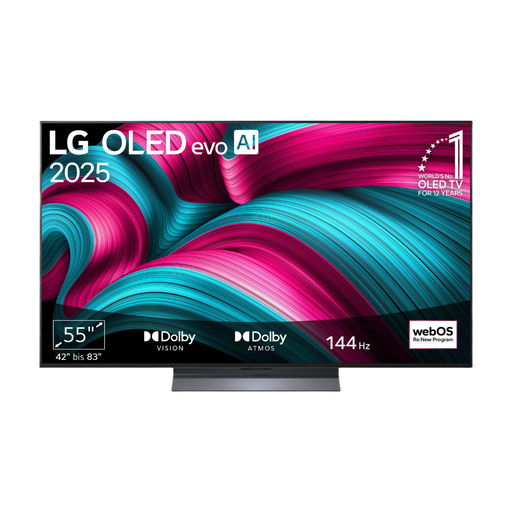
Why it stands out: The OLED55C57LA combines the benefits of a brighter LG OLED evo panel with the powerful α9 Gen8 4K AI processor in the popular 55-inch size. It offers a 120 Hz refresh rate, which can be extended up to 144 Hz via VRR, presenting a well-balanced option between pure gaming performance and excellent picture quality for movies.
Advantages:
Who is it for? For users seeking a high-quality LG OLED TV 4K that delivers excellent picture quality for films and series, while also supporting all modern gaming features for consoles and PC. It is a great choice for the living room.
The models presented here are just a sample of the available range. If you are considering other screen sizes, specific features, or alternative models, you can find a broader selection in our category.
1. Is an LG OLED TV worth it for gaming? Yes, LG OLED TVs are very well-suited for gaming due to their technological properties. The self-lit pixels allow for a near-instantaneous response time (often under 1 ms), which minimises input lag. Models with 120 Hz or 144 Hz, HDMI 2.1, and support for G-Sync/FreeSync offer a smooth and responsive gaming experience without visual artifacts.
2. What is the difference between LG OLED and LG OLED evo? LG OLED evo is an advancement of the standard OLED technology. According to LG, evo panels use optimised luminous materials and more precise light control via the processor. The result is higher peak brightness compared to previous OLED generations, which improves picture quality, especially with HDR content and in brighter environments.
3. How can you prevent burn-in on an OLED TV? Modern OLED TVs have built-in protective features to minimise the risk of burn-in. These include functions like "Pixel Refresher," which regularly calibrates the pixels, and "Screen Shift," which imperceptibly moves the image. As a user, you should avoid displaying static image elements (e.g., channel logos, in-game HUDs) for many hours at maximum brightness. It is also recommended not to unplug the TV from the power source completely, but to leave it in standby mode so it can perform automatic maintenance cycles.