
Lieferung heute & morgen

Qualitätsgarantie

Willkommens-Angebote freischalten: KOSTENLOSE Lieferung | Bis zu 80 % RABATT | Kostenlose 30-Tage-JoyPlus-Testphase
App herunterladen
A light grey pleated blind with no-drill clamp fittings can provide privacy and shade in rented homes, owner-occupied properties and offices without leaving permanent holes. However, not every option will be right for you. Inaccurate measurements, unclear information about light transmission or unsuitable fittings can all affect how securely your blind stays in place day to day.
This buying guide explains what to check before you buy and which options may suit different rooms.
A no-drill pleated blind for a rented home can be fitted with clamp brackets, adhesive brackets or a combination of the two. Clamp brackets grip the window sash and can generally be removed without leaving a trace. Adhesive brackets, on the other hand, need a clean, dry, grease-free surface.
Before you buy, check the following:
Adhesive pads may not stick as well to delicate or textured surfaces. Check that the blind is firmly secured before using it regularly.
Terms such as privacy pleated blind, “sun protection” or “light-filtering pleated blind” don’t necessarily mean the blind will completely darken a room. A semi-transparent polyester pleated blind lets daylight into the room and, depending on the fabric, reduces direct visibility from outside. However, privacy may be reduced when it’s brighter outside than in.
If you want to keep a bedroom as dark as possible, look specifically for an option described as blackout or light-blocking. Read the product details carefully, as “opaque”, “light-filtering” and “blackout” can refer to different properties.
A blind that’s too narrow won’t cover the entire glazed area. A model that’s too wide may catch on handles, seals or the window frame. For several options in this product range, the recommendation is to measure the width of the glass and add around 2 to 4 cm. The height is usually based on the entire window sash or frame.
Measure the width of the glass in at least two places. If the recommendation is “glass width plus 4 cm”, a 55 cm-wide blind would be suitable for glass measuring 51 cm across. If a product has different measuring guidance, follow the instructions in its product description.
You’ll often need the full height of the window sash, including the frame. For balcony or patio doors, also check that the blind won’t catch on the floor, handle or door seal when you open and close the door.
A pleated blind with clamp brackets is especially suitable for vertical windows and doors where the window sash is accessible. For a model with adjustable clamp brackets, the stated adjustment range may be important. One option in this selection, for example, has a range of 10 to 23 mm.
Adhesive brackets are an alternative if clamp brackets aren’t suitable. Clean the frame and let it dry completely before fitting them. After installation, allow the adhesive to bond properly before moving the blind repeatedly.
Many models are made from polyester fabric. It’s lightweight, keeps its shape and can be cleaned with a soft, slightly damp cloth. However, moisture-resistant doesn’t mean waterproof. These pleated blinds aren’t designed for areas exposed to direct splashes, such as inside a shower.
Depending on its design, an adjustable pleated blind can be moved using a handle, a control cord or both. If the product has a cord, follow the safety instructions and keep it out of children’s reach.
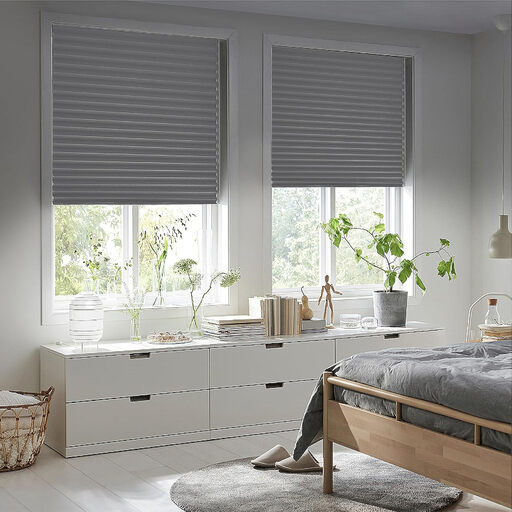
Why this product suits this type of buyer: Its compact size is suitable for narrower windows in living rooms, home offices or children’s bedrooms. This polyester model can be fitted without drilling, using clamp or adhesive brackets.
The exact size of 65 × 100 cm and the recommended extra width make it easier to check your measurements before ordering.
Light-filtering fabric, adjustable positioning and four adhesive brackets listed.
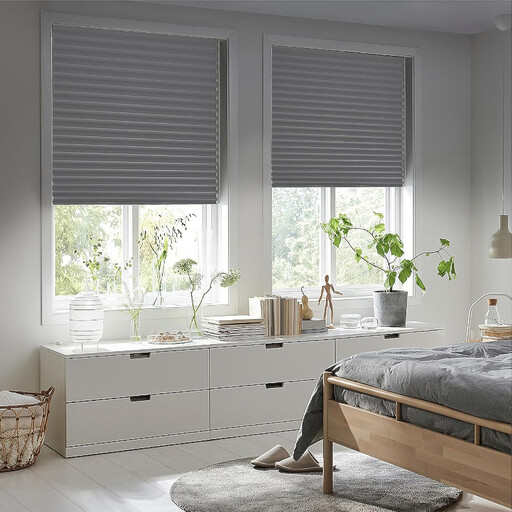
Why this product suits this type of buyer: Described as light-blocking, this option is designed for rooms where you want more privacy and less light, such as bedrooms or children’s rooms.
The description specifically identifies it as a light-blocking option, making this clearer than descriptions of fabrics that simply filter light. You’ll still need to check that it can be fitted to your window.
80 × 140 cm, polyester blackout fabric and clamp-fit installation for windows or doors.
Why this product suits this type of buyer: At 200 cm high, this blind is a good option for taller windows, balcony doors or patio doors. Its semi-transparent fabric filters daylight and helps maintain privacy.
The longer design is clearly listed with specific width and height measurements, reducing the risk of choosing a short window blind for a door.
75 × 200 cm, no-drill installation and suitable for windows or doors.
Why this product suits this type of buyer: At 90 cm wide, it may suit larger windows, provided the window sash measurements and recommended overlap are a good match.
The instructions explain how to measure the glass width and the full window height. They also remind you to clean the frame before fitting.
90 × 100 cm, light-filtering polyester fabric and flexible operation using a handle and cord.
We’ve put together a complete, regularly updated list of products that meet these strict selection criteria and fully comply with the safety regulations in force in the EU.
Check that the brackets are secure regularly, especially on doors and windows that are used frequently. Keep the cord out of children’s reach.
Follow the guidance for the specific product. You’ll often need to measure the glass width and add 2 to 4 cm. The height is usually the full height of the window sash, including the frame. For doors, also take the handle, seals and opening path into account.
There’s no set lifespan that applies to every blind. It depends on how it’s fitted and operated, how much sunlight it gets, how it’s cleaned and how securely the brackets are attached. If you use adhesive pads, check them regularly and replace them if they start to lose their grip.
Not every light grey pleated blind is completely opaque. Light-filtering and semi-transparent fabrics reduce visibility from outside, but you may still be able to see through them when it’s very bright outside. For greater privacy, look specifically for descriptions such as “opaque” or “light-blocking”.