What should you look for?
First, check that your yarns remain distinguishable in the finished camera image. Then assess how the light spreads and attaches to your loom, and record a short test clip using the room lighting you plan to have on.
| What matters |
What to look for when buying |
Who it matters most to |
| Yarn colours under artificial light |
Check the colour temperature and colour rendering of the specific model. Film your yarns under your planned room lighting and camera white balance. |
If I want to tell similar yarn colours apart in my video, I test them under my actual lighting. Around 31% of consumers prioritise yarn colour. |
| Work surface and keeping your hands free |
Measure the table edge, distance and camera framing. Check the clamp area or tripod position, as well as any shadows cast by moving hands. |
If I want to show my hands, threads and several stages of my work, the light needs to cover the weaving area without getting in the way of my movements. Around 31% of consumers prioritise lighting coverage and freedom of movement. |
| Flicker and banding |
Record a test clip with all the lights you plan to use. In regions with a 50 Hz mains frequency, try 1/50 s or 1/100 s as possible settings, as recommended by Sony Support. |
If bands appear in my video under my room lighting, I test the camera settings and light together. Around 23% of consumers want to avoid flicker. |
| Mounting and power supply |
Check what’s included with the specific version, along with the mount, power supply and compatible light shapers. For USB-C, check the power requirements. |
If I want to use the light on my loom without additional modifications, I first check which parts I already have and what else needs to be compatible. Around 15% of consumers prioritise a straightforward setup that works with their existing equipment. |
The percentages group consumers by their main priority in this use case. They are not based on measured market shares.
Joybuy products for online weaving demos
This product selection features COB video lighting for a setup where you can match the colour temperature and a suitable light shaper to your weaving area.
 No image available
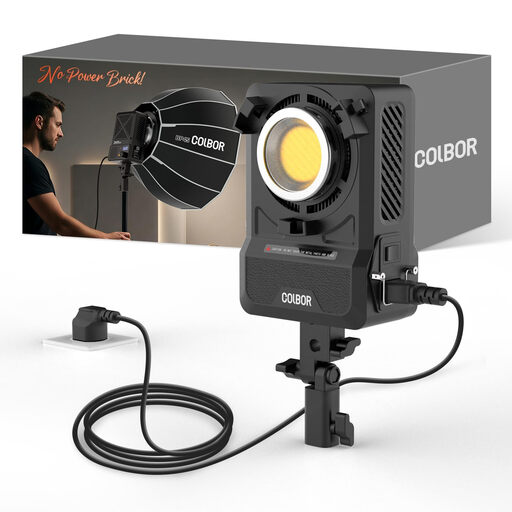
COLBOR 200W Bi-Color COB video light
For a COB setup where you want to match the colour temperature to your existing artificial lighting and use a suitable light shaper.
200 W; 2,700–7,000 K; Bowens mount; integrated power supply design.
View at Joybuy
Frequently asked questions
How can I check yarn colours before a longer recording?
Film the yarns you actually use under the planned combination of room and video lighting. Set the white balance to suit that lighting, then check the colours in the video. A Kelvin or CRI rating can’t replace this test. Canon Europe explains that the colour temperature of the light affects how the camera perceives colours.
What can I try if I see bands under artificial light?
Start by recording a short clip with all your lights switched on. Sony Support suggests trying a shutter speed of 1/50 s or 1/100 s in regions with a 50 Hz mains frequency to reduce flicker. The results depend on your camera and scene, so test the settings with your actual setup.
Do I need a softbox from the same brand as my COB light?
Check that the mount and light shaper are compatible; they don’t automatically have to be from the same brand. Godox lists a Bowens mount for the SL60IIBi. Nanlite lists an FM mount for the FC-60B and includes a Bowens adapter. Also consider the space required and what’s included.
What labelling and instructions are required for an electric video light in Germany?
According to the European Union, CE marking is only required for products covered by relevant harmonised EU rules; it isn’t a general mark of quality. The German Federal Network Agency says its checks include labelling, manufacturer details and German-language instructions with the required warnings. This doesn’t, by itself, confirm that a specific listing complies.
Are a manufacturer’s guarantee, statutory rights and the right to cancel the same thing?
No. Statutory rights relate to faults and apply against the seller, while a guarantee is an additional voluntary promise with its own terms. According to the Verbraucherzentrale, consumers buying online generally have a 14-day right to cancel from the date they receive the goods, although exceptions may apply. The Verbraucherzentrale explains these points in articles dated 13 August and 28 September 2026. The terms of your specific purchase and any applicable exceptions are what matter.


