
Lieferung heute & morgen

Qualitätsgarantie

Willkommens-Angebote freischalten: KOSTENLOSE Lieferung | Bis zu 80 % RABATT | Kostenlose 30-Tage-JoyPlus-Testphase
App herunterladen
White running shoes look versatile, but the colour alone doesn't tell you much about grip, fit or everyday practicality. If you're looking to buy lightweight trail running shoes unisex white, you shouldn't focus solely on weight and appearance. What really matters is the intended use, the material construction and the sizing information.
A mesh upper can improve air circulation. However, moisture also comes from socks, the weather and how long you're active. With an unlined upper, heat can escape more quickly, but at the same time it won't offer complete protection from rain in wet conditions. For summer road runs and dry paths, breathable running shoes are often a good choice; when it's wet, it's best to keep your expectations about waterproofing realistic.
The term "non-slip" isn't a uniformly protected quality promise for every surface. A tread that feels comfortable on tarmac may be less suitable on deep mud or loose scree. So pay attention to the specific description of the outsole and whether the rubber, abrasion resistance and tread pattern are designed for changing surfaces.
A soft midsole can increase running comfort, but on its own it says nothing about support, lateral guidance or fit. Running shoes with EVA cushioning offer a springy midsole, but they should still fit snugly around the midfoot. Too much movement at the heel or a cramped forefoot can become uncomfortable on longer runs and hikes.
A sandwich mesh and fabric upper can dissipate air and heat relatively quickly. In the PELLIOT models we're looking at here, the upper is additionally reinforced with a TPU film, depending on the variant. This can help protect against abrasion from branches and stones, but it may also alter the ventilation behaviour.
For women's and men's running shoes with versatile use, it's worth considering:
White shoes show dirt more quickly. A low-maintenance clean with mild soap and cold water is therefore more practical for everyday use than a construction designed purely for looks.
The PELLIOT version has a midsole made from highly elastic EVA foam. This material is often used to combine rebound and cushioning on different surfaces. However, the individual running feel depends on your body weight, gait and the terrain.
When trying them on, you should check whether:
The ROCKYTEC outsole described is designed for grip and abrasion resistance. According to the product description, it is intended for wet rocks, muddy slopes and loose sand. An optional Vibram Megagrip version is reportedly only available on selected variants. So check the specific product variant before you buy.
For all-terrain running shoes and shoes for road and trail, a balanced approach is also important: a very deep tread can feel harder on tarmac, while a flatter tread may offer less grip on soft ground.
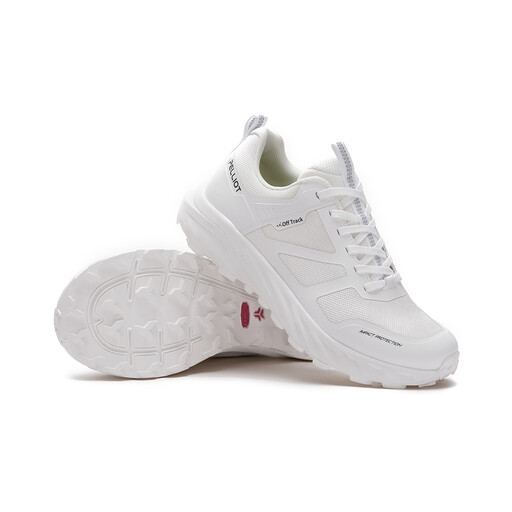
Why this product fits the profile: EU size 37 is suitable for people looking for lightweight shoes for their first road runs, paved paths and occasional trips on easy trails.
The sizing information includes a foot length of 235 mm. This makes it easier to check your selection than simply ordering by the usual EU size.
Sandwich mesh and fabric upper; EVA midsole for cushioning and rebound.
Why this product fits the profile: EU 38 is aimed at users who prefer a versatile shoe for regular runs and changing paths.
The product description mentions standard and slim variants. This means the fit can be adapted for narrower or regular-width feet.
ROCKYTEC rubber outsole according to the supplier; upper with abrasion-resistant properties.
Why this product fits the profile: EU size 39 could be of interest for longer hikes, daily commutes and runs on road and trail, provided the foot length of 245 mm is right.
The construction combines ventilation with an abrasion-resistant outer layer. This reduces the trade-off between a lightweight build and use on natural paths.
EVA foam in the midsole; size range of the listed variants from EU 37 to 39.
We've put together a complete, regularly updated list of products that fully meet these strict selection criteria and the safety regulations in force in the EU.
The following foot lengths are given for the models listed:
It's best to measure your foot at the end of the day, wearing the running socks you plan to use. There should be a little room to move between your toes and the end of the shoe for longer runs or hikes. If you have narrower feet, check the slim variant; for standard or wider feet, the standard version is intended according to the product description.
White lightweight hiking shoes and running shoes should be cleaned of coarse dirt after use. The recommended care is hand washing with mild soap and cold water. Afterwards, the shoes should be air-dried away from direct heat sources. Machine washing, tumble drying and ironing can damage the material and adhesives.
Models designed for road and trail can be used on paved paths and tarmac. The running feel depends on the tread, midsole and personal preference. For exclusively long road runs, a classic road running shoe with a suitable outsole may be a better fit.
It's not possible to give a reliable lifespan for all users. Wear and tear is influenced by load, body weight, running surface, care and running technique. Check the tread, outsole, midsole and upper regularly. If you see visible cracks, a heavily flattened tread or reduced support, it's time to replace them.
Dirt shows up more quickly on white. That doesn't necessarily mean more effort, but it does require regular cleaning. On mesh and fabric uppers, dirt should be gently removed with water and mild soap. Allowing them to dry completely before the next use helps prevent odours and material stress.