Anyone looking to smooth out creases in linen
You want to smooth out several placemats and need temperature and, where applicable, steam settings that suit each item’s care label.


For a few linen placemats in a shared flat, a compact steam iron is an obvious choice, provided the care label allows steam and you have somewhere suitable to store it. The key things to consider are the care instructions for each set, an appropriate temperature setting and a safe place to rest the iron. You don’t automatically need a steam generator iron for small ironing sessions.
You want to smooth out several placemats and need temperature and, where applicable, steam settings that suit each item’s care label.
You share a kitchen or living space and want to put the hot appliance down safely, switch it off and store it away afterwards. An automatic shut-off can be helpful, but it doesn’t replace careful use.
You iron individual placemats and want to keep the space and effort needed to look after another household appliance to a minimum.
A good fit if: You smooth out placemats regularly, the care label allows moisture and you have limited storage space.
Consider: The tank and steam function need looking after. The manufacturer’s steam output figures don’t prove a particular result on your placemat.
A good fit if: You only iron a few items occasionally, or the care label says not to use steam.
Consider: Deep creases may take more manual effort to remove if you can’t use steam.
A good fit if: You often iron larger loads as well as placemats, and have enough room to use and store it.
Consider: The extra space it takes up isn’t automatically justified if you only iron small loads occasionally.
| What you need | What to look for when buying | Who is it important to? |
|---|---|---|
| Smooth creases without damaging the linen | The care label on the set, adjustable temperature and a steam setting that’s suitable for the label. | If I want to smooth out several placemats, the setting needs to suit each care label. Around 40% of consumers put a finish that’s suitable for the care label first. |
| Put the iron down and switch it off safely | A stable place to rest it, suitable cable management and an automatic shut-off specified for the exact model variant. | If I’m ironing in a shared space, I need a safe place to put the iron down and want to keep an eye on the hot appliance. Around 30% of consumers prioritise safe use in a shared flat. |
| Small ironing sessions without taking up much space | The appliance and resting-area dimensions, as well as tank capacity in relation to the amount you iron. | If I only iron individual placemats, I don’t want to make room for an unnecessarily large appliance. Around 20% of consumers focus above all on space and ease of use. |
| Care requirements and support after purchase | Cleaning instructions for the exact model, repair options and the terms of any voluntary guarantee. | If I want to use an appliance for longer, I want to know how to look after it and what support is available if something goes wrong. Around 10% of consumers put care and after-sales support first. |
Mains-powered household appliances within the scope of the EU Low Voltage Directive must meet the relevant conformity requirements. The European Commission explains that the CE marking indicates the manufacturer’s declaration of conformity; it is not an independent quality mark.
The label on each individual item tells you how it can be treated. A lower-temperature ironing symbol may rule out steam.
Check the care label first, then set the temperature and steam accordingly.
This feature varies by model. Rowenta explicitly states that the Focus Excel DW5310 does not have automatic shut-off.
Check the features of the exact model variant, and don’t leave a hot iron plugged in unattended.
Braun Household lists a 270 ml tank for the TexStyle 3 SI 3055, while a similarly named Joybuy listing states 220 ml. These differing figures don’t prove that they refer to the same variant.
Compare the full model number and key specifications before matching a listing to a particular model.
The FreeStyle 3 and TexStyle 3 ranges include documented handheld steam irons. The TexStyle 3 SI 3055 is a specific model you can use to compare temperature settings and automatic shut-off.
The 3000 Series DST3041/80 is a handheld steam iron you can compare in terms of tank, soleplate and steam.
The Easygliss Plus FV5736 is another documented handheld steam iron with automatic shut-off.
The Focus Excel DW5310 adds a handheld steam iron with manually adjustable steam and temperature settings to the comparison.
This selection features compact steam irons for placemats whose care labels allow the chosen temperature and, where applicable, steam.
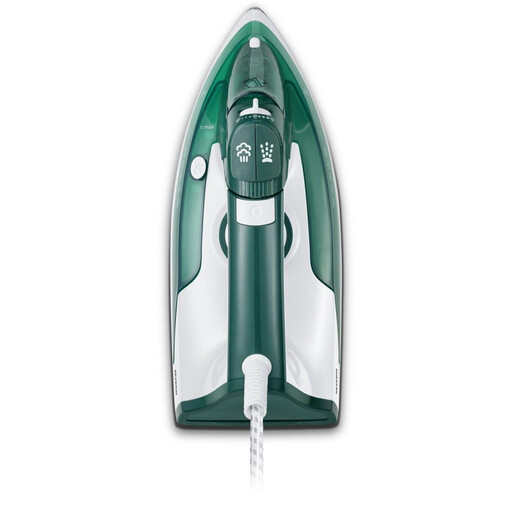 No image available
For placemats whose care labels allow the selected temperature and steam setting.
The product title lists a stainless steel soleplate, a removable 175 ml water tank, variable steam output of 30 g/min and a 85 g/min steam boost.
 No image available
For placemats whose care labels allow the selected temperature and steam setting.
The product title lists a non-stick soleplate, an automatic cleaning function and an anti-drip feature.
 No image available
For placemats whose care labels allow the selected temperature and steam setting.
The product title lists 2500 W, 40 g/min continuous steam and a 160 g/min steam boost.
 No image available
For placemats whose care labels allow the selected temperature and steam setting.
The product title lists a 280 g/min steam boost, vertical steam, an XL filling opening, a stable heel rest, and anti-scale and anti-drip features.
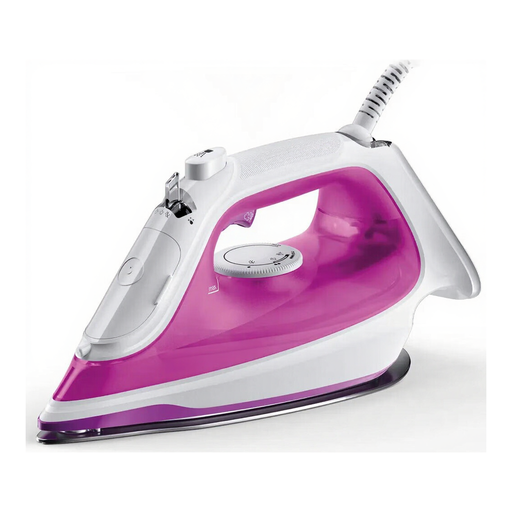 No image available
For placemats whose care labels allow the selected temperature and steam setting.
Follow the ironing symbol on the specific placemat rather than relying on the fibre name alone. GINETEX Germany’s guide gives maximum soleplate temperatures of 210 °C, 160 °C or 120 °C, depending on the symbol; for the lowest setting, it warns of a risk when using steam. Older GINETEX guidance may differ, so don’t apply a temperature limit across the board to an unfamiliar label.
If the care label allows it, SWR recommends ironing linen when it’s slightly damp. Adding moisture doesn’t override a steam ban or a lower temperature limit on the label.
Follow the instruction manual for your chosen model, as the recommended cleaning method can vary. For example, Braun lists a self-cleaning function for the SI 3055; this doesn’t mean other appliances should be cared for in the same way.
No. If a product is faulty, your statutory rights are against the seller; a guarantee is a voluntary promise made under the guarantor’s terms. The Verbraucherzentrale advises consumers to distinguish between the two and check the terms of each separately.
The EU Low Voltage Directive and its relevant conformity requirements apply to mains-powered household appliances operating between 50 and 1,000 V AC. Your Europe explains that the CE marking represents the manufacturer’s declaration that the product complies with the relevant EU rules; it is not an independent quality mark. Check the marking on the specific appliance.