If you want to press a linen scarf completely flat, a regular steam iron on a suitable surface is the obvious choice. GINETEX Germany recommends ironing linen while it is slightly damp and turned inside out. A mini iron saves storage space, but its small soleplate will probably mean more passes to cover a whole scarf. A handheld steamer is better suited to freshening up a scarf on a hanger. Always check the care label before use, as temperature limits or a ban on steam may determine which option is suitable.
Who are these appliances suitable for?
For regularly ironing whole linen scarves
If you want to press a whole scarf carefully, you’ll need a suitable ironing surface. GINETEX Germany recommends ironing linen while it is slightly damp and turned inside out; the care label on the individual scarf should always take precedence.
For ironing with very little storage space
If you mainly work on hems or small sections, a small ironing surface could be a good fit. Bear in mind that ironing a whole scarf will take more passes.
For freshening up scarves between wears
If you want to freshen up a scarf on a hanger without setting up an ironing board, a handheld steamer could be a good option. However, steaming is not the same as pressing fabric flat.
What should you look for when buying?
Traditional steam iron
A good fit if: you want to press whole scarves flat and can set up a safe ironing surface.
The trade-off: an iron and ironing surface take up more room than a handheld steamer.
Mini steam iron
A good fit if: storage space is limited and you mainly iron hems or narrow sections.
The trade-off: the smaller soleplate will probably mean more passes to cover a whole scarf.
Handheld steamer
A good fit if: you want to freshen up a hanging scarf and would rather not use an ironing board.
The trade-off: manufacturers’ steam output specifications do not prove that a steamer will press linen as effectively; it is not suitable if the care label says not to use steam.
GINETEX Germany lists different temperature limits depending on the care label, including a prohibition on ironing. So check the label on the specific scarf before choosing a temperature or using steam.
| Priority |
What to look for when buying |
Who it matters to |
| A smooth finish |
Check the soleplate size and temperature control, and follow the care label when choosing a setting. |
If I want to press a whole, creased linen scarf, a suitable soleplate and a safe ironing surface matter most to me. Around 40% of consumers put the finished result first. |
| Limited space |
Compare the size of the appliance and its soleplate, and allow for a suitable ironing surface. |
If storage space is limited and I mainly work on narrow hems, a compact appliance is important. Around 30% of consumers put space requirements first. |
| Gentle treatment |
Check the temperature settings and whether steam can be switched off; the care label determines the permitted treatment. |
When my scarves have different care instructions, I want to adjust the temperature and steam to suit each one. Around 20% of consumers prioritise protecting their fabrics. |
| Freshening up without an ironing board |
Check whether steam is allowed and whether a hanging finish, rather than a flat-pressed one, will be enough. |
If I just want to freshen up a scarf between wears without setting up an ironing surface, a handheld steamer is likely to be a better fit. Around 10% of consumers prioritise this. |
Avoid common mistakes
-
Using the same high temperature for every scarf
Blended fabrics and care labels may specify different temperature limits or prohibit steam.
Check the label on each scarf before switching on the iron, and choose only a setting that is permitted.
-
Choosing a mini iron just because it is small
The documented soleplate size of the Prym Mini is 130 × 75 mm. Compact storage and quickly pressing a whole scarf are therefore two different requirements.
Choose based on the area you usually iron, and make sure you have a suitable ironing surface.
The small soleplate may mean more passes, and therefore more time, when ironing a whole scarf.
-
Assuming steaming is the same as pressing fabric flat
The steam specifications for a handheld appliance do not prove that it will achieve the same results on a linen scarf as a heated iron soleplate.
Choose a steamer to freshen up a hanging scarf only if steam is allowed and you are happy with a finish that has not been pressed flat.
Brands to consider
Braun
Braun offers traditional steam irons. The FreeStyle 3 FI3194BK is one documented example with a manual temperature control.
- According to Braun, this model delivers 45 g/min of continuous steam and has a self-cleaning function.
- These manufacturer specifications do not prove a particular smoothing performance on linen scarves or apply to every Braun model.
Prym
Prym offers a mini steam iron which, according to the manufacturer, is designed for delicate ironing and travel.
- The documented model has a 130 × 75 mm soleplate, making it suitable for targeted work on narrow sections.
- Its small soleplate will probably mean more passes to cover a whole scarf, and a heat-resistant surface is still essential.
Philips
As well as irons, Philips offers handheld steamers. The STH7020/20 is an option for freshening up clothes without a traditional ironing board.
- Philips lists a 100-ml tank and steam output of up to 28 g/min for this model.
- These manufacturer specifications do not prove equivalent pressing performance on linen or suitability where steam is prohibited.
Tefal
The Express Steam FV2838 is a traditional steam iron with adjustable temperature settings.
- Tefal lists 40 g/min of continuous steam and a 270 ml water tank for this model.
- Tefal does not list an automatic shut-off function for this model; the manufacturer’s figures are not an independent performance comparison on linen scarves.
Irons at Joybuy
The range includes traditional steam irons for pressing fabric flat, including a compact travel iron.
 No image available
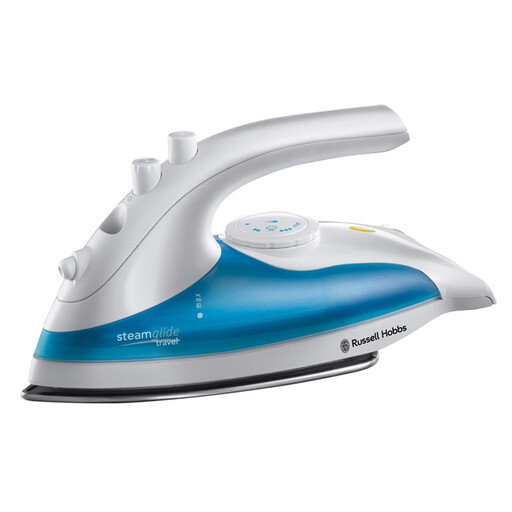
Russell Hobbs Travel Iron 22470, Dual Voltage
A travel iron for pressing fabric flat, designed for situations where a compact appliance is useful and storage space is limited.
Dual voltage; cable length listed in the product name: 1.5 m.
The water tank holds 80 ml, so you may need to refill it during longer ironing sessions.
View at Joybuy
 No image available
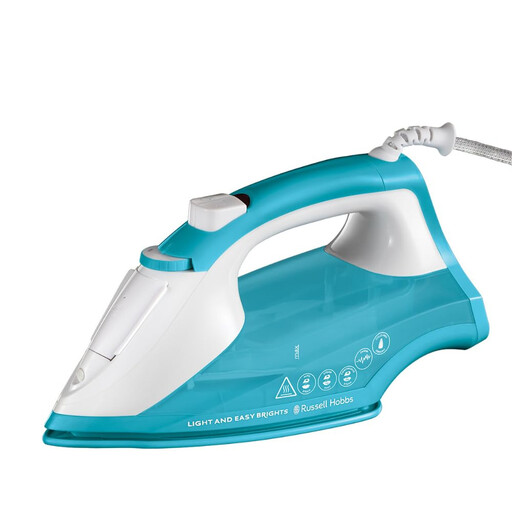
Russell Hobbs 26482-56 Light & Easy Brights, Blue/White
A traditional steam iron for pressing fabric flat; check the care label to choose the right temperature setting.
View at Joybuy
 No image available
Steam Iron, 2400 W, Non-stick Soleplate
A steam iron for pressing fabric flat; the right treatment depends on the care label on the scarf.
Features listed in the product name: 2400 W, non-stick soleplate, automatic cleaning and anti-drip protection.
View at Joybuy
 No image available
Rowenta DW4320 Express Steam
A traditional steam iron for pressing fabric flat. A vertical steam function is described for hanging fabrics, but it is no substitute for pressing fabric flat.
Features listed in the product name: 2500 W, continuous steam at 40 g/min, a 160 g/min steam boost, Eco function and anti-drip protection.
View at Joybuy
 No image available
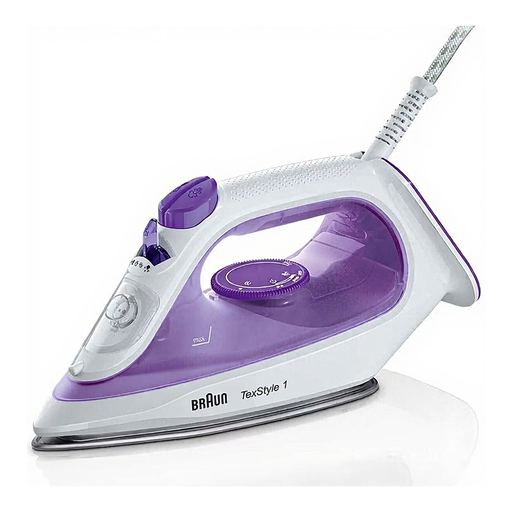
Braun TexStyle 1 SI1080VI, Violet
A traditional steam iron for pressing fabric flat. Before use, check that the temperature and steam settings are suitable for the scarf’s care instructions.
View at Joybuy
Frequently asked questions
What is the right ironing temperature for my linen scarf?
The care label on the specific scarf is what matters, not just the word ‘linen’. The GINETEX guide lists different maximum soleplate temperatures depending on the ironing symbol, as well as a ‘do not iron’ symbol. Individual care instructions are especially important for blended fabrics.
How should I iron linen if the care label allows it?
GINETEX Germany recommends ironing linen while it is slightly damp and turned inside out. Also follow the iron’s instructions and check whether the scarf’s care label prohibits steam.
How can I prevent limescale marks and reduced steam output?
Follow the descaling and water instructions for your specific model. Philips explains that limescale can build up more quickly in its steam generator irons when used with hard water, and that deposits can cause discolouration and reduced steam output, among other issues. Don’t assume this maintenance advice applies to other appliances without checking.
What happens if a product develops a fault after purchase in Germany?
Your statutory consumer rights are with the seller; a manufacturer’s guarantee is a separate, voluntary promise. If a product is faulty, you can initially request that the seller puts things right, either by repairing or replacing it.
Which electrical product markings should I look for when buying?
For electrical equipment covered by the EU Low Voltage Directive, including appliances with a rated voltage of 50 to 1,000 V AC, EUR-Lex describes conformity assessment and CE marking as manufacturer responsibilities. Check the markings on the specific product listing separately; they do not prove how well an iron performs on linen.


