For a few linen tea towels between guest stays, a steam iron is usually the more compact option. If you regularly iron large piles, a steam generator with a larger tank can mean fewer refills. The right choice depends on how much laundry you have, where you’ll set it up and store it, and the care labels on the individual towels. A high advertised steam boost doesn’t tell you how much continuous steam the iron produces.
Which option is right for you?
Hosts with a short turnaround between guests
If you iron just a few towels before your next guests arrive, look for a model that’s easy to handle and compact to store. F.A.Z. Kaufkompass and Braun describe steam irons, and suitable models, for individual ironing sessions.
Hosts with larger loads of laundry
If you regularly iron lots of towels in one go, weigh up tank capacity and continuous steam against the space a steam generator takes up. F.A.Z. Kaufkompass covers steam generators as a separate appliance category; Braun lists a removable 1,5-l tank for the IS 2565 BL.
Hosts with different types of towels
If your towels vary in colour, finish or fabric blend, set the temperature and steam according to each item’s care label. GINETEX notes that care instructions also take account of dyeing and fabric finishes.
What should you look for when buying?
Start with the size of your usual pile: an iron is more compact to store, while a steam generator may be a good choice for longer ironing sessions thanks to its separate tank.
Steam iron
A good fit if: You only iron a few towels between guest stays and want to store your appliance neatly.
Things to weigh up: Tank capacity and continuous steam vary by model; check the temperature controls and care features too.
Steam generator
A good fit if: You regularly iron larger piles and have room for the base unit and hose.
Things to weigh up: A steam generator needs more space; the manufacturer’s steam figures alone don’t guarantee a particular time saving when ironing your towels.
| Buying priority |
What to check |
Who it matters most to |
| Short turnaround between guests |
Compare continuous steam separately from the steam boost; check the temperature controls and storage requirements. |
If I’m only smoothing a few towels before guests arrive, ease of use and quick storage matter most to me. Around 40% of consumers prioritise ironing in a short turnaround window. |
| Larger piles |
Compare tank capacity, refill options, continuous steam, footprint and hose arrangement. |
If I’m ironing lots of towels one after another, I want to reduce refills without overlooking the space a steam generator takes up. Around 30% of consumers put the amount of laundry first. |
| Fabric and finish |
Check the care label on each towel; check the model’s temperature, steam, anti-drip and limescale-management features. |
If the care labels vary, I want to adjust the settings for each towel and avoid visible marks. Around 20% of consumers prioritise protecting their towels and their finish. |
| Care and storage |
Check the cleaning instructions and auto shut-off, and plan a safe place for the appliance to cool and be stored. |
If the appliance is stored between guest stays, I value straightforward maintenance and a safe place for it to cool down. Around 10% of consumers prioritise maintenance and safe storage. |
Common buying and usage mistakes
-
Confusing the steam boost with continuous steam
Manufacturers list continuous steam output and the short burst of steam separately. For several passes with the iron, continuous steam is the more useful figure to compare.
Compare continuous steam output in g/min and also consider the tank and ease of use.
-
Using the highest setting on every linen towel
Care instructions take account not only of the fibre, but also of the textile’s colour and finish. GINETEX recommends following the care symbols on the individual item.
Read the care label and set the temperature and steam accordingly.
-
Buying a steam generator just because it has a larger tank
A steam generator needs space for its base unit and hose. If you only iron a few towels between guest stays, a more compact iron may be the better appliance for you.
Compare the number of towels you usually iron with the space available for setting up and storing the appliance.
Make sure you have extra room to set up and store the base unit and hose.
-
Assuming auto shut-off means you can leave the iron unattended
Auto shut-off is an additional safety feature; it doesn’t replace safe handling of a hot soleplate and steam.
Switch the appliance off after ironing, unplug it and leave it to cool in a suitable place.
Brands to consider
Braun
FreeStyle steam irons for individual ironing sessions and CareStyle steam generators for larger piles.
- For the FI 3194 BK, Braun lists a manual thermostat and 45 g/min continuous steam; for the IS 2565 BL steam generator, it lists a removable 1,5-l tank.
- These specifications apply only to the models named. The manufacturer’s claims that a steam generator makes ironing faster don’t prove a particular time saving when ironing linen tea towels.
Tefal
Steam irons such as the Ultimate Pure FV9844, plus the Express Protect SV9202, which has been tested separately as a steam generator option.
- For the FV9844, Tefal lists up to 60 g/min continuous steam, an anti-drip system and a Micro-Calc Filter.
- F.A.Z. Kaufkompass assessed the SV9202 in a steam generator test; the result isn’t an assessment of every Tefal appliance or specifically of linen tea towels.
Philips
Steam irons in a range of styles, including the 3000 Series DST3041/80 and the Azur 8000 Series DST8030/70.
- Philips lists a 300-ml tank and up to 40 g/min continuous steam for the DST3041/80.
- OptimalTEMP is also advertised for ironable linen on the DST8030/70. This model-specific claim from the manufacturer doesn’t replace the care instructions for each towel.
Rowenta
The Everlast Anti Calc DW7120 is an option for buyers who prefer a removable limescale collector.
- Rowenta lists 50 g/min continuous steam, a 350-ml tank and a removable limescale collector for the DW7120.
- Rowenta doesn’t list auto shut-off for this specific model; its specifications shouldn’t be applied to the brand as a whole.
Steam irons at Joybuy
The Joybuy products below are steam irons for individual ironing sessions and short changeovers; this selection doesn’t include steam generators.
 No image available
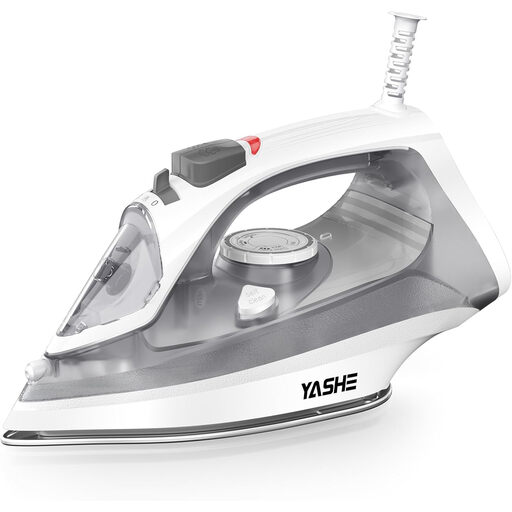
YASHE WSD-218 2300 W steam iron
For individual ironing sessions; the product description lists linen as a suitable fabric and includes an adjustable thermostat.
300-ml water tank; 25 g/min continuous steam; 150 g/min steam boost.
Features include an anti-drip system and self-cleaning.
View at Joybuy
 No image available
2400 W steam iron with non-stick soleplate
For ironing at different temperature settings; the description lists steam and dry ironing options.
50 g/min continuous steam; 350-ml water tank; five temperature settings.
An anti-drip system and self-cleaning are listed.
View at Joybuy
 No image available
Rowenta DW4320 Express Steam
For continuous ironing; an anti-drip system is listed as a feature.
40 g/min continuous steam; 160 g/min steam boost; 250-ml water tank.
The description lists a stainless-steel soleplate, vertical steaming and an Eco function.
View at Joybuy
 No image available
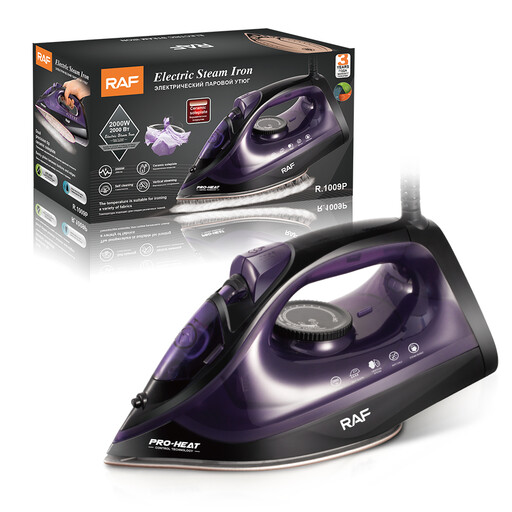
RAF 1600 W steam iron with ceramic soleplate
For ironing with steam; the product description lists a steam boost function and vertical steaming.
210-ml water tank.
Features include a ceramic soleplate and self-cleaning.
View at Joybuy
 No image available
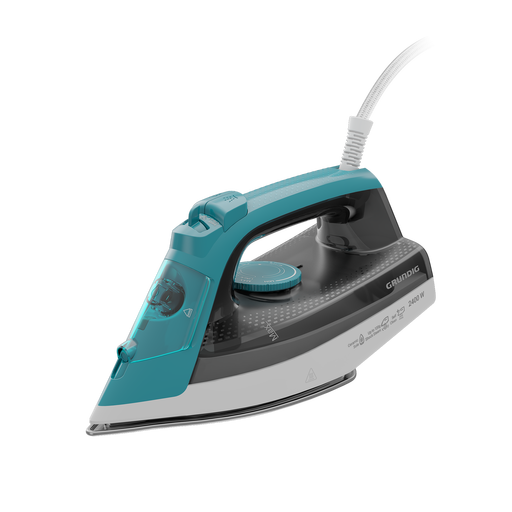
Grundig SI 3550 steam iron
For continuous ironing and towels with different care labels; the description lists a temperature dial.
25 g/min continuous steam; 220-ml water tank.
Drip Stop, limescale protection and self-cleaning are listed.
View at Joybuy
Frequently asked questions
What temperature should I use for linen tea towels?
Follow the care label on each towel; the fibre description alone doesn’t indicate a single safe temperature. GINETEX notes that care instructions also take account of delicate components such as dyeing and fabric finishes.
How should I care for a steam iron if I have hard water?
First, check your model’s instructions and take your local water hardness into account. Tefal explains that water hardness affects how often the iron needs cleaning; the specific care requirements depend on the appliance.
Are statutory rights and a manufacturer’s guarantee the same thing?
No. For a consumer purchase, the European Union describes a legal guarantee of at least two years from receipt of the goods; this is separate from a commercial manufacturer’s guarantee. If you buy the appliance as a business for a holiday let, check separately which contractual rights apply to that purchase.
What should I look for to make sure an electric iron is safe?
Goods sold in the EU must comply with the relevant product safety rules. Electrical appliances covered by the Low Voltage Directive must meet its requirements; a CE mark alone doesn’t prove how well an appliance irons or that it hasn’t been subject to a product recall.


