Who might need a dehumidifier?

Households where shower moisture reaches the living room

If you notice humidity rising after a shower, first check whether you can clear the moisture from the bathroom before it spreads to other rooms. The German Environment Agency recommends removing peaks in humidity straight away by ventilating thoroughly.

People with a large living room that stays damp

If humidity repeatedly remains high despite clearing the moist air from the bathroom, make sure the unit’s stated coverage suits the measured room volume. The Verbraucherzentrale recommends monitoring humidity with a thermo-hygrometer.

People who use their living room every day

If you plan to run the unit while using the living room, weigh up its noise levels, power consumption and condensate-handling options together. Manufacturers’ noise and power figures apply to specific models and operating conditions.

What should you look for when choosing one?

What matters What to check before buying Who is it important to?
Stop shower moisture at its source Monitor the bathroom and living room with a hygrometer before and after showering; check bathroom ventilation and how humidity changes with the bathroom door closed. If I want to find out first whether I can clear the moisture from the bathroom rather than immediately buying another appliance, the cause matters to me. Around 28% of consumers put controlling shower moisture first.
Choose a capacity that suits your living room Work out the room volume from the floor area and ceiling height; compare the stated coverage and test conditions for the exact model’s daily extraction rate. If I have a large living room, I want to know whether the model suits its actual volume, rather than relying on a litres-per-day figure alone. Around 28% of consumers prioritise a capacity suited to the room.
Noise in the living room Check the dB(A) rating and the operating mode it applies to for the specific model; take the intended location into account. If I read, work or watch television in the living room, I want to factor in operating noise when choosing a unit. Around 17% of consumers put low noise levels first.
Handling condensate Check the tank capacity, whether the unit switches off when the tank is full, the hose connection and the route to a drain. If I’m using the unit repeatedly, I want a tank I can manage or a drainage set-up that works for me. Around 16% of consumers prioritise easy emptying.
Power consumption and running costs Check the power rating, controls and expected running time; calculate costs using your own electricity tariff and a realistic operating duration. If I plan to use the unit regularly, I want to consider its power consumption alongside how long I expect to run it. Around 11% of consumers focus mainly on energy use during intended operation.

Common buying mistakes you can avoid

  • Buying a dehumidifier when you could clear shower moisture from the bathroom

    Try to clear peaks in humidity directly from the bathroom. You won’t necessarily need a unit in the living room if suitable ventilation can prevent humidity from rising there.

    First, check the bathroom ventilation and use a hygrometer to see whether humidity in the living room repeatedly remains high.

  • Assuming the litres-per-day figure is guaranteed performance in your living room

    Extraction performance depends on the operating conditions. A manufacturer’s figure under specific test conditions doesn’t tell you how much water the unit will actually collect in your room.

    Compare the test conditions and stated coverage for the exact model with your measurements.

  • Assuming a tank, hose connection and pump are interchangeable

    These features vary by model. Wood’s lists an integrated pump for the MDX20P, while the MRD20GW is described as having a tank and hose connection.

    Before buying, decide where the condensate can drain to and check the connection options on the specific unit.

Brands and specific model details

Comfee

Comfee gives an extraction rate of 30 l/24 h for both the MDDA-30DEN7-SD and MDDP-30DEN7 models.

  • For the MDDA-30DEN7-SD, Comfee lists a room volume of 92.5–130 m³, a 3.2-l tank and humidity control.
  • The floor area figures listed alongside this can’t be directly equated with the room volume unless the ceiling height is specified. Compare volumes and check the details for the exact model.

Trotec

Trotec describes the TTK 96 E as a compressor dehumidifier for larger rooms.

  • For this model, the manufacturer states coverage of up to 90 m² or 230 m³, an extraction rate of 30 l/24 h and a 3-l tank.
  • The manufacturer’s room-size figure doesn’t guarantee how quickly the unit will dehumidify after a shower. Check that your living room’s volume suits the specific model.

Meaco

Meaco recommends the Arete One 25L for larger living spaces and also offers separate desiccant models.

  • For the Arete One 25L, Meaco lists 25 l/day, coverage of up to 125 m² and noise levels of 40/42 dB.
  • Without identical test conditions, these figures don’t allow a direct performance comparison with other models. Check whether a desiccant model such as the DD8L Junior is suitable for your needs based on its own stated coverage.

De’Longhi

According to De’Longhi, the Tasciugo AriaDry Multi DDSX220 combines humidity control with continuous drainage.

  • For this model, De’Longhi states an extraction rate of 20 l/24 h at 30 °C and 80% relative humidity, a noise level of 42–47 dB(A) and a power input of 470 W.
  • The daily extraction rate applies under the stated test conditions; it doesn’t establish a suitable maximum living-room size.

Wood’s

Wood’s offers the MRD20GW for heated living spaces and the MDX20P as a separate option with an integrated pump.

  • For the MRD20GW, Wood’s lists 20 l/day, a 3.8-l tank and a hose connection.
  • The pump is a feature of the MDX20P and shouldn’t be attributed to the MRD20GW. Choose the connection and drainage set-up that suits the specific model.

Dehumidifiers at Joybuy

This selection of dehumidifiers at Joybuy includes models for living spaces. Check the stated room size and the conditions behind the performance figures against your measured room volume.
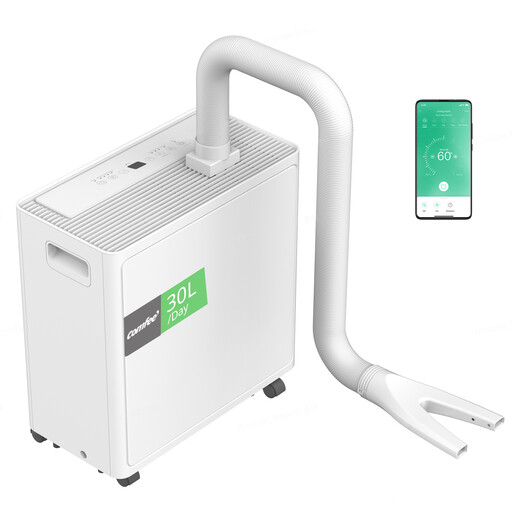
Comfee MDDA-30DEN7-SD dehumidifier

Comfee MDDA-30DEN7-SD dehumidifier

The stated room volume can help you check whether this unit is suitable for a large living room.

30 l/24 h; 3.2-l tank; coverage stated in the product name: around 130 m³ or 73 m²; humidity control, hose drainage, app control and a 24-hour timer.

For hose drainage, connect the hose correctly and position it lower than the unit. The unit contains R290; keep it away from naked flames and flammable materials.

View at Joybuy

CONOPU CS10B dehumidifier

CONOPU CS10B dehumidifier, 16 l/day

The product details state coverage of up to 60 m²; compare this figure with your living room’s dimensions.

16 l/day; 2.5-l tank; adjustable target humidity; 24-hour timer and hose drainage.

Sleep mode is a separate operating mode, with a stated noise level of 30 dB. The unit contains R290; follow the guidance on flammable refrigerant and heat sources.

View at Joybuy
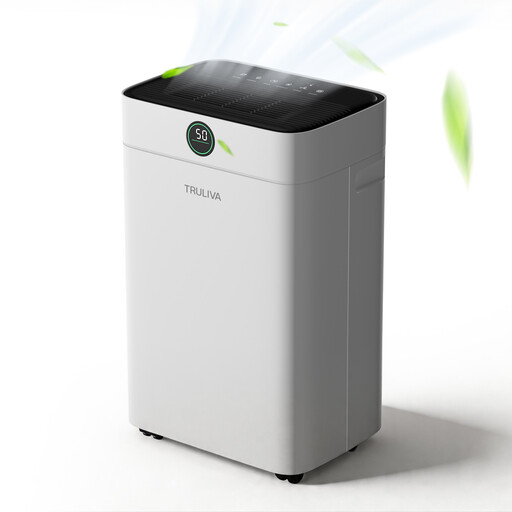
TRULIVA dehumidifier, 25 l/day

TRULIVA dehumidifier, 25 l/day

The stated daily extraction rate may be useful in high humidity, but the product details say it applies under specific conditions.

25 l/day at 90% relative humidity and 95 °F; 2.8-l tank; hose drainage and automatic defrost.

The unit contains R290; keep it away from naked flames and flammable materials.

View at Joybuy
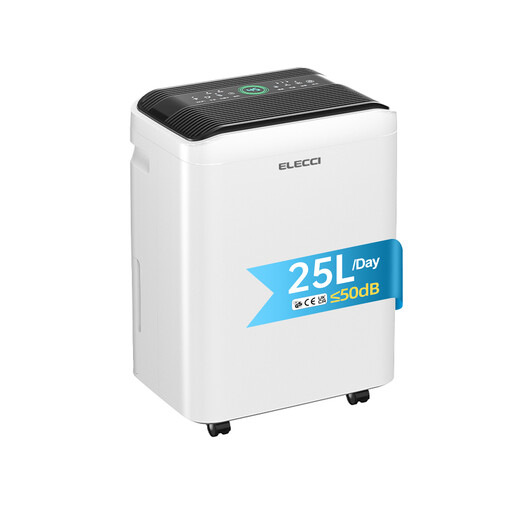
ELECCI dehumidifier with 25 l/day capacity and 4.8-l tank

ELECCI dehumidifier, 25 l/day

The product details state coverage of up to 50 m²; compare this with your measured room volume.

25 l/day at 30 °C and 80% relative humidity; 4.8-l tank; three fan speeds, a 24-hour timer and hose drainage. This model contains R290.

View at Joybuy
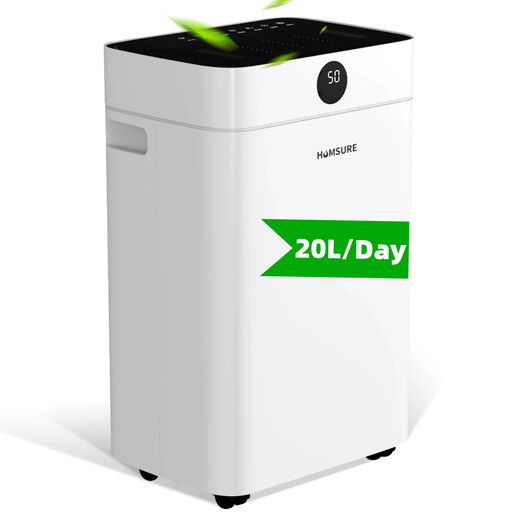
HUMSURE dehumidifier for rooms up to 50 m²

HUMSURE dehumidifier, 20 l/day

The product details state coverage of up to 50 m²; check whether this suits your room.

20 l/day; 2.8-l tank; automatic defrost, humidity control and hose drainage.

The hose is designed for gravity drainage. The unit contains R290; keep it away from naked flames and flammable materials.

View at Joybuy

Frequently asked questions

Should I open the bathroom door to the living room after a shower?

No. The German Environment Agency recommends keeping the bathroom door closed and clearing the peak in humidity by ventilating the bathroom thoroughly. If you can only ventilate to a limited extent, the agency also recommends wiping water from walls and floors.

What humidity level should I monitor in my living room?

The Verbraucherzentrale gives around 40–60% relative humidity at approximately 18–22 °C as a comfortable range for the home, and recommends using a thermo-hygrometer. Also consider whether a high reading occurs only briefly after a shower or keeps returning over a longer period.

Can I connect a drainage hose to any dehumidifier?

No. Check the connection on the specific model and whether you can run the hose to a suitable drain. An integrated pump is a feature of particular models: Wood’s lists one for the MDX20P, while the MRD20GW is described as having a hose connection.

How do I calculate the electricity costs of running a dehumidifier?

Multiply the power in kilowatts by the actual running time in hours and your price per kilowatt-hour. The 470 W power input stated for the De’Longhi DDSX220 isn’t enough to calculate a specific cost without knowing the running time and your electricity tariff.

Can I put an old dehumidifier in my household rubbish?

No. The German Environment Agency says that waste electrical equipment must be collected separately and must not be disposed of with household rubbish. The conditions for returning it to a retailer vary.