
Lieferung heute & morgen

Qualitätsgarantie

Willkommens-Angebote freischalten: KOSTENLOSE Lieferung | Bis zu 80 % RABATT | Kostenlose 30-Tage-JoyPlus-Testphase
App herunterladen
Finding the right lamps for your living room may seem straightforward at first. In practice, however, table and floor lamps differ considerably in their fittings, light output, controls and space requirements. A decorative lamp may look the part but not provide enough light for reading. A modern smart floor lamp may offer a host of features, but it won’t be the right choice for every home.
Three common buying mistakes are particularly likely to lead to the wrong choice:
Before buying, make sure the fitting is compatible with the bulb you want to use. E27 bulbs and E14 bulbs are common:
Also check the stated maximum wattage. For example, a lamp with an E27 fitting may be rated for a maximum of 40 or 60 watts. An LED bulb usually uses less power in practice, but you must not exceed the maximum specified by the manufacturer.
Wattage mainly tells you how much energy a lamp uses, rather than how bright it is. Lumens, colour temperature and beam angle are more useful when choosing a light.
An LED table lamp with a touch switch can be handy at your desk. By contrast, a decorative lamp with a fabric shade often gives a softer, more even light around the room.
Measure the space where you plan to put the lamp before you buy. A floor lamp shouldn’t block walkways or stand unsteadily behind a sofa or armchair. In particular, check:
With a smart floor lamp or Wi-Fi lamp, you’ll also need to check app compatibility, network access and, where relevant, voice assistant support. Make sure these features work with your existing smart home system before buying.
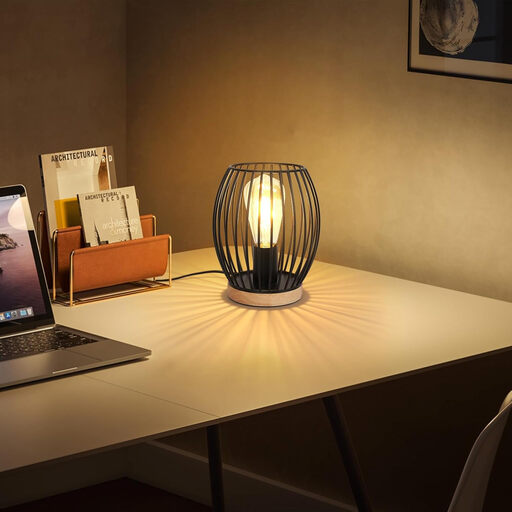
Why it suits this profile: This table lamp combines a black metal body with a wooden base, making it suitable for the living room, bedroom or office. You can choose a separate bulb with the colour of light you prefer.
The E27 fitting and maximum wattage of 60 watts are clearly stated. The bulb is not included, so this is made clear too.
Open metal design, wooden base, 1.8-metre cable and touch switch, according to the product description.
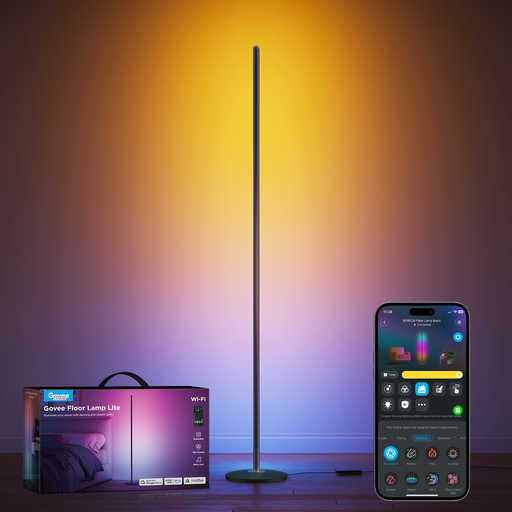
Why it suits this profile: This slim floor lamp is designed for households that want to use app, Wi-Fi and voice controls in the living room, gaming area or home cinema.
Its features are clearly specified: dimming, Wi-Fi, Bluetooth, app control and compatibility with Alexa and Google Assistant.
24 watts, 1,000 lumens, a height of 136 centimetres, 58 scene modes and a stated RGBIC colour spectrum.

Why it suits this profile: Suitable for a desk, side table or bedside table, this LED table lamp combines dimming and USB charging in a compact design.
The specifications include 8 watts, around 400 lumens, warm white light and touch dimming, rather than relying on the word LED alone.
Touch switch, dimmable LED, USB port and operation at 220–240 volts, according to the product details.

Why it suits this profile: Its pleated shade and gold finish make it a good choice for a sideboard, console table or side table in the living room.
The product details clearly state the E27 fitting, maximum wattage of 25 watts and suitability for indoor use.
Fabric shade, iron frame, E27 socket and 1.6 metres of visible cable, according to the description.
We’ve put together a complete, regularly updated list of products that meet these strict selection criteria and fully comply with the safety regulations in force in the EU.
It depends on how you plan to use it. A table lamp for accent lighting usually needs less light than a reading lamp or a floor lamp for general room lighting. Check the stated light output in lumens and, in larger rooms, consider combining several light sources.
A dimmable lamp can be useful if you want to use it for both reading and softer evening lighting. If the lamp takes a replaceable bulb, check that the LED bulb you choose is also dimmable. For models with integrated LEDs, the product details should explicitly state that they can be dimmed.
Consumption depends on the wattage and how many hours a day the lamp is on. An 8-watt lamp used for five hours consumes around 0.04 kilowatt-hours a day. To work out the running cost, multiply this figure by your electricity tariff. The specific wattage of the model is what matters, not simply the fact that it’s described as an “LED” lamp.