For mostly reflowable EPUB text, a compact black-and-white device is an obvious choice. For historical scans, however, the key question is whether the fixed page and its captions are readable on the screen. Colour matters when maps use it to convey information. If you plan to borrow titles through Onleihe, also check the specific device, software version and, for PDFs, the copy protection. A larger screen alone won’t automatically make a scan easy to read.
Which e-reader is right for you?
Local history readers with EPUB books
If you mainly read running text outdoors, weigh up font size, portability and a screen described by the manufacturer as glare-free. This manufacturer’s claim is not an independent assessment of readability in direct sunlight.
Readers of historical scans
For fixed PDF pages with small captions or maps, what matters is whether the original page remains readable at the intended display size. Onleihe’s help pages point out that PDF text does not automatically adapt to smaller screens in the way EPUB text does.
Library users borrowing titles through Onleihe
If you want to borrow books about local history, check the specific title, device, software version and copy protection. Onleihe PDFs may have additional requirements.
What should you consider when choosing?
First, check whether you mainly read reflowable text, fixed-layout scans or colour-coded maps. If you borrow books, factor in compatibility with the specific Onleihe title from the outset when choosing your device.
Compact black-and-white device
A good fit if: you mainly read EPUB text on the go and prefer a compact device.
The trade-off: fixed PDF pages with small text may mean you need to zoom and scroll frequently.
Larger black-and-white screen
A good fit if: your local history books contain lots of fixed-layout pages, footnotes or map labels.
The trade-off: a larger screen doesn’t automatically make small details readable without zooming; weight also matters when you’re reading with the device in your hand.
Colour E Ink
A good fit if: colours in historical maps or illustrations convey information you need to identify.
The trade-off: check colours and small legends on a representative page; colour won’t replace a map view that’s large enough to read.
| What matters |
What to check before buying |
Who will find this important? |
| Running text in daylight |
Try a typical text page outdoors; compare the font size, screen size and weight of the specific model. |
If I mainly read running text on the go, I want to be able to set a comfortable font size and hold the device easily. Around 36 % of consumers put running text in daylight first. |
| Historical PDFs and scans |
Check an original page with footnotes and a map legend at the intended size, as well as when zoomed in. |
If my local history book has fixed-layout pages and small labels, I want to be able to make them out as clearly as possible. Around 29 % of consumers prioritise historical PDFs and scans. |
| Onleihe access |
Check the Onleihe version, title type, device model, software version and DRM requirements. |
If I want to borrow specific local history titles from my library, the device needs to be compatible with the title and its copy protection. Around 21 % of consumers prioritise access to borrowed titles. |
| Colour information on maps |
Look at a representative map and its legend, and check whether colour is essential to understanding it. |
If a map uses colour to distinguish different meanings, I want to be able to make out that information on the screen. Around 14 % of consumers prioritise colour-coded maps. |
Common buying mistakes
-
Assuming PDF support means historical scans are easy to read
Unlike an EPUB, a PDF with a fixed page layout won’t adapt its text to a small screen. Even a larger E Ink screen won’t automatically make small labels readable.
Before buying, check a representative original page with its legend at the intended screen size.
-
Assuming file format support guarantees access to every library loan
Whether you can open an Onleihe title also depends on the device, software and copy protection. Borrowed PDFs may have specific DRM requirements.
Check that the title you want and your library’s Onleihe version meet the device and software requirements.
-
Choosing a colour screen just for colourful book covers
Colour is most useful when maps or illustrations use it to convey important information. If you mainly read running text, a black-and-white model may meet your needs.
Check a representative map and its legend before making colour a deciding factor.
Key brands at a glance
tolino
A compact black-and-white option for EPUB collections; a colour model is worth considering if map colours matter to you.
- The 5th-generation tolino shine specifications list a 6-inch screen, a weight of 173 g, and EPUB and PDF support.
- The manufacturer lists 150 ppi for colour content and 300 ppi for black-and-white content on the tolino shine color.
- For direct access to Onleihe 3, Onleihe’s help pages specify software version 5.15.253009 or later for the 5th-generation shine. Borrowed PDFs also have additional DRM requirements.
PocketBook
The InkPad 4 is a larger black-and-white option for readers who often view fixed-layout document pages.
- PocketBook lists a 7.8-inch screen and PDF and EPUB support for the InkPad 4.
- The manufacturer lists its weight as 265 g. Weigh up the extra screen space against the weight when reading with the device in your hand.
- For Onleihe 3, check the specific device model and software version; borrowed PDFs have additional DRM requirements.
Rakuten Kobo
The Clara BW is a compact black-and-white option; if you borrow from a library, check that your preferred access method is supported.
- Rakuten Kobo describes the Clara BW’s 6-inch screen as glare-free.
- Onleihe’s help pages do not actively support or guarantee the functionality of Kobo devices that are not listed. So check the specific model and the borrowing method you want to use.
Joybuy products for colour maps
This selection features colour E Ink devices for readers who want to view colour-coded maps or illustrations.
 No image available
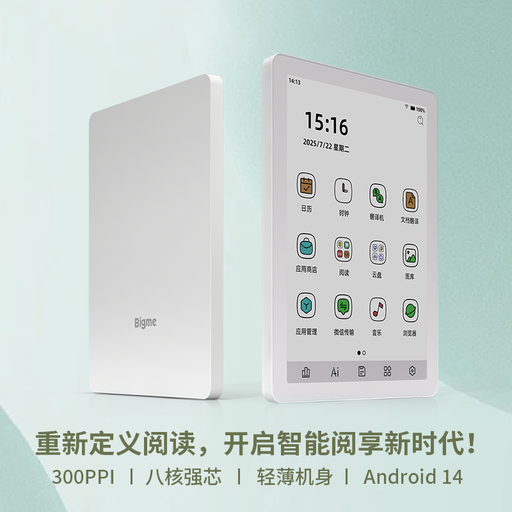
Bigme B6, 6-inch E Ink e-book reader, white
Could be a good option if you’re looking for a colour E Ink screen for maps and illustrations; check how readable a representative map and its legend are.
Listed in the product name: 6 inches, white, 36-level front light, Android 14, built-in Google Play and 4+64GB.
View at Joybuy
 No image available
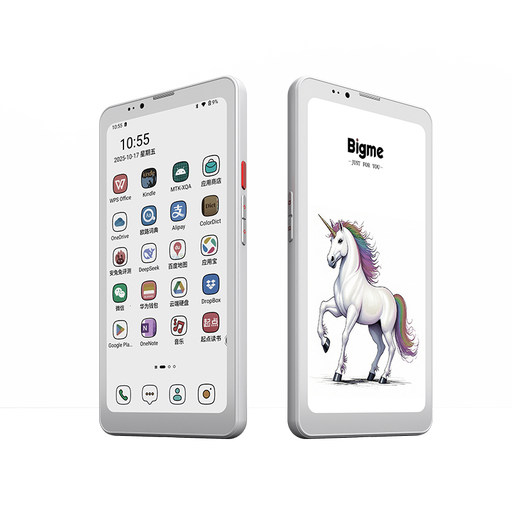
Bigme HiBreak Pro Color, 6.13-inch E Ink e-book reader
Could suit readers looking for a colour E Ink device for maps or illustrations. Check the details on a representative page and confirm compatibility with your preferred library titles before buying.
Listed in the product name: Android 14, 8GB+256GB and 5MP/20MP cameras.
View at Joybuy
Frequently asked questions
Can I zoom in on a scanned local history book in the same way as an EPUB?
No. A PDF with a fixed page layout won’t automatically adapt to a small screen in the way an EPUB does. Onleihe’s help pages recommend taking the original page, including footnotes and the legend, into account; zooming may mean you need to scroll frequently.
What do I need to set up before using Onleihe for the first time?
According to Onleihe’s help pages, you’ll need a valid library card and its password to borrow books. Also check your library’s Onleihe version and your device’s software. Onleihe 3 PDFs on tolino or PocketBook require specific Adobe or ByteBooks DRM support.
What if my e-reader develops a fault or isn’t right for me after I order it online?
If a product is faulty, your statutory rights are against the seller and are separate from any voluntary guarantee. According to the Verbraucherzentrale, goods ordered online generally come with a 14-day right to cancel. Check the terms of your specific purchase; cancelling an order and making a claim about a fault are different matters.
What safety rules apply to e-readers in Germany?
For radio equipment, the EU Radio Equipment Directive sets requirements including safety and electromagnetic compatibility. The European Commission explains that the CE marking indicates the manufacturer’s declaration that the product complies with relevant EU rules; it is not an independent quality assessment. The marking alone does not prove that a specific product listing is compliant.


