Interviewers recording two important voices
If you want to capture both the storyteller and the interviewer clearly, the number of microphones, transmitters and recording channels all need to work together.


For a seated one-to-one interview, a wired lavalier is a sensible starting point, provided its connector, input and power requirements are compatible with your recording device. If you want to record the storyteller and interviewer separately, each person needs their own microphone and recording channel. A wireless system with two transmitters or an additional recorder may be an option, but both involve more setup and file management. Check the exact package contents and listen back to a saved test recording before the interview.
If you want to capture both the storyteller and the interviewer clearly, the number of microphones, transmitters and recording channels all need to work together.
If you’re mainly recording someone telling their story while seated, you can choose a lavalier that’s compatible with your existing smartphone or recorder.
If you need to save a story that may be difficult to repeat, a body-worn recorder could be an option alongside a microphone.
First decide which voices you want to record separately, then check the connection and how you want to save the files.
| What you need | What to check before buying | Who this matters most to |
|---|---|---|
| Capture both voices | Check how many microphones or transmitters are included and whether both signals can be recorded. | If I want to capture questions and answers as two equally important voices, each person needs their own microphone and recording channel. That’s why around 33% of consumers prioritise capturing both voices. |
| Choose the right connection | Check the connector, compatible microphone input, power requirements and any adapters needed, then make sure you can play back a test recording. | If I want to keep using my existing smartphone or recording device, the whole signal path needs to work – not just the connector. That’s why around 27% of consumers prioritise device compatibility. |
| Save the story as a file | Check whether the specific device records locally, which mode is active, and whether you have enough storage and power. | If a story is difficult to repeat, I want to be able to check the recording and save it as a file. That’s why around 20% of consumers prioritise saving the file. |
| Freedom to move | Consider whether movement is necessary, then check the receiver connection and number of transmitters in the specific package. | If the people being interviewed move around during the conversation, a suitable wireless setup may be more practical than a cable. That’s why around 20% of consumers prioritise freedom to move. |
RØDE says the Lavalier GO is designed for a TRS input with plug-in power. Shure specifies that the MVL is for compatible mobile devices with a 3.5 mm socket or a suitable CTIA adapter. A jack of the right size alone doesn’t guarantee that recording will work.
Check that the signal path matches the device you plan to use, and test whether you can play back a saved recording.
Depending on your recording device, you may need a suitable adapter or a different way to record.
DJI explicitly distinguishes between Mic Mini versions with one transmitter and those with two. A single lavalier won’t give the second person their own microphone channel.
Compare what’s included in the exact package with the number of people who need their own microphone.
According to RØDE, the Wireless PRO’s 32-bit float specification applies to local transmitter recordings. It doesn’t automatically apply to recordings made on the connected device.
Check the recording mode you want and listen back to the file that was actually saved.
Local transmitter files need to be checked, transferred and matched to the relevant voices afterwards.
Zoom specifies that the F2 records to microSD and runs on two AAA batteries. Both are part of the recording setup.
Get everything you need ready before the interview and test the complete setup.
The range includes everything from a wired lavalier to a wireless system with two transmitters.
The MVL is designed for compatible mobile recording devices with a 3.5 mm socket or a suitable CTIA adapter.
The F2 combines a body-worn recorder with an included lavalier to record one voice locally.
DJI offers the Mic Mini in packages with one or two transmitters.
The LARK M2 is available in different versions for mobile devices, cameras and combinations of the two.
This selection includes wired lavalier microphones for recording one voice and wireless sets for interviews with two people. For each product, check that the connection and package contents suit your recording device and the interview.
 No image available
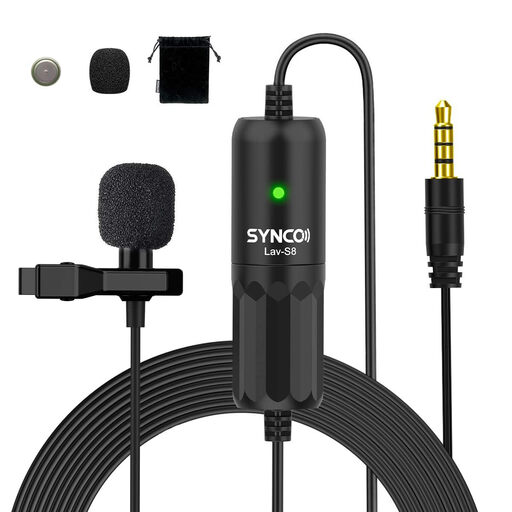
An option for recording one voice if you’re looking for a lavalier to use with one of the recording devices named in the product title.
The product title lists smartphones, PCs, laptops and cameras as compatible devices.
 No image available
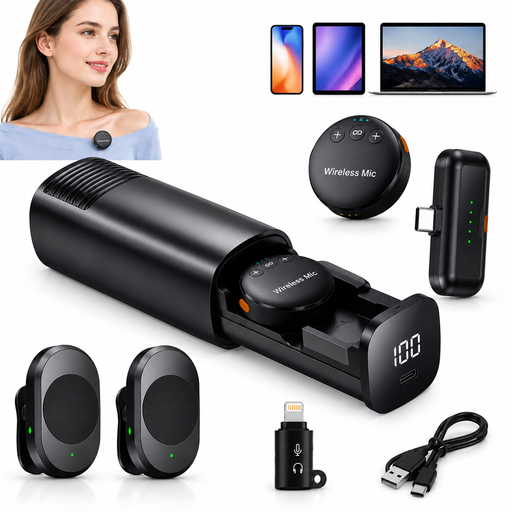
An option if both people need to wear their own microphone and the recording device uses one of the listed connections.
The product title lists two transmitters, USB-C and Lightning. It also specifies 2.4 GHz, DSP noise cancellation, latency below 20 ms and a range of up to 40 m.
 No image available
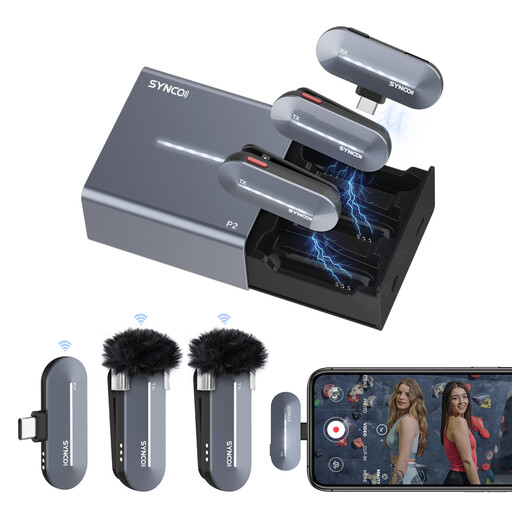
For a two-person interview when your recording device uses USB-C.
The product title lists two microphones, USB-C and a charging case.
 No image available
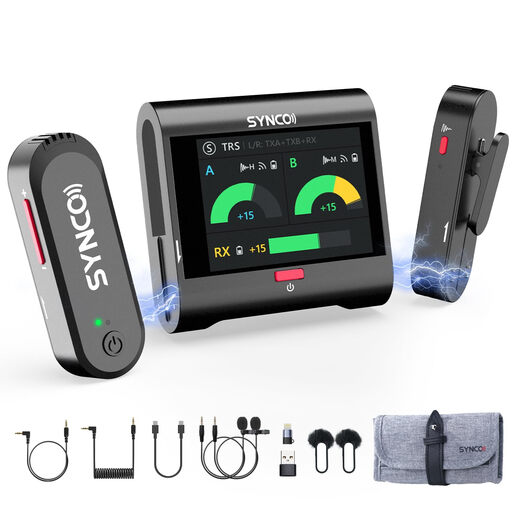
An option if each of two people needs to wear a lavalier microphone.
The product title lists two lavalier microphones and 2.4 GHz.
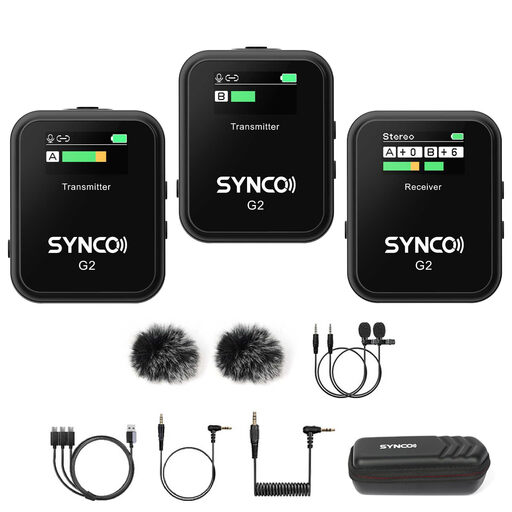 No image available
For an interview where you need to capture two voices; check that the number of transmitters you need is included in the specific version.
The product title describes the model as dual-channel and lists 2.4 GHz.
If you want to capture both voices clearly and separately, plan a microphone or a separate recording channel for the second person too. DJI explicitly distinguishes between Mic Mini versions with one and with two transmitters.
Check the input and recording mode, make a short recording from the spot you plan to use, then play back the saved file. With the Wireless PRO, the local 32-bit float file is a transmitter recording; with the Zoom F2, batteries and microSD are part of the recording setup.
No. Recording privately spoken words without authorisation may be a criminal offence under § 201 StGB. Make sure you have permission to record before the interview. The purpose and legal basis for storing, sharing or publishing personal content must be considered separately; the Oral History Association also recommends documenting informed consent and intended use.
No, not as a general rule: the German Federal Network Agency publishes general frequency allocations for certain radio applications and frequencies. Whether a particular system meets the relevant technical conditions depends on its wireless version; a general allocation doesn’t guarantee interference-free recording.
The Zoom F2 requires a suitable microSD card and two AAA batteries as part of the recording setup. Have both ready before the interview and check that you can play back the saved file.